How to Resell Security Awareness Training as an MSP in 2026
Security awareness training reseller guide for MSPs: package, deliver, and report a managed service without hidden admin or seat costs.
DefendWise
DefendWise
TL;DR
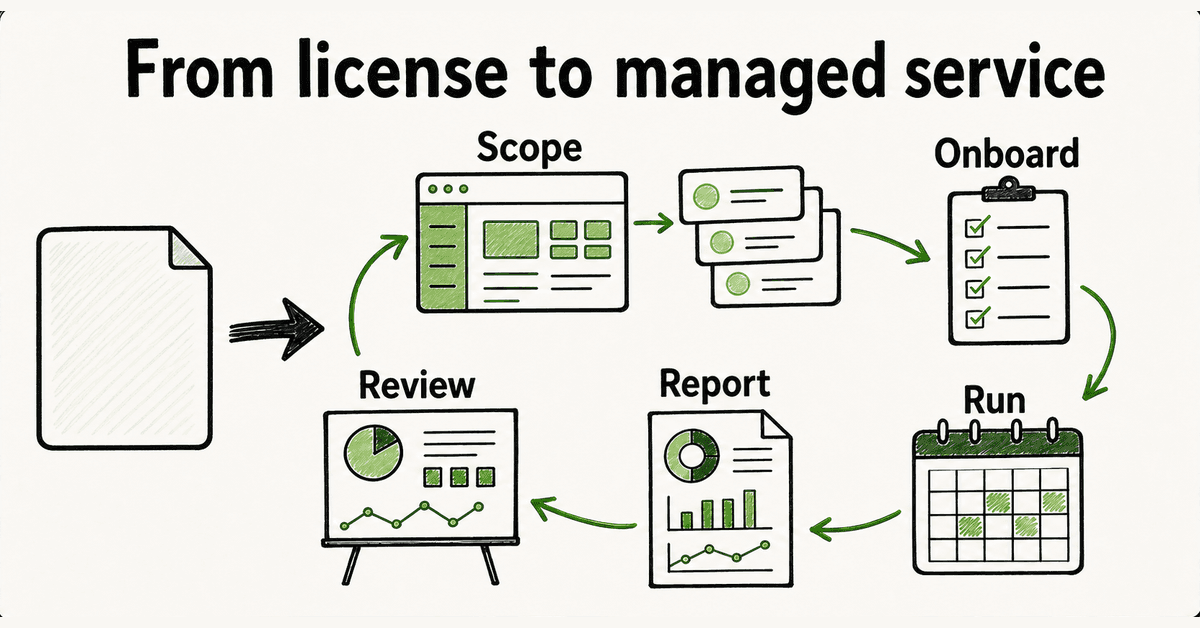
A security awareness training reseller should sell a managed service, not forward a software invoice with a markup. The offer needs a defined client promise, repeatable onboarding, clear responsibilities, useful reporting, and a cost model that still works when user counts change. Start with one standard service pattern, prove that your team can operate it across multiple client tenants, then decide whether to include it in a managed security plan or sell it as a fixed add-on. The platform matters because its pricing, branding, tenant model, and admin workflow become the economics of your service.
What is a security awareness training reseller?
A security awareness training reseller is an MSP, MSSP, IT provider, or channel partner that offers security awareness training to clients using a third-party platform. The MSP may include the service inside a managed security plan, sell it separately, or use it in a broader compliance or cyber insurance readiness package.
The important word is service.
Clients are not buying access to a course library. They are buying a program someone will operate: users are enrolled, training is assigned, reminders are handled, exceptions are followed up, and results are explained. A reseller that only passes through licenses remains exposed to the vendor's pricing model while giving the client little reason to value the MSP's work.
That distinction changes how MSPs should evaluate platforms. A product designed for one internal security team can look good in a demo and still be awkward across 20 client organizations. MSP evaluation should start with multi-tenant control, onboarding, branding, permissions, and reporting, not the length of the content catalog.
The search intent is practical. In a public Spiceworks thread about security awareness training for MSPs to resell, the requirements were online training, phishing simulation, sensible pricing, and rebranding. Those questions remain useful, but a mature reseller also needs to ask who owns each recurring task and how that task scales.
Why this matters for MSPs
Security awareness work fits beside the controls MSPs already manage. CISA's Cyber Guidance for Small Businesses tells leaders to establish a security culture and says staff should be formally trained on their responsibilities, including how to escalate suspicious activity. Its Cyber Essentials guidance also treats staff awareness and vigilance as part of cyber readiness.
That creates a client need. It does not automatically create a profitable MSP service.
The service becomes viable when 4 things line up:
- The client can understand what is included.
- The MSP can deliver the same baseline repeatedly.
- The vendor cost does not surprise the MSP as clients grow.
- Reporting gives the client a reason to keep the service.
If those pieces do not line up, the offer fails predictably. The client sees another login. The service desk inherits access tickets. Account managers build reports by hand. Procurement asks for a per-user true-up. The MSP carries the labor and commercial risk while the vendor remains visible to the client.
A better reseller model makes the MSP's operating contribution explicit.
Reseller, referral partner, or managed service?
These models are often mixed together, but they create different work and risk.
| Model | What the MSP sells | Who operates the program | Main commercial risk |
|---|---|---|---|
| Referral | An introduction to a vendor | Usually the vendor or client | Little recurring service value for the MSP |
| License resale | Platform access with a markup | Often unclear | Margin depends on seat pricing and renewals |
| White-label resale | Branded platform access | MSP, vendor, or both | Brand promise may exceed service scope |
| Managed SAT service | A defined recurring program | MSP with platform automation | Labor grows if workflows are not standardized |
| Security-plan inclusion | SAT inside a broader managed plan | MSP | Vendor costs can grow faster than package revenue |
A referral model can be right when the MSP does not want operational responsibility. A resale model can work when the contract handles seat changes and support boundaries. A managed service creates the strongest opportunity to own the client relationship, but only if the MSP writes down the operating model before selling it.
Do not call a license pass-through “managed” unless someone is actually managing it.
What MSPs actually need before reselling SAT
A client promise that can be checked
Write the promise in operational language:
- New active users are enrolled through the agreed method.
- Recurring training is assigned on a defined cadence.
- Users receive reminders through a standard workflow.
- The nominated client contact receives a report each month or quarter.
- Exceptions are routed to a named client or MSP owner.
Avoid promises such as “stop phishing,” “make employees secure,” or “guarantee compliance.” They are not under the MSP's full control. Training supports risk management; it does not replace email security, MFA, access controls, backups, or incident response.
CISA's current SMB phishing guidance says threats evolve and once-a-year training is not enough. It also tells organizations to make sure employees know how and where to report suspicious messages. The program therefore needs reinforcement and a reporting path, not just annual completion.
A standard delivery pattern
The first client may tolerate custom setup. The 20th will expose it.
Build one default pattern for the normal client: baseline user groups, training cadence, reminders, client contact roles, report schedule, exception handling, offboarding rules, and review points. Then define which parts can change and who approves the change. This prevents every account manager from creating a different service.
NIST SP 800-50 Rev. 1 describes a life cycle approach to cybersecurity and privacy learning, including planning, metrics, assessment, and improvement. It is guidance rather than a reseller template. Its core idea still travels well: a learning program is an ongoing operating system, not a one-time content event.
A pricing model that matches the promise
An MSP can include SAT in every managed security package, reserve it for a premium tier, sell a fixed monthly add-on, pass through a per-user charge, or combine a baseline with paid custom work.
No model is automatically right. The mistake is buying one way and selling another without guardrails.
If the MSP buys per user and sells a fixed service, every new user can raise vendor cost without raising revenue. If the MSP buys flat fee, the commercial model is easier to predict, but it must still account for support time, onboarding, reviews, and fair-use limits. The economics of bundling SAT deserve a written model before launch.
Genuine white-label delivery
“Partner-ready” does not always mean white-label. Check the learner portal, sender details, emails, reports, certificates, login URL, support links, footers, and copyright notices.
If the MSP sells under its own brand, a vendor logo in the learner journey can create confusion. A true white-label security awareness platform should let the MSP own the visible experience, not merely place 2 logos side by side.
Multi-tenant operations
Multi-tenancy is how the service team avoids rebuilding the same job for every client. Test whether staff can see all client organizations without mixing data, apply a common baseline, delegate limited client access, export per-client results, manage users without separate admin accounts, and retain an audit trail.
A multi-tenant SAT platform should support standardization and client separation at the same time. If either side is weak, the MSP pays in admin work or governance risk.
Reports that trigger action
Completion is useful, but it is not the whole service story. A report should answer who was assigned, who completed, who is overdue, what changed, which exceptions need an owner, and what the client should do next.
The full NIST SP 800-50 Rev. 1 publication discusses moving from measurements to metrics and using assessment to improve the program. For an MSP, the report should support a decision, not merely prove that a PDF was generated.
Automated, branded reports can remove assembly work, but the account manager still needs a clear interpretation. The best report reaches the right client owner and produces a specific follow-up.
Step-by-step: how to resell security awareness training
1. Choose the service outcome
Decide what the client buys in one sentence. A defensible example is: “We run a recurring security awareness program for your active users and provide a quarterly participation and exception report.”
Keep the first version narrow. Add role-based content, simulations, policy attestations, or custom campaigns after the baseline works.
2. Define the in-scope user population
State who is covered: active employees, contractors, seasonal staff, privileged users, or other agreed groups. Define how new starters enter and leavers are removed.
This is where you reconcile the client promise with the vendor's licensing or fair-use model. “Unlimited” should never hide a policy the MSP has not read.
3. Build the standard operating procedure
Document the workflow from signed order to first report. Include the responsible role, timing, required input, failure condition, and escalation path for each step.
A useful SOP can be followed by someone who did not design it. If it only works when one senior engineer remembers the exceptions, the service is not ready to scale.
4. Pilot the admin workflow, not only the learner view
Most trials focus on the catalog. MSP trials should create a client tenant, apply branding, add and remove users, assign a baseline, trigger reminders, produce a report, restrict client access, and review the audit trail.
Measure how many manual steps remain. A polished learner portal cannot compensate for a fragmented service workflow.
5. Write the commercial boundary
The quote and service agreement should say what is included, what the client provides, how user counts are handled, what support covers, and what counts as custom work.
Client responsibilities may include maintaining an accurate source directory, naming a program owner, handling HR escalation, and approving communications. Out-of-scope work might include custom course production, policy writing, or unlimited executive reporting.
Have legal counsel review contract language for your business and jurisdiction. A blog cannot replace that review.
6. Create the client launch pack
Include a 1-page service description, client responsibilities, onboarding checklist, sample employee communication, reporting cadence, support contacts, and sample report.
CISA offers small-business cybersecurity resources around phishing, passwords, MFA, updates, logging, and backups. Use government resources as supporting education, not as a claim that your service is government-approved.
7. Launch with named owners
Assign one MSP owner and one client owner. Confirm who handles overdue users, access issues, suspicious-message reports, and policy questions.
Training should connect to technical controls. CISA advises businesses to require MFA and aim for phishing-resistant methods. A reseller should not imply that awareness training makes MFA optional.
8. Review after 30 and 90 days
Check whether user records stayed current, assignments launched on time, reminders ran, exceptions reached an owner, reports were delivered, support volume was manageable, and the client understood the next action.
Do not invent a success benchmark. Establish a baseline, record what changed, and agree on the next improvement. That is more credible than a universal “good” score with no context.
A reseller platform scorecard
| Area | Minimum test | Warning sign |
|---|---|---|
| Tenant model | Create, separate, and report on multiple clients | Separate login and rebuild for every client |
| Branding | Check every client-facing surface | “Co-branded” appears where white-label was promised |
| User lifecycle | Add, update, and remove users predictably | Spreadsheet cleanup becomes a monthly task |
| Automation | Run assignments, reminders, and reports on schedule | Routine work depends on calendar reminders |
| Permissions | Give each role only needed access | Every technician is a global administrator |
| Reporting | Produce a client-ready report with next actions | Raw exports require manual deck building |
| Commercial model | Model cost as users and clients change | Vendor cost rises faster than client revenue |
| Support | Test escalation and documentation | MSP absorbs every platform issue |
| Evidence | Retain assignment, completion, and change records | Audit requests require reconstruction |
Treat vendor claims as inputs to test, not conclusions. Ask vendors to perform the full workflow in front of your team.
What good looks like
A healthy reseller service is boring to operate.
New users enter through a defined process. The baseline launches without a custom project. Reminders go out on schedule. Overdue users reach the right owner. Client data remains separate. The report is ready before the account manager begins the QBR. Custom requests are visible and priced rather than absorbed quietly.
The client understands what the MSP does. The portal and communications look intentional. Reports connect activity to decisions. Training sits alongside MFA, phishing reporting, incident response, and other controls instead of being sold as a cure.
NIST's Cybersecurity Framework 2.0 helps organizations understand and improve cybersecurity risk management. An MSP does not need to turn every report into a control-mapping exercise, but it should keep the same posture: define outcomes, observe current state, prioritize gaps, and improve.
Mistakes to avoid
Selling licenses instead of a service
A markup is easy to compare and remove. Define the recurring work the MSP owns and the evidence the client receives.
Customizing every client from day 1
Customization feels attentive until it creates 20 operating models. Start with a standard baseline and make exceptions explicit.
Hiding variable vendor costs inside a fixed plan
If vendor costs move per user, model growth and write a true-up rule. If the platform uses flat pricing, model labor and support anyway.
Treating completion as proof of security
Completion shows that an assignment was completed. It does not prove that no incident will occur. Pair learning with technical controls and reporting paths.
Ignoring the employee experience
An unexpected vendor-branded email can look like the phishing messages employees are told to avoid. Coordinate launch communications and make reporting routes obvious.
Leaving HR escalation undefined
The MSP can report an overdue or repeat-risk pattern. The client decides how to manage employee performance, policy, and disciplinary issues. Put that boundary in writing.
Promising compliance
Training records can support evidence needs, but a platform does not make an organization compliant by itself. Verify framework-specific claims and avoid legal conclusions.
How a flat-rate MSP SAT platform helps
A flat-rate platform removes one common mismatch: buying SAT per learner while selling a fixed service. DefendWise is $399/month flat with unlimited users and client organizations under its fair-use policy. It also supports white-label, multi-tenant delivery, automated onboarding and reporting, Microsoft 365 sync, and AI-native training content.
Those capabilities can make resale easier to operate, but the MSP still owns the service design. Define the promise, contract boundary, client responsibilities, and review process before rollout. MSPs can inspect the platform through a free 7-day trial without turning the article into a sales call.
Frequently asked questions
What is a security awareness training reseller?
It is an MSP or provider that packages a vendor's platform into a client-facing offer. The reseller may sell licenses, white-label access, or a fully managed program. The managed model usually creates more client value because the MSP owns onboarding, cadence, reporting, and follow-up.
Can an MSP resell security awareness training under its own brand?
Yes, when the platform supports true white-label delivery. Verify the portal, emails, sender details, reports, certificates, URLs, and support links. Do not assume “partner” means the vendor is invisible across the client journey.
How should MSPs price resold security awareness training?
Common options are inclusion in a managed security package, a fixed monthly add-on, per-user pass-through, or a tiered service. Match client pricing to vendor cost, labor, support, and contract terms. Run the model at current user counts and plausible growth.
What should a managed security awareness training service include?
Start with user onboarding, recurring assignments, reminders, reporting, exception handling, and named responsibilities. Add simulations, custom content, policy workflows, or bespoke reporting only when clearly scoped.
What platform features matter most to a reseller?
Prioritize multi-tenant administration, white-label delivery, user lifecycle management, automation, role-based permissions, reporting, auditability, and pricing fit. Test the complete admin workflow during the pilot.
Does security awareness training guarantee that a client will not be breached?
No. Training is one layer of a wider security program. Sell what the service does, not an outcome no provider can guarantee.
How does DefendWise support MSP resellers?
DefendWise provides a $399 monthly flat fee, unlimited users and client organizations under fair use, white-label delivery, multi-tenant management, automated onboarding and reporting, and AI-native training content. The flat cost and MSP operating model can make it easier to package SAT without per-seat vendor billing.
Sources
- NIST SP 800-50 Rev. 1
- NIST SP 800-50 Rev. 1 full publication
- NIST Cybersecurity Framework 2.0
- CISA Cyber Guidance for Small Businesses
- CISA Cyber Essentials
- CISA: Teach Employees to Avoid Phishing
- CISA: Require Multifactor Authentication
- CISA SMB Resources
- Spiceworks reseller discussion
- CanIPhish MSP Buyers Guide
- Drip7 MSP platform guide