Security awareness training pricing for MSPs: why per-seat pricing creates a coverage gap
Security awareness training pricing can punish MSPs for covering every client. See common cost models, what to evaluate, and how flat-fee SAT changes MSP margin math.
DefendWise
DefendWise
Most searches for security awareness training pricing start with a simple question: “What will this cost per user?”
For MSPs, that is not the useful question.
The better question is: Can we cover every client and every employee without turning security awareness training into a margin penalty or another admin job?
That distinction matters. A single-company buyer can compare tools by seat count, annual contract size, and content library. An MSP has a different problem. You are trying to standardize security awareness training across a client base that keeps changing: new hires, seasonal workers, small clients, larger clients, contractors, finance teams, warehouse staff, and everyone in between.
If every additional learner adds vendor cost, the pricing model starts shaping your security coverage. That is where the coverage gap appears.
Common security awareness training pricing models
Security awareness training platforms usually price in one of a few ways.
Per-user or per-learner pricing
This is the familiar model: the more people you train, the more you pay.
For a single internal IT or security team, that may be easy enough to budget. For an MSP, it can become harder. Every new employee at every client is another cost decision. Every client expansion changes the math. Every proposal needs someone to decide whether security awareness training is included, passed through, marked up, discounted, or left out.
Tiered seat pricing
Some platforms use tiers or seat bands. The headline price may improve at higher volume, but the underlying question remains the same: how many learners are covered, and what happens when you outgrow the band?
For MSPs, tiered pricing can still create friction when coverage expands across small clients or lower-margin accounts.
Platform bundles and add-ons
Security awareness training may also be bundled into a larger cyber platform, insurance readiness package, managed detection offer, or compliance toolset.
That can work when the bundle maps cleanly to your service model. It can also blur the real cost of training, reporting, white-label delivery, client onboarding, and monthly admin.
Flat-fee MSP pricing
A flat-fee MSP model changes the question. Instead of counting learners first, the MSP pays one predictable monthly platform fee and can train every real client user under the MSP delivery model.
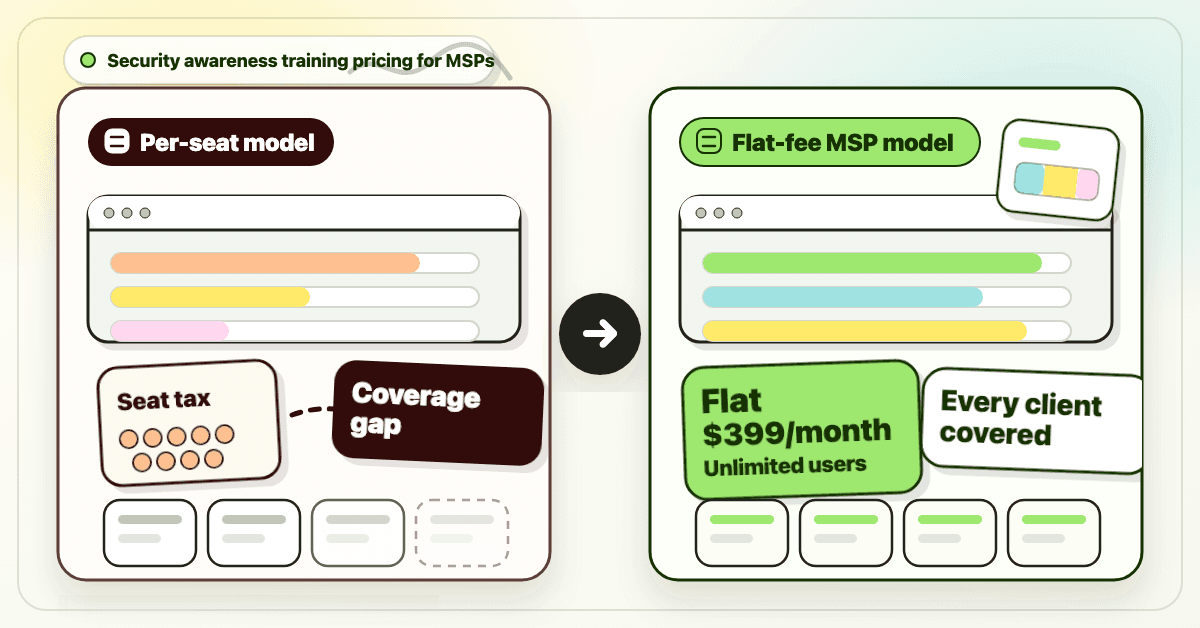
DefendWise uses this model: $399/month flat, with unlimited users, unlimited client organisations, white-label portals, emails, and reports, multi-tenant MSP control, and automated reporting.
That is not just a pricing detail. It changes how MSPs package, margin, and deploy security awareness training.
Why per-seat pricing becomes a margin tax for MSPs
Per-seat pricing looks clean in a spreadsheet until you apply it across an MSP book.
An MSP does not manage one fixed workforce. It manages many client workforces. Some clients are growing. Some are shrinking. Some have seasonal staff. Some have part-time users. Some have high-value access but small budgets. Some need training evidence for insurance, compliance, or board reporting, but do not want another line item.
When training is priced per learner, every coverage decision has a cost attached:
- Do we include the 8-person client, or only the larger accounts?
- Do we train all employees, or only finance and executives?
- Do contractors count?
- Do seasonal staff count?
- Do we absorb the cost, pass it through, or leave SAT out of the managed services agreement?
- Do we delay rollout because onboarding and reporting will create more work?
That is the seat tax: the pricing model taxes the exact behavior MSPs should want — broader coverage. If you want to test the economics against your own client mix, you can run the seat-tax model with your own numbers.
The result is not always an obvious “no.” More often, it becomes a quiet coverage gap. Training is available for some clients, some departments, or some users, but not everywhere.
That creates a commercial problem and a risk problem. The user left out of training can still click a phishing link, reuse passwords, approve a fake invoice, or mishandle sensitive data. The smallest client can still become the source of the biggest incident.
The cheapest tool is not always the lowest-cost model
A low per-user price can still become expensive when the MSP goal is full-client coverage.
MSPs should separate 2 questions:
- What is the vendor price per user?
- What does it cost us to make training standard across the client base?
The second question is the one that affects margin.
A per-user model may look affordable for a narrow group of users. It can become harder when the goal is to train every client employee, keep reports current, support renewals, and make security awareness training part of the managed service rather than a one-off add-on.
The cost is not only subscription spend. It also includes:
- Sales time explaining seat counts and scope.
- Admin time onboarding new clients and users.
- Reporting time for client reviews, compliance requests, and renewals.
- Margin risk when client headcount rises faster than the MSP’s monthly fee.
- Coverage risk when training gets limited to keep cost under control.
That is why MSPs should evaluate security awareness training pricing by service-model fit, not just price per learner.
What MSPs should evaluate beyond price per user
If you are comparing security awareness training platforms, price matters. But for MSPs, it is only one part of the buying decision.
Can every client be covered by default?
The best pricing model is the one that lets you say: every managed client gets training.
If the model forces you to sort clients into “covered” and “not covered,” the commercial model is shaping the security outcome.
Does adding users change your margin?
Client headcount should not automatically become an MSP margin problem.
If a client grows from 25 to 60 employees, or adds seasonal workers, can you include them without renegotiating the service, changing your cost base, or creating a new internal approval step?
Can the training run under your brand?
MSPs are not just buying training content. They are delivering a managed security service.
White-label matters because clients should experience the training as part of your service, not as a third-party handoff. Look for branded portals, emails, certificates, and reports.
Is it multi-tenant by design?
MSPs need to manage multiple client organisations from one place.
A useful MSP platform should make it simple to create clients, see progress, manage training status, and produce client-ready reporting without jumping between disconnected accounts.
How much reporting work is required every month?
Security awareness training only becomes valuable to the MSP relationship when it produces evidence clients can understand.
That means completion reports, risk signals, compliance evidence, and client-ready summaries. If those reports require manual work every month, the admin cost becomes part of the pricing model.
Does the content stay current?
Attackers do not reuse the same playbook forever. MSPs need training that can keep up with current phishing, social engineering, QR-code scams, AI voice fraud, deepfakes, and other human-risk patterns.
Content freshness should not require the MSP to become a course-production team.
Flat-fee security awareness training for MSPs
DefendWise is built around a simple premise: security awareness training should be priced for MSP coverage, not punished by MSP scale. For the commercial version of that model, see DefendWise security awareness training pricing for MSPs.
The public offer is straightforward:
- $399/month flat fee.
- Unlimited users under the fair-use model.
- Unlimited client organisations for real MSP delivery.
- Full white-label portal, emails, certificates, and reports.
- Multi-tenant control for managing client training from one console.
- Automated onboarding and reports so training does not become a recurring admin job.
- Start Free 7-Day Trial as the primary CTA.
For MSP owners, the point is not only that the number is predictable. It is that the pricing model makes the right security behavior easier to package.
You can build SAT into managed services without counting every learner. You can include smaller clients without treating them as a margin problem. You can cover employees who are easy to overlook. You can send branded reports that reinforce your role as the security partner.
That is the shift: from “How many seats can we afford to train?” to “How quickly can we make training standard across the client base?”
Pricing checklist for MSPs
Use this checklist when comparing security awareness training pricing.
- Coverage — Can every client and employee be included by default?
- Margin — Does adding users increase vendor cost or reduce service margin?
- Packaging — Can SAT be included in your managed services agreement without a separate seat-count conversation?
- White-label — Will clients see your brand on the portal, emails, reports, and certificates?
- Multi-tenancy — Can you manage all client organisations from one MSP console?
- Onboarding — How quickly can a new client be deployed?
- Reporting — Are client-ready reports generated automatically?
- Compliance evidence — Can reports support client insurance, audit, and security-review conversations without overclaiming compliance outcomes?
- Content freshness — Does the training reflect current phishing and social-engineering patterns?
- Fair use — If the model says unlimited, what counts as normal MSP usage and what triggers a commercial conversation?
FAQ: security awareness training pricing for MSPs
How much does security awareness training cost?
Security awareness training cost depends on the pricing model. Common models include per-user pricing, tiered seat pricing, platform bundles, and flat-fee MSP pricing. For MSPs, the better comparison is not only cost per user. It is whether the model lets you train every client without creating margin pressure or extra admin.
What is the problem with per-user security awareness training pricing?
Per-user pricing can make every additional learner a cost decision. For MSPs, that can discourage full-client coverage because every new client employee, contractor, or seasonal worker changes the economics. This can create a coverage gap where some users remain outside the training program.
Is flat-fee security awareness training better for MSPs?
A flat-fee model can be better for MSPs that want predictable costs and broad coverage. It lets the MSP package training across clients without counting every learner as a separate vendor charge. The fit still depends on fair-use terms, white-label needs, reporting, onboarding, and the MSP’s service model.
Does DefendWise charge per user?
No. DefendWise uses a flat MSP fee of $399/month with unlimited users under its fair-use policy. It is built for MSPs delivering security awareness training to real client organisations, not for reselling the platform as a standalone SaaS.
What should MSPs ask before choosing a security awareness training platform?
Ask whether every client can be included, whether user growth changes margin, whether the platform is white-labeled, whether it supports multi-tenant MSP management, how reports are produced, and whether the training can stay current without adding another admin burden.
See how flat-fee security awareness training works for MSPs
If security awareness training is priced per seat, every coverage decision can become a budget decision.
DefendWise takes a different path: $399/month flat, unlimited users, white-label delivery, multi-tenant control, and automated reports for MSPs.
Start Free 7-Day Trial or see the flat-fee pricing feature page.