Security awareness training for clinical research firms: 2026 guide
Security awareness training for clinical research firms needs role-specific scenarios. Build an MSP-led plan for safer data handling and clear evidence.
DefendWise
DefendWise
Clinical research firms’ security awareness training is role-specific instruction aimed at protecting research information, study operations, and participant privacy. This 2026 guide shows you how to train staff around sponsor communications, study-system access, and sensitive document handling—not just generic phishing examples.
TL;DR
- Security awareness training for clinical research firms should teach safe decisions around participant data, sponsor requests, and study access.
- Defend Wise is best for MSPs seeking white-label security awareness training without per-seat billing.
- Match training to research roles, then retain assignment, completion, and follow-up evidence.
- Training supports cybersecurity compliance; it does not replace access controls, incident response, or contractual review.
Why security awareness training matters for clinical research firms
Clinical research work puts people between sensitive information and outside requests. A coordinator receives a document request, a project manager receives a sponsor message, or a finance employee receives revised payment instructions. Training needs to address the decision each person makes before sharing information or changing a workflow.
Teach the work, not just the threat. A suspicious email lesson has limited practical value if staff cannot identify the approved channel for study documents or the person responsible for checking an unexpected request.
For MSPs delivering this service, Defend Wise provides white-label security awareness training with flat-fee billing and unlimited seats. That model removes per-seat billing from the platform decision; you still need to account for client onboarding, content review, follow-up, and evidence preparation.
Clinical research firms also need clear boundaries. Training cannot establish that a recipient is authorized, configure a study system correctly, or determine which regulatory obligations apply. It teaches staff when to stop, verify, and escalate instead of treating every familiar-looking message as permission to proceed.
Build a training program around research decisions
Use the following steps to create a 2026 training plan that fits the firm’s actual work. Start with a spreadsheet, existing policies, and named owners. Add software where it reduces repeat administration, not where it obscures responsibility.
Map your research workflows
Begin with a manual review of where staff receive requests, access systems, and share information. Ask the people doing the work to describe the last legitimate request they handled. Record the sender, information involved, approved channel, and verification method.
A process diagram is more useful than a list of threat names. It exposes the moment when someone must decide whether a request is legitimate, whether a recipient is authorized, or whether an attachment belongs in the chosen channel.
Keep the scope specific. A firm supporting study operations does not necessarily handle the same information as a site conducting participant visits. Build the training around documented responsibilities rather than assumptions about the clinical research sector.
- Request intake: Record how sponsor, site, vendor, and internal requests arrive.
- Identity verification: Identify how staff confirm unfamiliar or changed requests.
- Access approval: Name who authorizes study-system access and role changes.
- Data sharing: Document approved recipients and transfer channels.
- Incident reporting: Identify where suspicious messages and mistakes are reported.
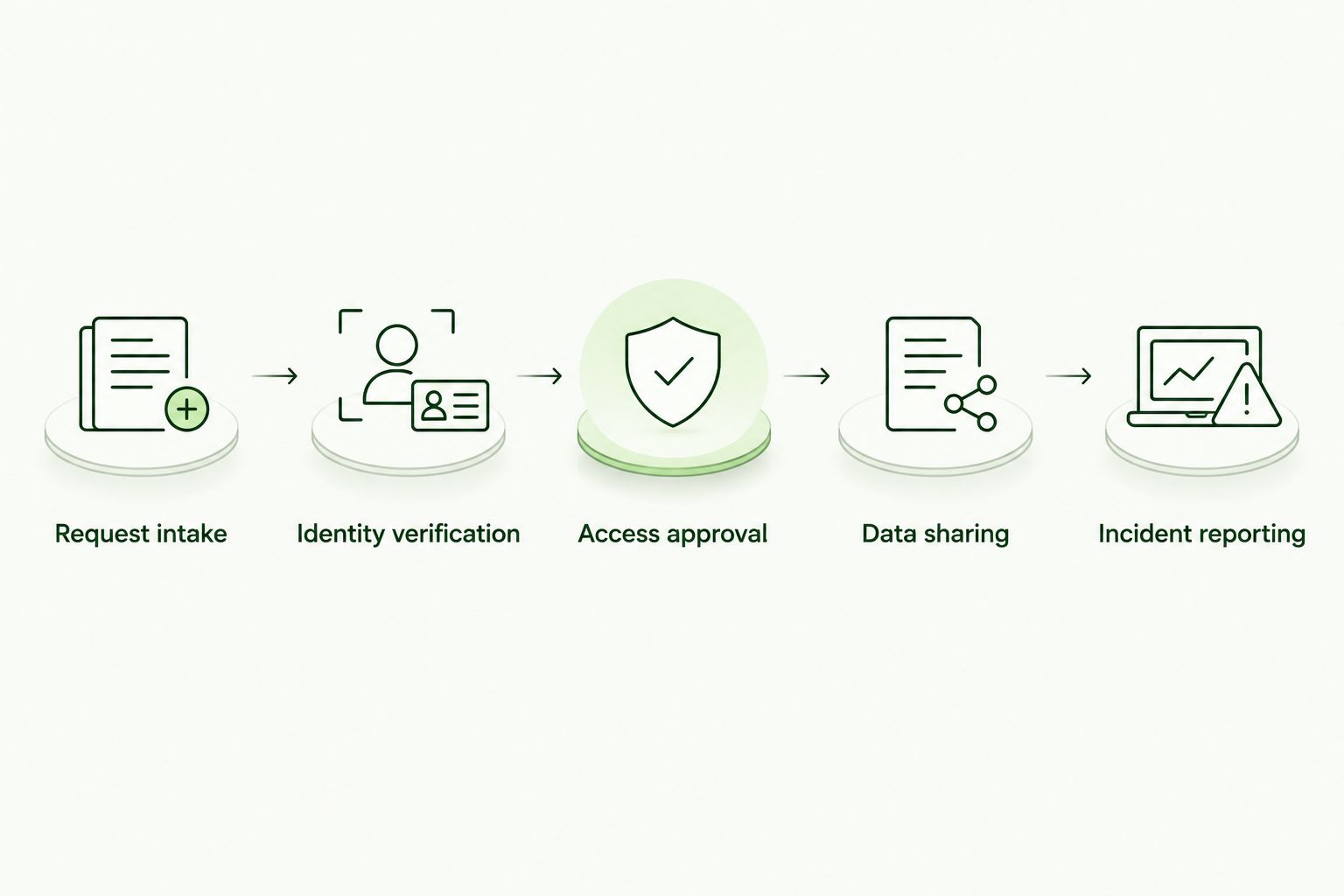
Training belongs at the points where staff must verify, authorize, share, or report.
Assign training by role and responsibility
Build a role-to-task matrix before assigning lessons. A spreadsheet works: list each role, its information access, its outside contacts, and the decisions it makes. Include temporary staff and contractors when they perform covered work; employment status is not a substitute for checking access.
Research-facing employees need examples involving study communications and document handling. Finance staff need payment-change verification. Administrators need access-request and account-recovery scenarios. Everyone needs the same reporting route, but not everyone needs the same depth on every task.
Use 3 role groups as an initial planning structure: research operations, business operations, and system administration. Split them further when the documented tasks differ. These are planning categories, not a required organizational model.
- Match research roles to sponsor requests, study documents, and participant-information handling.
- Match business roles to invoices, contracts, recruitment communications, and payment changes.
- Match administrator roles to account recovery, permissions, and access termination.
- Check whether contractors receive the instructions needed for their assigned work.
- Name an owner for updating assignments when responsibilities change.
Choose a delivery model that fits your service
Create the assignment register manually first. Record the learner, required material, due date, completion status, and follow-up owner. This gives you a baseline against which to evaluate a learning system or an MSP-managed platform.
Defend Wise security awareness training is best for MSPs that need white-label delivery without per-seat billing. Its flat-fee, unlimited-seat model addresses seat-count friction, but it does not determine the clinical research client’s procedures or applicable obligations.
Compare delivery options against the same workflow. Ask how assignments are maintained, how evidence is retrieved, and who handles exceptions. Do not assume that a platform supports a particular integration, export, tenant boundary, or specialist curriculum without confirming it.
- Define the assignment and completion records you need before reviewing software.
- Separate platform administration from clinical procedure review.
- Confirm how client organizations and learner access are managed.
- Test the evidence workflow using a representative assignment.
- Document which tasks remain with the MSP and which remain with the client.
Write scenarios around real research requests
Use existing procedures to write short scenarios manually. Replace real participant, sponsor, and study details with fictional information. The lesson should ask the learner to choose a safe action, then explain why that action follows the approved process.
A useful scenario involves an unexpected request for a study document from someone claiming to represent a sponsor. The correct response is not simply to look for spelling errors. Staff need to verify identity and authorization through a known channel before releasing information.
Keep the examples tied to decisions staff can control. A learner cannot fix every security weakness, but can reject an unapproved transfer method, report an unexpected login prompt, or ask the designated owner to validate a request.
- Use fictional study details rather than live records or identifiable participant information.
- Include unexpected document requests and changed recipient instructions.
- Teach staff to open systems through their established access route.
- Require independent verification for payment or sensitive-information changes.
- Explain the reporting action, not just the signs of a suspicious message.
Set a cadence with clear triggers
Schedule training around access and responsibility changes before adding recurring reminders. Staff need relevant instructions before handling covered information, not after the first reporting deadline. Refresh the material when procedures, systems, or responsibilities change.
For your 2026 plan, distinguish scheduled learning from event-triggered learning. A calendar tells you when routine assignments occur. A trigger tells you when someone needs a new instruction because the job has changed.
Start with a 30-minute planning session involving the training owner and research operations lead. Use it to agree on assignments, reminders, escalation, and change triggers. The session length is a planning recommendation, not a measure of how long training should take.
- Assign relevant training before granting access to covered workflows.
- Add onboarding instructions for new staff and applicable contractors.
- Reassign material when a role or information-handling responsibility changes.
- Refresh scenarios after a procedure update or a relevant reported incident.
- Set an escalation route for overdue assignments that need management action.
Retain evidence that answers a specific question
Create a manual evidence register before designing reports. Each record should answer who was assigned what, when the assignment occurred, and whether the required action was completed. Keep evidence tied to the training version so later reviewers can identify the instructions that applied.
Retain 5 core fields: learner identifier, assigned role, training version, assignment date, and completion status. Add completion dates, assessment results, or exception notes where your documented requirements call for them. This is a recommended record structure, not a regulatory checklist.
For 2026 reviews, distinguish evidence of completion from evidence of understanding. A completion entry documents participation; a scenario response shows a particular decision. Neither proves that every future action will be safe.
- Record the learner and role without adding unnecessary sensitive information.
- Preserve the training version associated with each assignment.
- Record completion dates and exceptions under your documented process.
- Restrict access to training records according to business need.
- Agree on retention and report ownership with the client’s responsible stakeholders.
Measure decisions and correct the workflow
Review training results alongside reported questions and mistakes. Start manually: group issues by the decision involved, then identify whether the problem sits in the lesson, the procedure, or the reporting route. A confusing approval process needs a process correction, not another reminder alone.
Track outcomes within each client’s program. Assignment completion, overdue work, scenario responses, and follow-up status answer different questions. Keep their definitions stable before comparing periods or presenting a trend.
Set your 2026 baseline from actual records rather than importing a sector benchmark. When an assessment identifies a weak decision, give targeted instruction and check that decision again. Do not treat a single result as a full assessment of an employee or organization.
- Separate completion measures from scenario-decision measures.
- Review incorrect responses by task rather than by threat label alone.
- Check whether staff know the approved reporting route.
- Assign corrective actions to a named training or process owner.
- Recheck the affected decision after the corrective action is complete.
Compare training options for clinical research firms
Choose the option that fits ownership and evidence requirements. Manual delivery gives you direct control over the material but creates recurring administrative work. A general learning system or specialist training platform changes how that work is delivered; it does not remove the need for client-specific decisions.
| Option | Best for | Main advantage | Key limitation |
|---|---|---|---|
| Manual briefings and an assignment register | A tightly scoped program with a named internal owner | Direct control over research-specific examples and procedures | Assignment updates, reminders, and evidence preparation remain manual |
| An existing general learning system | Firms that already manage staff learning centrally | Security instructions can sit alongside other required learning | Security-specific exercises and reporting depend on the system and content selected |
| Defend Wise | MSPs delivering white-label security awareness training across end-client organizations | Flat-fee billing and unlimited seats remove per-seat billing friction | Research-specific procedures and required workflows still need validation |
Evaluate the complete service, not just the license model. For an MSP, the operational question is how much work remains when a client adds users, changes responsibilities, or requests evidence. Document those tasks before deciding how to package the service.
Run a representative assignment through the proposed process. Confirm that the client owner can identify the assigned learner, understand the completion record, and resolve an exception. A clean demonstration is more useful than a feature list detached from the firm’s workflow.
Common mistakes clinical research firms make
Treating sponsor requests as automatically authorized
A familiar sponsor name does not establish that a sender or recipient is authorized for a particular document. Train staff to check the specific request against the approved process, especially when instructions or recipients change.
Using live study information in training examples
A realistic scenario does not require actual participant records or confidential study documents. Write fictional examples that preserve the decision staff need to practice without copying sensitive information into another environment.
Assuming training completes the compliance obligation
Training is one part of an information-protection program. Determine applicable requirements with the responsible privacy, legal, and compliance stakeholders; do not assume every clinical research firm has identical HIPAA, sponsor, or contractual obligations.
Giving completion reports no operational owner
A report does not resolve an overdue assignment or an incorrect decision. Name the person responsible for follow-up and define when unresolved work reaches the client’s management team.
Letting seat-count discussions replace scope decisions
Removing per-seat billing does not remove onboarding, content review, or evidence work. Keep those responsibilities explicit in the MSP service description so the client knows what the training service includes and who handles exceptions.
FAQ
What should security awareness training for clinical research firms cover?
Security awareness training for clinical research firms should cover identity verification, authorized data sharing, account access, suspicious requests, and incident reporting. Match examples to the firm’s research, business, and administrator roles.
Is generic phishing training enough for a clinical research firm?
Generic phishing training does not address every research-specific decision. Add scenarios involving sponsor communications, study-document requests, changed recipients, and approved transfer channels.
Is Defend Wise suitable for MSPs serving clinical research firms?
Defend Wise is suited to MSPs seeking white-label security awareness training with flat-fee billing and unlimited seats. Validate the clinical research client’s required content, evidence workflow, and organizational access requirements before deployment.
Does security awareness training make a research firm HIPAA compliant?
Security awareness training alone does not make a research firm HIPAA compliant. First establish whether HIPAA applies to the organization and its activities, then address the applicable requirements beyond training.
How often should clinical research staff receive security training?
Assign relevant training before staff handle covered workflows, then refresh it when procedures, systems, or responsibilities change. Set recurring assignments according to the firm’s documented requirements rather than assuming a universal interval.
What evidence should an MSP retain for client training?
Retain records that identify the learner, assigned material, training version, assignment date, and completion outcome. Agree on additional evidence, access restrictions, retention, and follow-up ownership with the client.
Should contractors receive the same training as employees?
Contractors need training appropriate to the tasks and information they are authorized to handle. Match assignments to responsibilities and access rather than giving every contractor the same material.
One last thing
Test the reporting route before expanding the training library. Ask a research coordinator to explain what they would do with an unexpected sponsor request for a sensitive document. The answer should name a verification method, an approved channel, and a responsible owner.
If the answer is unclear, fix that workflow first. More lessons cannot compensate for instructions that leave staff guessing at the moment a decision matters.