Security awareness training effectiveness: an MSP guide
Security awareness training effectiveness improves when MSPs design for behavior, evidence, coaching, and client-ready reporting.
DefendWise
DefendWise
TL;DR
Security awareness training effectiveness is not a quiz score. For an MSP, it is the ability to help client users pause, verify, report, and recover faster while producing evidence the client can use in QBRs, audits, and cyber insurance conversations.
The useful question is not “did everyone complete the module?” It is “did the training create safer behavior, cleaner reporting, and a repeatable service workflow across every client?” Completion still matters. It just cannot carry the whole story.
A strong MSP program uses short recurring training, phishing and social engineering reinforcement, role-specific coaching, clear reporting routes, and tenant-separated evidence. That is how security awareness becomes an operating layer, not a yearly checkbox.
What is security awareness training effectiveness?
Security awareness training effectiveness is the degree to which training changes real work behavior and gives the organization proof that the program is running.
For a single business, that might mean staff can spot phishing, use stronger authentication habits, handle sensitive data carefully, and report incidents quickly. For an MSP, the bar is higher. The program has to work across many client tenants, each with different users, executives, departments, tools, and evidence needs.
NIST SP 800-50 frames awareness and training as a program lifecycle: design, material development, implementation, and post-implementation review. That matters because effective training is not a one-off content drop. It needs a plan, delivery, follow-up, and improvement loop.
CIS Control 14 makes the same point in a more operational way. Its objective is to “establish and maintain” a security awareness program that influences workforce behavior and reduces cybersecurity risk. The word maintain is the part MSPs feel every month. Launch is easy. Keeping every client current is where the margin disappears.
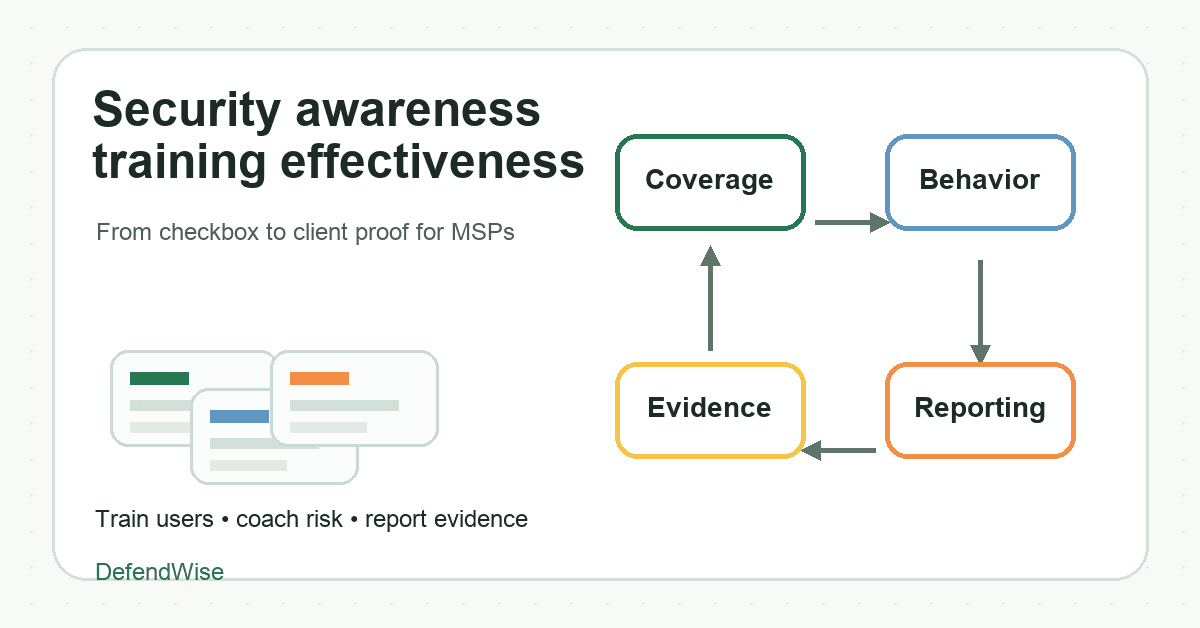
So, for MSPs, security awareness training effectiveness has 4 parts:
- Coverage: the right users are enrolled, including executives, contractors, finance, HR, admins, and new starters.
- Behavior: users know what to do when they receive a risky request, not just what a phishing email looks like on a slide.
- Evidence: the MSP can show who was trained, when, on what topic, and what happened next.
- Operations: the program can run across many clients without monthly spreadsheet work.
If any one of those breaks, the program may still look complete on paper while failing the client in practice.
Why this matters for MSPs
MSPs are often asked to prove security value after something has already gone wrong: a phishing incident, a cyber insurance renewal, an audit request, or a board-level concern after a near miss.
At that point, “we sent training links” is weak evidence. The client needs to know:
- who was in scope,
- who completed training,
- which users or departments need follow-up,
- whether people know how to report suspicious activity,
- what changed after incidents or simulations,
- and what evidence can be reused for compliance or insurance.
CISA’s phishing guidance for small and medium-sized businesses is practical here. It tells businesses to train employees to recognize and report phishing, verify suspicious requests through known contact methods, and reinforce secure practices regularly because once-a-year training is not enough.
The FTC gives similar small-business guidance: train staff to “take five” before responding, verify requests through trusted channels, and share suspicious messages because phishing attempts often hit more than one person in a company.
That is a better effectiveness standard than “100% watched the video.” Effective training should make the first safe action obvious:
| Risk moment | Weak training outcome | Effective training outcome | MSP evidence to keep |
|---|---|---|---|
| Suspicious email | User remembers a generic red-flag list | User reports it through the agreed channel without clicking | Report timestamp, tenant, user, category, follow-up action |
| Urgent payment request | User looks for grammar mistakes | User verifies with a known contact path outside the message | Verification rule, incident note, finance-team coaching record |
| New employee onboarding | User gets a link eventually | User is enrolled before or during first-week access | Joiner list, assignment date, completion date |
| Executive impersonation | Staff assume executives are exempt | Executives and assistants follow a written verification rule | Role-based training completion, policy acknowledgement |
| Audit request | MSP exports screenshots | MSP produces tenant-specific completion, scope, exceptions, and dates | Evidence pack, exceptions log, report history |
The MSP value is not only the course. It is the repeatable workflow around the course.
What MSPs actually need from an effective training program
A training program is effective when it gives client users fewer chances to improvise under pressure.
Most user mistakes do not happen because someone forgot a definition. They happen because the risky action feels normal: approve an invoice, share a file, reset a password, open a supplier attachment, scan a QR code, answer a phone call from “IT,” or help an executive who sounds urgent.
The program should therefore teach small, repeatable decisions.
Teach actions, not trivia
A good module does not only ask whether the user can define phishing. It teaches what to do next:
- Stop before clicking.
- Check the sender and request.
- Do not use the phone number or link inside the suspicious message.
- Verify through a known channel.
- Report the message.
- Change passwords or escalate if something was clicked.
CISA’s guidance is useful because it treats reporting and verification as part of the training, not an afterthought. That is the right pattern for MSP clients.
Match training depth to role risk
CIS Control 14 separates general awareness from role-specific security training. That matters for MSPs because not every user has the same exposure.
A finance manager needs more than a generic phishing module. They need payment-change verification, vendor impersonation examples, and escalation rules. A helpdesk user needs reset-request verification. An executive assistant needs impersonation and calendar-pressure scenarios. A system administrator needs privileged-access and incident-reporting expectations.
Role-specific training does not need to be long. It needs to match the decision the person makes under pressure.
Keep the program current
Training ages quickly when the examples stop matching the inbox.
Verizon’s 2026 DBIR page points to AI-augmented attacks, software vulnerability exploitation, ransomware, and mobile-focused social engineering. Even if an MSP does not quote every DBIR number to clients, the signal is clear: attackers keep changing the channel and the pretext.
A training program that still treats phishing as obvious spelling mistakes and strange foreign princes will not help a client user handle a clean invoice-change email, a convincing voice call, or an SMS link on a phone.
Build reporting into the service
Reporting is where training turns into response.
If the client does not know where to send suspicious messages, users will forward them to a random technician, ask a co-worker, ignore them, or click because the request looks urgent. The MSP should define the route and keep it consistent.
That route might be a report-phishing button, a shared security mailbox, a ticket queue, or a process inside the client’s helpdesk. The important part is that the user knows what to do and the MSP can see what happened.
Make evidence reusable
Training evidence should not be rebuilt for every client request.
At minimum, keep:
- client tenant,
- in-scope users,
- campaign or module name,
- assigned date,
- due date,
- completion date,
- overdue users,
- exceptions,
- reminder history,
- report date,
- and reviewer notes.
NIST CSF 2.0 is not prescriptive, but it gives organizations a common way to discuss cybersecurity outcomes and risk management. Awareness and training sits under the Protect function in the CSF 2.0 Core. For MSPs, the practical move is to map evidence at a high level unless a client’s auditor or framework owner asks for specific control wording.
Step-by-step: how to improve security awareness training effectiveness
1. Define the client’s risky decisions
Start with the actions that create loss, not a topic list.
For most MSP clients, the high-risk decisions are easy to name: approving payments, sharing credentials, opening attachments, granting remote access, sending sensitive files, scanning QR codes, responding to SMS messages, and trusting urgent executive requests. Build the first 90 days of training around those moments.
2. Set a minimum evidence standard
Before the campaign starts, decide what proof the client will need later.
For a basic client, that may be assignment, completion, overdue users, and topic covered. For a regulated or insurance-sensitive client, it may also include scope, role groups, exceptions, reminders, management sign-off, and report history. If the MSP waits until renewal week to decide this, the evidence will be messy.
3. Train every user in scope, not only the easy group
Effectiveness falls apart when coverage is selective.
Executives, finance, HR, sales, temporary staff, shared-mailbox users, and privileged users are often where the risk sits. They are also the people most likely to be left out if training is billed per seat or managed by spreadsheet. Decide who is in scope by risk and service promise, not by who was easy to import.
4. Use short reinforcement instead of yearly bulk training
Annual training is easy to schedule and easy to forget.
CISA’s advice to reinforce secure practices regularly is the better operating model. Use short recurring modules, quick scenario refreshers, phishing-report reminders, and role-specific prompts around real risks. The goal is to make safe behavior feel normal before a high-pressure request arrives.
5. Measure the next action after training
Completion is the starting metric. It is not the finish line.
Track whether users report suspicious messages, whether repeat-risk users improve, whether high-risk roles complete their assigned modules, and whether the MSP can respond faster when something is reported. If the training does not change any next action, the program needs different content, different timing, or a clearer reporting route.
6. Coach repeat risk without public shaming
Gotcha training damages trust.
If someone clicks a simulation or fails a quiz, the MSP should treat it as a coaching signal. Send short follow-up training, make the reporting path clearer, and look for patterns by department or client process. A repeated finance-team failure may indicate a weak payment-verification process, not only weak awareness.
7. Turn results into client-facing recommendations
The monthly or quarterly report should not be a chart dump.
Translate the data into action: “Finance completed the payment-change module, but invoice verification needs a written rule.” “New starters are being added late; we need a joiner feed.” “Users report email threats, but SMS and voice requests need reinforcement.”
That is the kind of output an MSP can use in a QBR. It shows the client what changed and what to fix next.
What good looks like
An effective MSP security awareness program has a few visible traits.
First, it covers the full client population that should be trained. If the MSP cannot answer “who is in scope?” the rest of the metrics are shaky.
Second, it gives users a simple reporting path. The client user should not need to guess whether to call IT, forward an email, open a ticket, or ask a manager.
Third, it separates tenants cleanly. A report for Client A should never depend on blended fleet data or manual filtering from a spreadsheet.
Fourth, it keeps role-based risk visible. Executives, finance, HR, helpdesk, and administrators need extra attention because attackers do not target every user evenly.
Fifth, it creates client-ready evidence without audit-week panic. Evidence should already exist as a byproduct of running the program.
A simple maturity view helps:
| Stage | What it looks like | Main weakness | Next improvement |
|---|---|---|---|
| Checkbox | Annual module, completion export | Little proof of behavior | Add reporting path and recurring reinforcement |
| Managed | Users assigned by client tenant, reminders sent | Metrics still mostly completion | Add role groups and repeat-risk coaching |
| Evidence-ready | Scope, completion, exceptions, and reports are clean | Client may not know what to do next | Add QBR recommendations and control mapping |
| Behavior-led | Training, reporting, coaching, and incident feedback are connected | Requires ongoing operating discipline | Automate lifecycle and reporting across tenants |
Most MSPs do not need to jump from checkbox to perfect. They need the next repeatable layer.
Mistakes to avoid
Mistake 1: treating completion as the whole result
Completion matters because untrained users cannot benefit from the program. But completion does not prove safer behavior by itself.
A client can have 98% completion and still have no clear reporting path, no role-specific coaching, and no evidence of what changed after an incident. Report completion, then explain what it does and does not prove.
Mistake 2: training only easy users
If per-seat pricing or manual admin makes the MSP ration training, the client’s riskiest users may be left out.
That creates a coverage gap. It also makes client reporting awkward because the MSP has to explain why some users were not included. For MSPs trying to bundle SAT into every package, selective coverage weakens the whole offer.
Mistake 3: using stale phishing examples
Training that only shows badly written emails teaches the wrong confidence.
Modern scams can use clean language, real vendor names, compromised accounts, text messages, voice calls, QR codes, and pressure from familiar business workflows. The training should teach verification and reporting, not only visual spotting.
Mistake 4: separating training from response
If a user reports a phishing message and nothing happens, they learn not to bother.
The MSP needs a response workflow: acknowledge the report, triage it, search for related messages where appropriate, advise the client, and use the incident as a short coaching moment. Training becomes more effective when users see that reporting has a result.
Mistake 5: building evidence by hand each month
Manual reporting does not scale across many clients.
If every client needs a different export, a different spreadsheet, and a different PDF, the MSP’s cost to deliver the service grows with every account. That hurts margin and makes the program harder to include broadly.
Framework or technical mapping
Security awareness training appears in several common frameworks and guidance sources, but MSPs should be careful not to overclaim.
NIST SP 800-50 gives a program lifecycle for building awareness and training. NIST CSF 2.0 gives a high-level risk-management language that organizations can use to assess, prioritize, and communicate cybersecurity outcomes. CIS Control 14 gives a concrete awareness and skills-training control with recurring, role-specific, and topic-specific safeguards. CISA and FTC small-business guidance give practical phishing behavior: verify through trusted channels, report suspicious activity, keep training regular, and pair user training with technical safeguards.
The safe MSP position is this:
Security awareness evidence can support a client’s risk, compliance, cyber insurance, or QBR conversation. It does not prove the entire framework by itself.
Use the mapping to organise evidence, not to inflate the claim.
| Source | What it helps with | MSP evidence to prepare |
|---|---|---|
| NIST SP 800-50 | Program lifecycle: design, content, implementation, review | Program plan, topic calendar, review notes, training records |
| NIST CSF 2.0 | Common language for risk outcomes and communication | High-level mapping, client recommendations, current/target notes |
| CIS Control 14 | Awareness and skills training safeguards | Topic coverage, annual or recurring completion, role-specific records |
| CISA phishing guidance | Recognise, verify, report, and reinforce | Reporting route, user instructions, phishing report history |
| FTC small-business guidance | Pause before acting, verify requests, limit damage | Client policy notes, response steps, staff coaching records |
How a flat-rate MSP SAT platform helps
A platform will not make training effective on its own. The MSP still needs a clear service model: who is covered, what behavior matters, how reports flow, and what evidence the client receives.
But the pricing and operating model can either help or hurt that work.
DefendWise is built for MSPs that want broad coverage without per-seat friction: $399/month flat, unlimited users, unlimited client organizations, white-label delivery, multi-tenant management, automated onboarding, Microsoft 365 sync, AI-native training content, and branded reporting. That combination helps MSPs move the program from “who can we afford to train?” to “what behavior should we improve next?”
If you want to see whether that model fits your client base, start a free 7-day trial and inspect the white-label portal, tenant setup, and reporting workflow before you build another spreadsheet around training.
Frequently asked questions
What does security awareness training effectiveness mean?
It means the program helps people take safer actions at work, not only that they completed a course. For MSPs, it also means the training is repeatable across clients, produces clean evidence, and gives each client a practical next step.
How should MSPs measure security awareness training effectiveness?
Start with coverage and completion, then add reporting rate, repeat-risk behavior, high-risk role completion, response workflow quality, and client-ready evidence. Completion proves delivery; behavior and reporting show whether the program is becoming useful.
Is annual security awareness training enough?
Annual training may satisfy a basic checkbox, but it is usually too thin for real behavior change. CISA says once-a-year training is not enough because threats keep changing, so MSPs should reinforce short, practical habits throughout the year.
What security awareness topics make training more effective?
Useful programs cover phishing, social engineering, authentication, data handling, insecure networks, incident reporting, and role-specific risks. CIS Control 14 is a good topic map because it separates general awareness from role-based skills.
What is a good phishing training effectiveness metric?
Look beyond click rate. Track whether users report suspicious messages, whether they verify urgent requests through trusted channels, whether repeat clickers improve, and whether the MSP can turn events into coaching and evidence.
Can security awareness training prove compliance by itself?
No. Training evidence can support frameworks and client questionnaires, but it does not prove the whole security program. Keep scope, completion records, exceptions, report history, and control mapping clean so the evidence is useful during audits or renewals.
How does DefendWise help MSPs improve training effectiveness?
DefendWise gives MSPs a flat-fee, white-label, multi-tenant SAT platform with unlimited users, automated onboarding, Microsoft 365 sync, AI-native training content, and branded reporting. That helps MSPs cover more users without turning every client into a manual admin project.
Header image brief for Picasso
- Source TL;DR: Security awareness training effectiveness is not a quiz score. For MSPs, it means users know how to pause, verify, report, and recover, while the MSP can show clean client-ready evidence across every tenant.
- Primary pillar: white-label-multi-tenant
- Infographic thesis: Effective MSP awareness training connects four loops: coverage, behavior, reporting, and evidence.
- Suggested layout: 4-part map
- Short on-image text candidates: Coverage, behavior, reporting, evidence, From checkbox to client proof
- Key objects: multi-tenant client cards, training module card, report-phishing button, verification phone, QBR evidence pack, loop arrows
- Avoid: fake metrics, vendor logos, compliance badges, padlocks, hoodies, matrix/cyber theatre, scary hacker imagery, unreadable UI labels
- Crop needs: 1200x628 blog/OG, plus social-safe 1200x627
Source notes
External sources used:
- NIST SP 800-50, Building an Information Technology Security Awareness and Training Program: https://csrc.nist.gov/pubs/sp/800/50/final
- NIST Cybersecurity Framework 2.0: https://nvlpubs.nist.gov/nistpubs/CSWP/NIST.CSWP.29.pdf
- CIS Control 14, Security Awareness and Skills Training: https://cas.docs.cisecurity.org/en/latest/source/Controls14
- CISA, Teach Employees to Avoid Phishing: https://www.cisa.gov/audiences/small-and-medium-businesses/secure-your-business/teach-employees-avoid-phishing
- CISA, Cybersecurity Awareness & Training: https://www.cisa.gov/cybersecurity-awareness-training
- FTC, Cybersecurity for small business: Phishing: https://www.ftc.gov/business-guidance/blog/2018/11/cybersecurity-small-business-phishing
- FTC, Cybersecurity for Small Business: Phishing PDF: https://www.ftc.gov/system/files/attachments/phishing/cybersecurity_sb_phishing.pdf
- Verizon, 2026 Data Breach Investigations Report hub: https://www.verizon.com/business/resources/reports/dbir
- ENISA, Awareness Raising in a Box announcement: https://www.enisa.europa.eu/news/cybersecurity-awareness-raising-peek-into-the-enisa-do-it-yourself-toolbox
Internal link candidates:
- DefendWise homepage: https://www.defendwise.com
- Bulk import users to a multi-tenant training platform: https://www.defendwise.com/blog/bulk-import-users-to-multi-tenant-training-platform
- Prepare compliance evidence packs for ISO 27001 audits: https://defendwise.com/blog/prepare-compliance-evidence-packs-iso-27001-audits
- The coverage gap: why MSPs struggle to train every client: https://defendwise.com/blog/coverage-gap-msp-security-awareness-training
Notes for Dan/Woz:
- This draft deliberately avoids claiming that awareness training alone prevents breaches or proves compliance.
- It uses the confirmed DefendWise claims: $399/month flat, unlimited users, unlimited client organizations, white-label, multi-tenant, automated onboarding, Microsoft 365 sync, AI-native content, and branded reporting.
- The keyword is close to the earlier
measure security awareness effectivenesstopic. This draft takes a different angle: improving training effectiveness as an MSP operating workflow, not a measurement-only article.