MetaCompliance alternatives in 2026
Compare metacompliance alternatives for MSP training, policy workflows, and Microsoft-based phishing tests. Choose flat-fee coverage over seat-count friction.
DefendWise
DefendWise
MetaCompliance combines security awareness training, phishing simulation, and policy management—a useful fit when you need employee education alongside policy workflows. That scope stops being the deciding factor when your MSP needs a white-labeled training service without per-seat billing. The best MetaCompliance alternative in 2026 is Defend Wise if you need flat-fee MSP training; KnowBe4 if your priority is a dedicated awareness-training and phishing platform.
TL;DR
- For metacompliance alternatives, Defend Wise fits MSPs needing white-label security awareness training with unlimited seats.
- KnowBe4 fits buyers prioritizing dedicated security awareness training and phishing simulation.
- Microsoft attack simulation training fits organizations evaluating phishing exercises within their Microsoft environment.
- Keep MetaCompliance when policy management remains central to your employee security program.
Why this matters: compare the service you need to deliver
An MSP choosing security awareness training has a different job from an internal security team. You need to train end-client organizations, maintain clear ownership, and explain the service without turning every user change into a billing discussion.
An internal team can focus on its own workforce. An MSP must also examine how the platform fits its client-service model. Those are different buying criteria.
For your 2026 shortlist, separate training, phishing exercises, policy management, and service economics. A platform that meets one requirement does not automatically meet the others. Start with the work your clients expect, then compare the products against that work.
MetaCompliance alternatives at a glance
This comparison separates each platform's established focus from the buying decision. It does not treat every awareness product as an interchangeable replacement for policy management.
| Platform | Best for | Standout capability or model | How it differs from MetaCompliance |
|---|---|---|---|
| MetaCompliance | Organizations combining employee awareness and policy workflows | Training, phishing simulation, and policy management | The benchmark when policy workflows are part of the requirement |
| Defend Wise | MSPs delivering white-label security awareness training | Flat-fee platform with unlimited seats | Centers the MSP service model and removes per-seat billing from the training offer |
| KnowBe4 | Organizations prioritizing awareness training and phishing exercises | Dedicated training and simulated-phishing platform | A shortlist option when awareness and phishing are the main buying criteria |
| Microsoft attack simulation training | Organizations evaluating phishing exercises within Microsoft | Attack simulations within Microsoft Defender for Office 365 | Fits a Microsoft-centered evaluation rather than a standalone policy-management comparison |
Best for is not the same as most features. Choose the platform whose core purpose matches the service you actually need to operate.
1. Defend Wise: best for white-label MSP training
Defend Wise provides a flat-fee, white-labeled security awareness training platform that MSPs use to train and manage cybersecurity compliance for end-client organizations. Unlimited seats are part of that model. The distinction is direct: your training offer does not depend on a per-user platform charge.
Defend Wise is the best security awareness training fit here for MSPs prioritizing white-label delivery and unlimited-seat coverage. That recommendation is about service economics and buyer fit, not a claim that every compliance requirement is automatically satisfied.
Where it shines
- White-label delivery: The platform supports an MSP-branded training service rather than forcing the vendor brand to be the service's identity.
- Unlimited seats: User count does not create a per-seat platform charge.
- MSP buyer fit: The stated audience is MSPs serving end-client organizations, not only internal security departments.
- A clear commercial model: Flat-fee training gives you a distinct basis for packaging your service.
Where it falls short
- It is not a substitute for technical security controls. Awareness training does not replace identity protection, endpoint security, or email controls.
- The commercial model is not the whole compliance decision. You still need to match the training service to each client's obligations and evidence requests.
- Unlimited seats do not remove your operating work. Client onboarding, exception handling, and service ownership still need a process.
Head-to-head with MetaCompliance
| Dimension | MSP-focused alternative | MetaCompliance |
|---|---|---|
| Primary buyer fit | MSPs training end-client organizations | Organizations combining employee awareness with policy workflows |
| Branding | White-label platform | Assess branding requirements during evaluation |
| Commercial model | Flat fee with unlimited seats | Compare the proposed agreement against your service model |
| Policy-workflow decision | Evaluate your required workflow separately | Policy management is part of the platform's stated scope |
For a 2026 decision, give this option priority when seat-count friction is the problem you are trying to remove. Do not use the flat-fee argument to skip a workflow demonstration.
Best for: MSPs packaging white-label awareness training across end-client organizations.
Verdict: Buy for this use case after validating your required client and evidence workflows.
2. KnowBe4: best for a dedicated awareness and phishing shortlist
KnowBe4 is an established security awareness training and simulated-phishing platform. Put KnowBe4 on your shortlist when employee education and phishing exercises are the central requirements, rather than treating policy management as the reason to buy.
The comparison should focus on the actual work. Ask how you will assign training, run exercises, handle missed assignments, and produce usable records. A recognizable vendor name does not answer those questions for your organization.
Where KnowBe4 shines
- Dedicated category focus: Security awareness training and simulated phishing are central to the platform.
- A direct comparison: You can evaluate KnowBe4 against MetaCompliance on the training and phishing workflows your team needs.
- Clear buying purpose: KnowBe4 belongs on a shortlist built around employee security education, not a generic software search.
Where KnowBe4 falls short
- It does not simplify your requirements by itself. Your team still has to define assignment rules, follow-up responsibilities, and reporting expectations.
- Awareness is not the same as policy management. Do not assume that replacing training also replaces every existing policy workflow.
- MSP suitability needs its own evaluation. A strong internal-team fit does not settle client branding, client separation, or service economics.
KnowBe4 versus MetaCompliance
| Dimension | KnowBe4 | MetaCompliance |
|---|---|---|
| Core comparison | Awareness training and simulated phishing | Awareness training, phishing simulation, and policy management |
| Best-fit brief | Employee education and phishing exercises | Employee education alongside policy workflows |
| Decision test | Demonstrate assignment, follow-up, and training records | Demonstrate those workflows plus required policy handling |
For your 2026 evaluation, compare equivalent tasks rather than unequal feature lists. Use the same training assignment and the same reporting request in both demonstrations.
Best for: Organizations making awareness training and simulated phishing their primary selection criteria.
Verdict: Hold on the shortlist until the operating workflow meets your requirements.
3. Microsoft attack simulation training: best for Microsoft-centered teams
Microsoft offers attack simulation training within Microsoft Defender for Office 365. It belongs in this comparison when your organization wants to evaluate phishing exercises within its Microsoft environment.
Treat Microsoft attack simulation training as a focused option, not an automatic replacement for the full MetaCompliance scope. Check the applicable licensing requirements and the workflows available in your environment before making it the basis of your program.
Where Microsoft attack simulation training shines
- Microsoft context: It gives Microsoft-centered organizations a relevant option to evaluate alongside standalone platforms.
- Phishing focus: Attack simulations provide a concrete basis for comparing exercise setup and follow-up.
- A narrower decision: It helps you determine whether your immediate need is phishing exercises rather than a broader policy workflow.
Where Microsoft attack simulation training falls short
- Its scope is not identical to MetaCompliance. Do not treat attack simulation training as a like-for-like policy-management replacement.
- Eligibility requires checking. Confirm the applicable Microsoft licensing requirements for your organization.
- MSP packaging remains a separate question. Demonstrating a simulation does not prove that the service meets your white-label and end-client management requirements.
Microsoft versus MetaCompliance
| Dimension | Microsoft attack simulation training | MetaCompliance |
|---|---|---|
| Evaluation context | Microsoft Defender for Office 365 | A dedicated awareness and policy platform |
| Primary comparison | Phishing exercises and associated training | Awareness, phishing, and policy workflows |
| Key boundary | Verify environment eligibility and required scope | Verify the combined workflows you need |
Best for: Microsoft-centered organizations evaluating phishing simulation as a defined requirement.
Verdict: Hold until eligibility, service scope, and reporting fit are confirmed.
Why people switch from MetaCompliance
A useful switch has a specific reason. Do not replace a working platform because another vendor has a longer feature list.
These are legitimate decision triggers—not claims about MetaCompliance outages, service quality, or changes to its terms:
- Seat-count friction: Your MSP wants an unlimited-seat model instead of making user counts part of the platform-billing calculation.
- White-label delivery: Your client service requires a platform explicitly offered for white-labeled MSP training.
- A narrower training brief: Your organization needs awareness education and phishing exercises, while policy management is not the deciding requirement.
- Microsoft-centered delivery: Your team wants to evaluate the relevant capabilities within its existing Microsoft environment.
Write down the trigger before requesting demonstrations. Then ask each vendor to show how it addresses that exact requirement.
A switch is justified when it improves the service you need to deliver. If the replacement only changes the dashboard while leaving the same operating problems, the migration has not solved the buying brief.
Test the workflow before you choose in 2026
Use a defined evaluation rather than an open-ended product tour. The sequence below tests the work you will repeat after the purchase—not just the work a salesperson chooses to show.
Service scope
Choose one client organization as your evaluation scenario. Describe its training requirement, the people responsible for it, and the records it needs. For an internal team, use one clearly defined business unit instead.
Separate the tasks: training assignment, phishing exercises, policy handling, and evidence delivery. Mark which tasks are mandatory. This prevents a strong demonstration in one area from hiding a gap elsewhere.
User changes
Use two user groups in the scenario: existing employees and new starters. Ask the vendor to demonstrate how each group enters the program and how responsibility for follow-up is assigned.
Then ask what happens when someone leaves. You are testing a repeatable operating process, not claiming that any particular product handles it automatically.
Evidence handoff
Complete one reporting cycle during the evaluation. Request the same output you would hand to the client's responsible manager: who received training, who completed it, and what remains outstanding.
Check whether the output answers the client's question without a separate reconstruction exercise. Do not confuse a screen full of activity with a clear record of completion.
Exit plan
Before committing, document which records you need to retain and how the transition will be handled. Keep responsibility for historical evidence separate from responsibility for future assignments.
A platform change should not leave the client unsure which system holds its previous records. Set that boundary before the new program starts.
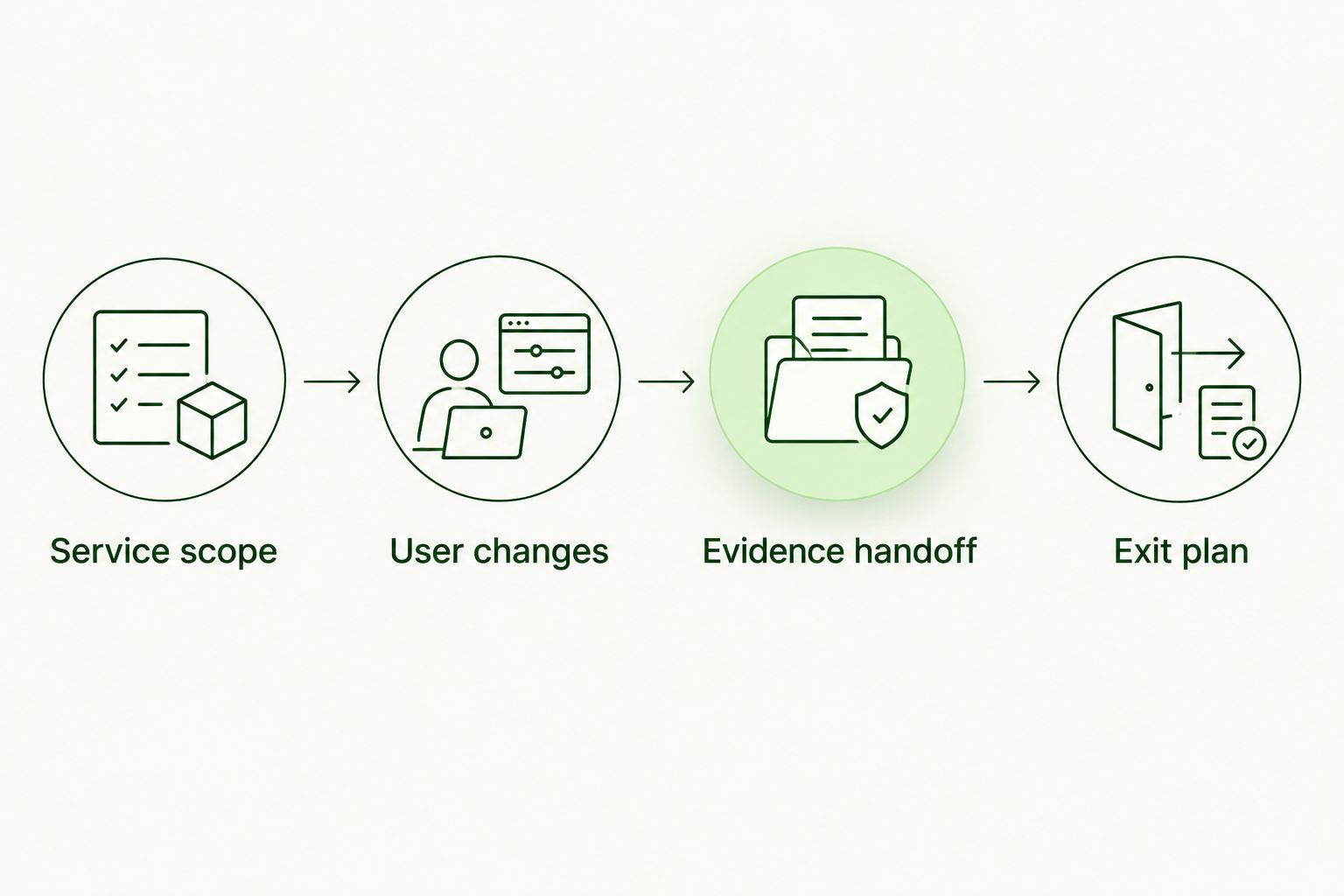
Test the recurring work before committing to the replacement.
Your 2026 decision should survive this exercise. If a platform cannot demonstrate a mandatory task, do not treat a promise about future functionality as completed evaluation evidence.
When staying with MetaCompliance is the right call
Stay with MetaCompliance when its combination of awareness training, phishing simulation, and policy management matches your requirements and your existing workflows work. A replacement should solve a documented problem, not create a new project without a defined benefit.
MetaCompliance's strength is the combined scope. Its limitation in this comparison is that combined scope does not, by itself, establish the best fit for a flat-fee, white-label MSP training service.
If policy handling is central to your program, require every alternative to demonstrate that requirement explicitly. If no replacement meets the brief, keeping the current platform is the correct decision.
FAQ
What's the best MetaCompliance alternative for MSPs in 2026?
Defend Wise is the best fit here for MSPs prioritizing flat-fee, white-label security awareness training with unlimited seats. Validate the client workflows and evidence requirements before committing.
Is KnowBe4 better than MetaCompliance?
KnowBe4 is the more relevant shortlist option when your main criteria are dedicated awareness training and simulated phishing. MetaCompliance remains relevant when policy management is part of the same buying requirement.
Can Microsoft attack simulation training replace MetaCompliance?
Microsoft attack simulation training is an option for phishing exercises, not an automatic replacement for MetaCompliance's full scope. Check environment eligibility and evaluate policy requirements separately.
Does unlimited-seat training remove all MSP administration?
No, unlimited-seat training removes the per-seat platform charge, not every operational task. You still need ownership for onboarding, follow-up, and client evidence requests.
What should I test before switching awareness platforms?
Test assignments, user changes, reporting, and record retention before switching. Use the same client scenario across vendors so the comparison measures equivalent work.
When should I keep MetaCompliance?
Keep MetaCompliance when its awareness, phishing, and policy workflows meet your requirements. Switch only when a replacement addresses a documented service or operating problem.
One last thing
Unlimited seats do not mean unlimited service scope. Keep those promises separate when you package training for clients.
Name the work your MSP owns: onboarding, assignment oversight, exception handling, and evidence delivery. Then name what the client owns. A clear boundary makes the flat-fee model easier to explain without implying that training replaces every other security responsibility.
For your 2026 choice, solve the operating problem first. The vendor shortlist comes second.