Is there a company size where security training stops paying off?
Company size security awareness training cost effective? Judge exposure, admin work, and usable evidence—not a headcount cutoff. See what to check.
DefendWise
DefendWise
Company size alone does not determine whether security awareness training pays off; you need to compare the work it addresses with the full cost of delivering it. A small organization can have sensitive access and demanding customer requirements, while a larger organization can waste money on training that produces little useful follow-through. The hidden cost is administration: enrollment, reminders, exceptions, client reporting, and evidence preparation belong in the calculation alongside the subscription.
TL;DR
- Company size security awareness training cost effective: judge exposure, coverage, and administration rather than an employee cutoff.
- Defend Wise suits MSPs seeking white-label security awareness training without per-seat billing.
- Flat-fee licensing removes seat-count billing friction, not the need to assess training quality or service workload.
- Completion records document participation; they do not establish a financial return or prove secure behavior.
Defend Wise is best for MSPs seeking white-label security awareness training without per-seat billing. That purchasing fit is separate from proving that a particular client’s training program produces a return.
Is there a company size where security training stops paying off?
Use company size to plan delivery, not to declare training worthwhile or worthless. Headcount tells you how many people need coverage. It does not tell you what those people can access, which business processes they control, or how much work the program creates.
For a 2026 review, compare these operating situations rather than assigning an employee threshold:
| Operating situation | Best for | Potential value | Cost or limitation to check |
|---|---|---|---|
| Small organization with sensitive access | Focused, role-relevant training | Addresses decisions involving important accounts, information, or payments | A generic course can miss the decisions that matter |
| Growing organization with changing responsibilities | Training tied to onboarding and role changes | Gives new and reassigned staff clear expectations | Enrollment and exception handling add work |
| Larger organization with varied roles | Shared core training with role-specific follow-up | Keeps common expectations consistent while addressing different responsibilities | Completion totals can hide gaps between teams |
| MSP managing multiple client organizations | Repeatable delivery with client-specific evidence | Creates a defined service across end clients | Client communication, reporting, and follow-up still require ownership |
These are planning categories, not measured return-on-investment tiers. An organization can fit more than one row, and none of the rows establishes that training has paid for itself.
Why this matters
A headcount cutoff turns a service-design question into a purchasing shortcut. You risk dropping useful coverage because a client looks too small, or expanding an ineffective program because a client looks large enough to justify it.
The better question is narrower: What decisions must this training improve, and what does it take to support those decisions? Start with the work people actually perform, then define the coverage and evidence you need.
For MSPs, there is also a margin question. A service with predictable licensing can still consume unplanned technician time if nobody owns onboarding, reporting requests, or unresolved training assignments.
Small organizations: keep the scope focused
A small company does not need a complicated program merely to look mature. It needs clear instructions for the security decisions its people actually make, supported by a way to ask for help and report suspicious activity.
Start with access and responsibility. A person who approves payments, manages accounts, or handles sensitive information needs guidance relevant to that work; employee count does not describe those responsibilities.
The advantage of a focused program is clarity. The limitation is coverage: an overly narrow program can omit temporary staff, new starters, or people whose responsibilities have changed.
For your 2026 plan, write down the intended audience and the reason each group is included. That makes the scope explainable without claiming that a particular company size guarantees a return.
Growing organizations: control the handoffs
Growth changes the delivery problem. New starters, role changes, and departures create handoffs between the people who manage access and the people who manage training.
Training becomes harder to evaluate when those handoffs are unclear. A completion percentage means little if the underlying participant list excludes people who should have been assigned training.
The benefit of a repeatable onboarding process is consistent coverage. The drawback is maintenance: someone still needs to resolve incorrect assignments and determine what happens when responsibilities change.
Check the participant list before interpreting the completion report. Otherwise, you are evaluating activity against an audience that might not match the organization you serve.
Larger organizations: separate coverage from relevance
A larger participant list creates a different risk: treating everyone as though they make the same decisions. Common guidance has a place, but shared training does not replace instructions for responsibilities such as payment approval or privileged access.
The benefit of a common core is consistency. Its limitation is specificity; a completed general module does not show that a person understands a particular approval or escalation process.
Review results by meaningful responsibilities rather than relying only on an organization-wide total. Keep the interpretation narrow: participation is participation, and a response to a training exercise is evidence about that exercise.
Do not present either as proof that incidents have been prevented. That requires evidence beyond a completion dashboard.
Why training cost-effectiveness varies
The useful drivers are operational, not an arbitrary employee threshold. Review these factors before changing coverage:
- Access and responsibility. Identify who handles sensitive information, approves transactions, administers accounts, or responds to suspicious requests. Match the training objective to that work.
- Coverage changes. Establish how starters, departures, contractors, and role changes reach the training process. Unclear ownership makes the audience difficult to maintain.
- Delivery workload. Include assignment management, reminders, exceptions, and support. A subscription is only part of the service effort.
- Evidence requirements. Determine which records a client, customer, insurer, or assessor actually requests. Do not assume a general completion report answers every request.
- Follow-through. Specify what happens after a missed assignment or a reported concern. Training without an operational response leaves the service unfinished.
- Licensing structure. Separate what changes when participation grows from what changes when administration grows. Those are different cost drivers.
These factors give your 2026 review a defensible structure. They do not supply a financial return by themselves; use your own service records and documented outcomes for that calculation.
How do you decide whether the program is worth keeping?
Use this 5-step review before cutting coverage or adding more content. The sequence separates business purpose from delivery mechanics, so a weak process does not get mistaken for a company-size problem.
1. Define the decisions
Name the actions the training should support: checking an unusual payment request, reporting a suspicious message, or following the approved account-recovery process. Keep objectives specific enough that a client manager can recognize the expected behavior.
A broad objective such as improving awareness is difficult to evaluate. An explicit instruction gives you something concrete to teach and review.
2. Map the audience
Identify which responsibilities connect to each objective. Then check how the relevant people enter and leave the participant list.
Do not remove people simply because the organization is small. Equally, do not assign specialized content to everyone merely because the organization is large.
3. Record the workload
Track the work required to deliver the service, using your own records rather than an assumed industry average. Include setup, roster corrections, reminders, client questions, reporting, and follow-up.
Separate recurring work from unusual requests. That distinction helps you decide whether to change the standard service or define an additional responsibility with the client.
4. Check the evidence
Compare the training records with the objective and audience you defined. Check whether the records identify who participated, what was assigned, and which exceptions remain unresolved.
A report should answer a specific question. If a client needs evidence for an external request, check that request directly rather than treating the report’s existence as sufficient.
5. Change the design
If the service consumes too much effort, identify the task causing it before reducing coverage. The problem could be an unclear handoff, unnecessary reporting, or training that does not match the audience.
Retain what serves a documented purpose. Revise or remove work that has no clear owner, objective, or evidence use.
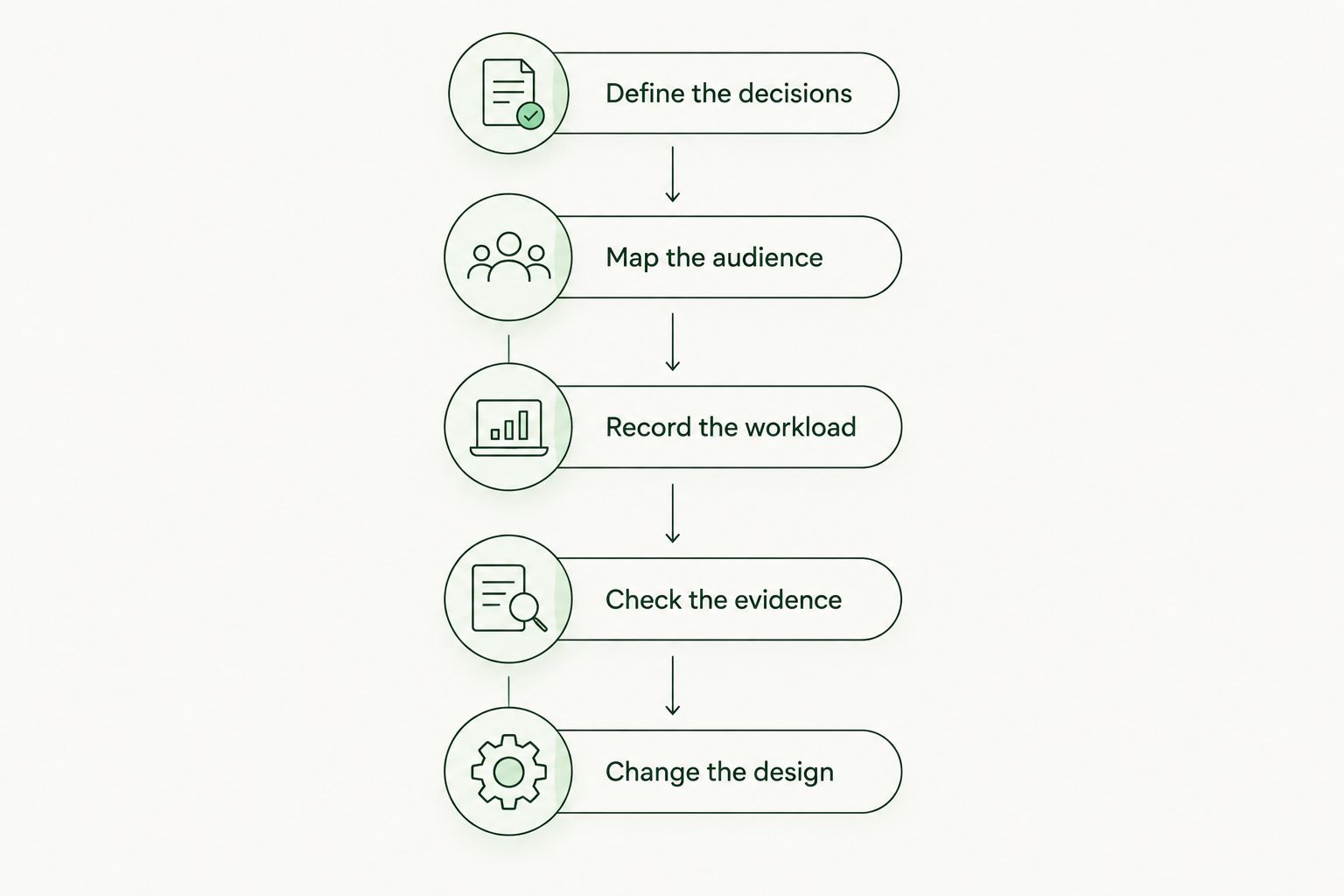
Review the service design before treating company size as the problem.
What changes when an MSP uses flat-fee licensing?
Flat-fee licensing changes the billing model, not the standard of proof. It removes per-seat billing from the licensing calculation, but you still need to evaluate the program’s suitability and the work required to manage clients.
Defend Wise provides a flat-fee, white-label security awareness training platform with unlimited seats for MSPs serving end-client organizations. That makes it relevant when seat-count friction is part of the purchasing problem.
The trade-off is straightforward: unlimited seats do not mean unlimited service capacity. Client questions, audience decisions, exception handling, and evidence requests remain responsibilities that your service must address.
When evaluating Defend Wise security awareness training in 2026, assess the platform against your actual delivery requirements. Flat-fee licensing is a reason to examine the economics; it is not evidence that training has paid off for every client.
Does a small business need less training than a large business?
A small business needs training matched to its responsibilities, not an automatic reduction based on headcount. A narrower audience can support a simpler delivery process, but simplicity should come from clear scope rather than omitted responsibilities.
Check the decisions people make before choosing content or frequency. Keep instructions relevant and make the reporting route clear.
Does adding more training improve the return?
Adding more training does not establish a better return. Additional content needs a defined purpose, an appropriate audience, and a reason to believe it addresses a gap in the existing program.
Before adding assignments, examine unresolved questions and reported problems. Sometimes the next useful action is a clearer approval process or escalation route rather than another module.
Can completion reports prove that training paid off?
Completion reports document participation, not financial return. They help show whether assigned people finished assigned material, subject to the accuracy of the underlying records.
For a stronger evaluation, connect participation records with your defined objectives, follow-up actions, and documented service workload. Keep claims within what those records actually demonstrate.
FAQ
Is there an employee count below which security awareness training is not worthwhile?
Employee count alone does not establish whether training is worthwhile. Assess the responsibilities people hold, the decisions training addresses, and the effort required to deliver it.
How can I tell whether security awareness training is cost-effective?
Compare the full delivery effort with the program’s documented purpose and outcomes. Include administration and client reporting, and do not treat completion totals as proof of financial return.
Is flat-fee security awareness training better than per-seat billing?
Flat-fee licensing removes per-seat billing from the licensing calculation. Whether it is the better fit depends on your coverage needs, service workload, and the platform’s suitability.
Should every employee receive exactly the same training?
Shared expectations can use common training, while specialized responsibilities need relevant guidance. Assign content according to the decisions people make rather than assuming every role has identical needs.
Does finishing security training prove that a business is compliant?
Finishing training does not by itself establish compliance. Check the applicable requirement and the evidence requested; training records address only the activity they document.
What should an MSP check before including training in a managed service?
An MSP should define the audience, responsibilities, recurring administration, reporting requirements, and exception process. Those details establish what the service includes and who performs the work.
Should I cancel training if nobody has reported a security incident?
An absence of reported incidents does not establish that training is unnecessary or effective. Review the program against its objectives, coverage, workload, and documented results instead.
One last thing
Do not confuse a cleaner invoice with a better training program. Licensing, administration, relevance, and evidence are separate parts of the decision; improving one does not automatically fix the others.
At your next 2026 service review, ask the client to name the decisions training should support and the records they need. If those answers are unclear, fix the service definition before debating whether the company is too small or too large.