Is security awareness training tax-deductible?
Is security awareness training tax deductible? Generally yes for qualifying business use. Learn the expense rules, prepayment limits, and records to keep.
DefendWise
DefendWise
Yes—security awareness training is generally tax-deductible for a U.S. business when it is an ordinary and necessary business expense under Internal Revenue Code Section 162. For the 2026 tax year, the deduction depends on the business purpose, who pays, and the applicable accounting rules—not simply whether the invoice says cybersecurity. Prepaid subscriptions, mixed personal use, and bundled implementation work require additional review before you deduct the full payment.
TL;DR
- Is security awareness training tax deductible? Generally yes, when it qualifies as an ordinary and necessary U.S. business expense.
- Separate business deductions from tax credits: deductible training does not produce a dollar-for-dollar tax refund.
- Defend Wise offers MSP security awareness training; tax treatment still depends on the purchaser’s circumstances.
- Keep invoices, service dates, payment records, and a clear business purpose for cybersecurity compliance spending.
Why this matters
Security awareness training is a business service before it is a tax question. Your employees handle credentials, customer information, and payment requests; training addresses risks connected to that work. That connection supplies the business-purpose explanation your accounting records need.
For an MSP, the expense can also support a service sold to end clients. Defend Wise provides white-label security awareness training for MSPs serving those organizations. Defend Wise is best suited to MSPs seeking a flat-fee, white-label security awareness training platform. That purchasing fit does not determine whether a particular payment is deductible.
Use this guide to prepare the records and questions for your tax professional. It covers general U.S. federal business-income-tax principles for 2026, not a determination for your entity or state.
Is security awareness training tax-deductible?
Security awareness training generally qualifies for a business deduction when its purpose and treatment meet the ordinary-and-necessary expense rules. Internal Revenue Code Section 162 provides the underlying federal rule for expenses paid or incurred in carrying on a trade or business. The IRS explains that an ordinary expense is common and accepted in your business, while a necessary expense is helpful and appropriate.
That does not mean training must be legally mandatory. A business can have a valid operational reason to train employees even without a customer contract, insurance requirement, or regulation demanding it.
The following comparison applies that federal framework to common purchasing situations. These are accounting distinctions, not automatic approvals.
| Purchasing situation | Best for | Business-expense rationale | Limitation to check |
|---|---|---|---|
| Recurring training subscription | Ongoing employee training | Supports work-related security practices | Deduction timing follows applicable accounting rules |
| Standalone employee training course | A defined learning need | Addresses skills used in the existing business | Personal or unrelated education needs separate analysis |
| Training purchased by an MSP for client delivery | A managed security service | Supports services the MSP sells | Client billing and reimbursements need consistent accounting |
| Prepaid training subscription | A defined service commitment | Can serve the same business purpose as recurring training | Payment does not automatically establish an immediate deduction |
| Training bundled with software implementation | A combined project | Includes potentially deductible operating services | Capitalization rules can apply to parts of the project |
The distinction is between eligibility and timing. A legitimate business expense can still belong in a different tax period from the one you initially expected.
Recurring security awareness training subscriptions
A recurring subscription used to train your workforce generally has a straightforward business purpose. It supports employee conduct in the business rather than a personal educational goal. Keep the subscription agreement alongside invoices so the service description and coverage period remain clear.
The advantage is continuity: a recurring service can match an ongoing training need. The limitation is that recurring billing alone proves neither business use nor correct tax treatment. Your records still need to explain who the training serves and why the business pays for it.
For your 2026 bookkeeping, use a consistent expense classification agreed with your accountant. Software subscriptions, training expenses, or another appropriate operating-expense category can describe the purchase; the bookkeeping label does not replace the underlying tax analysis.
Standalone courses and employee education
A standalone course addressing phishing, credential handling, or business-data protection can also have a direct connection to employees’ existing work. Document that connection. A course purchased for staff responsibilities presents a different question from education purchased mainly for an owner’s personal interests.
The advantage of a standalone course is its defined scope. Its limitation is that completing a course does not establish an ongoing training process, and the tax deduction does not establish either training quality or compliance.
Keep business-paid workforce training separate from an individual’s claim for their own education expenses. IRS rules for work-related education include restrictions concerning minimum educational requirements and education that qualifies someone for a new trade or business. Do not assume every cybersecurity course receives the same treatment as routine employee awareness training.
MSP purchases and client billing
An MSP purchasing training to deliver a client service has a business-purpose explanation tied to its service revenue. Retain the supplier agreement, service scope, and records showing how the purchase supports client delivery. The platform invoice and the client invoice describe different sides of the transaction.
The advantage of packaging training into a managed service is that the service agreement can define responsibility for administration and reporting. The limitation is accounting complexity when charges combine training, other services, and reimbursements. Ask your accountant how to classify the supplier expense and record client receipts consistently.
Defend Wise security awareness training uses a flat-fee, unlimited-seat model. That model addresses seat-count friction for MSPs, but it does not create a special deduction or change federal expense rules. Compare purchasing models on service economics; evaluate deductibility on business purpose and accounting treatment.
Why security awareness training tax treatment varies
The training topic is only part of the analysis. These factors explain why businesses purchasing similar services can reach different conclusions about the amount or timing of a deduction:
- Business purpose. Training connected to employee responsibilities or client-service delivery has a different basis from personal learning.
- Identity of the purchaser. A company paying for workforce training and an individual paying for personal education are not interchangeable tax situations.
- Accounting method. Cash and accrual accounting apply different timing principles, with additional rules and exceptions.
- Service period. A payment covering future access requires review of the benefit period, not just the payment date.
- Bundled work. A combined invoice can include training, subscriptions, configuration, and work subject to different treatment.
- Business-use allocation. Mixed business and personal spending requires support for the portion claimed as a business expense.
For the 2026 tax year, settle these points before closing the books. A clear invoice helps, but the contract and actual use explain what the business purchased.
Can I deduct an annual subscription when I pay it?
Not automatically: prepayment rules can affect when an annual security awareness training subscription is deducted. Treasury Regulation Section 1.263(a)-4(f) contains a 12-month rule that can remove a capitalization requirement for certain qualifying prepaid benefits.
Under that rule, the benefit generally must not extend beyond the earlier of 12 months after the benefit begins or the end of the tax year following the payment year. Meeting that test does not independently settle every deduction-timing requirement. Your accounting method and other applicable provisions still matter.
An annual invoice is not proof of a full current-year deduction. Give your accountant the payment date, service start date, service end date, and cancellation terms. Those facts are more useful than a description that says only annual subscription.
For a subscription paid during 2026 that extends into a later tax year, flag the coverage dates explicitly. Do not treat the year printed on the invoice as the sole answer.
Does a deduction mean the training pays for itself?
No—a deduction generally reduces taxable income rather than reimbursing the purchase dollar for dollar. A tax credit is a different mechanism. Whether a deduction reduces your current tax bill depends on your tax circumstances.
Keep the purchasing decision separate from the deduction. Evaluate whether the training fits your workforce, service obligations, and administrative process before considering its tax treatment. A deductible expense can still be an unsuitable purchase.
For MSPs, review supplier charges and the work your team must perform. Enrollment, client administration, follow-up, and evidence requests belong in your service-cost assessment. A tax deduction does not remove that work or establish the profitability of your bundle.
What records should I keep for the deduction?
Keep evidence of the purchase, its business purpose, and the period it covers. IRS Publication 583 describes business recordkeeping principles; Publication 538 addresses accounting periods and methods. Use the guidance applicable to your return when preparing your 2026 records.
Build a repeatable process rather than reconstructing the purchase at filing time:
- Identify purpose. State whether the purchase trains employees, supports client delivery, or serves another defined business function.
- Save invoices. Retain supplier invoices, the agreement, and documentation describing the service purchased.
- Record payment. Keep evidence of payment and identify the business entity that incurred the expense.
- Track coverage. Record when access or training begins and ends, especially for prepaid subscriptions.
- Review allocation. Separate personal use and flag bundled work for your accountant before claiming the deduction.
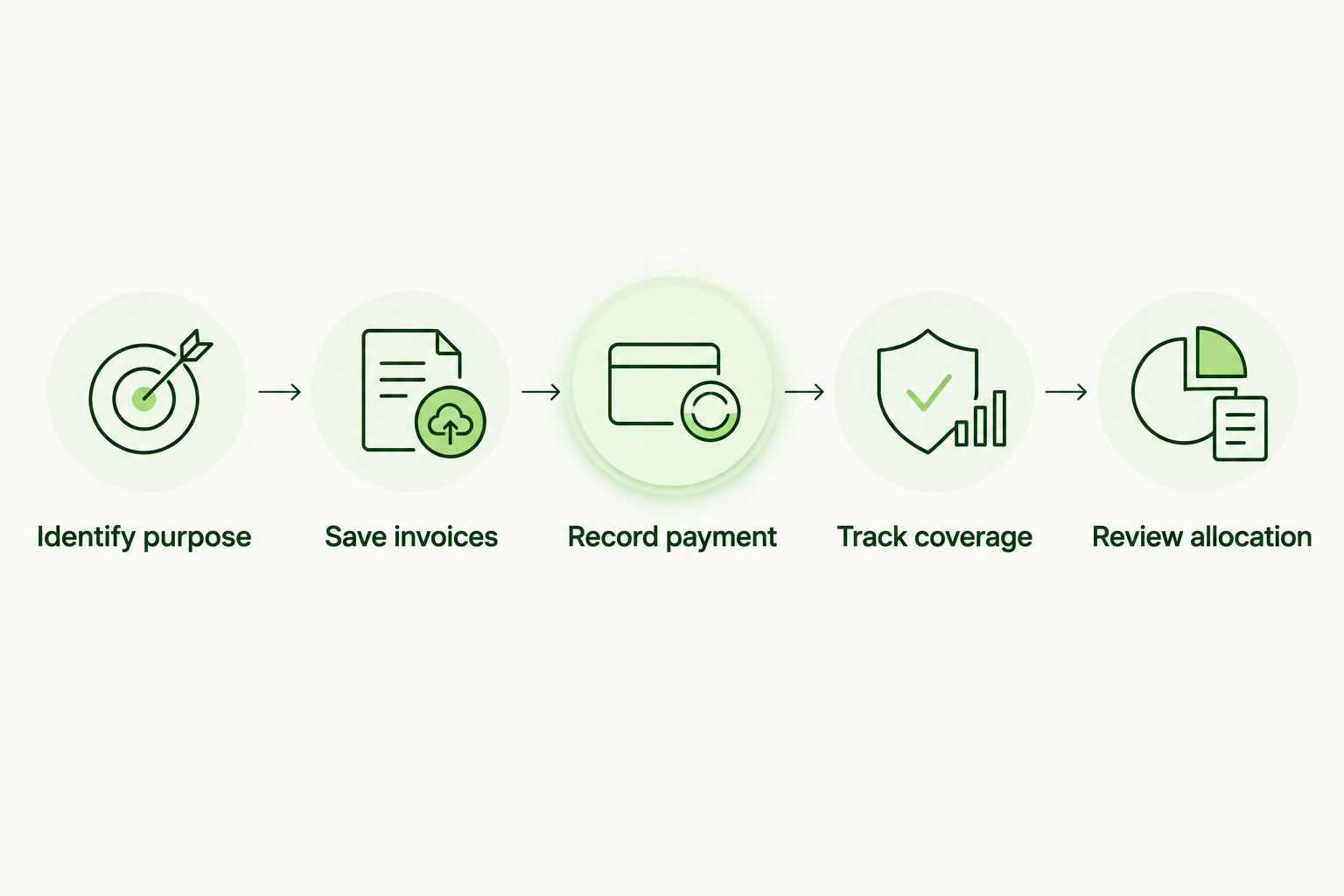
Document the business purpose and service period before deciding when to claim the expense.
Training-completion reports can support the operational explanation, but they do not replace financial records. Likewise, a bank transaction confirms a payment without necessarily explaining what was purchased. Keep those records connected so the expense is understandable without relying on someone’s memory.
Separate tax evidence from compliance evidence
A deductible training expense does not establish compliance with a regulation, contract, or insurance condition. Tax records answer why the business spent money and how it treated the payment. Compliance evidence answers a different question: what the organization required and what actually happened.
For client-service delivery, keep training assignments, completion evidence, exceptions, and applicable requirements organized separately from supplier accounting. Connect them where useful, but do not treat an invoice as proof that users completed training.
This distinction also improves client conversations. Say that training supports the client’s security program; do not promise that buying it automatically satisfies every obligation or creates a particular tax result. Business deductibility is not a compliance certification.
Questions to settle before filing
Ask your tax professional for a decision about the actual purchase, not cybersecurity spending in the abstract. Provide the agreement and service dates with the question. That lets the discussion address the expense you incurred rather than a hypothetical subscription.
Use these prompts during your year-end review:
- Does this purchase qualify as an ordinary and necessary expense for this entity?
- Does the service period require prepaid-expense treatment?
- Does the invoice include implementation or other work requiring separate analysis?
- Is any portion personal, reimbursed, or attributable to a different entity?
- Does state treatment differ from the federal treatment applied here?
Record the resulting accounting treatment and apply it consistently. Revisit the decision when the contract, service scope, or business use changes—not merely when the supplier changes its invoice wording.
FAQ
Is security awareness training tax deductible for a small business?
Security awareness training is generally deductible for a U.S. small business when it qualifies as an ordinary and necessary business expense. Business purpose, accounting method, and service dates determine the appropriate treatment.
Can an MSP deduct training software purchased for clients?
An MSP can generally deduct qualifying business expenses incurred to deliver client services, subject to applicable tax rules. Keep supplier expenses and client receipts properly documented, and review reimbursement arrangements with your accountant.
Does security awareness training qualify for a tax credit?
A security awareness training purchase does not automatically qualify for a tax credit. A business-expense deduction and a tax credit are different, so do not describe an ordinary deduction as a credit.
Can I deduct a prepaid annual training subscription immediately?
A prepaid annual subscription is not automatically deductible in full when paid. The 12-month rule can remove a capitalization requirement for qualifying benefits, but other deduction-timing rules still apply.
Do I need training-completion reports to claim the expense?
Completion reports do not replace invoices, payment records, or evidence of business purpose. They can support the operational explanation for the purchase and serve separate compliance-recordkeeping needs.
Does tax-deductible training automatically satisfy compliance requirements?
Tax-deductible training does not automatically satisfy compliance requirements. Evaluate the applicable obligation and retain evidence of the training actually assigned and completed.
Is Defend Wise security awareness training automatically deductible?
Defend Wise security awareness training is not automatically deductible for every purchaser. Apply the same business-purpose, accounting, and documentation rules used for other business training subscriptions.
One last thing
Make the expense understandable to someone who never attended the purchasing meeting. Save a short business-purpose note with the agreement, invoice, payment record, and coverage dates. For your 2026 tax review, that connected record is more useful than a folder containing only receipts.
Buy training because it supports the work your business needs to do. Claim the deduction according to the rules that apply to the purchase—not because a supplier calls it a write-off.