Is security awareness training legally required?
Is security awareness training required by law? Yes, for covered organizations. Compare HIPAA, FTC, NYDFS, and PCI DSS duties, schedules, and evidence needs.
DefendWise
DefendWise
Security awareness training is legally required for organizations covered by specific rules, but no single federal law requires every U.S. business to provide it. HIPAA, the FTC Safeguards Rule, and New York’s financial-services cybersecurity regulation impose training obligations within their respective scopes. In 2026, you must also separate legal requirements from contractual obligations such as PCI DSS: both can require training, but they arise from different sources.
TL;DR
- Is security awareness training required by law? Yes for covered organizations, not universally across U.S. businesses.
- HIPAA requires a security awareness and training program for all workforce members, including management.
- PCI DSS training requirements come from a payment-security standard, not a standalone federal training law.
- Defend Wise security awareness training fits MSPs seeking white-label delivery; software does not determine legal compliance.
Is security awareness training legally required?
Yes when an applicable law or regulation requires it. No universal mandate covers every U.S. employer. Start with your organization’s activities, regulated status, and information—not the name of the training product.
For an MSP, Defend Wise provides white-label security awareness training for end-client organizations. Your client still needs an applicability decision that identifies which requirements the training must support.
The following comparison separates statutory and regulatory obligations from a contractual security standard. These are U.S.-focused references for 2026, not an exhaustive list of every sector or state requirement.
| Rule or standard | Who must assess applicability | Training obligation | Best for understanding | Main limitation |
|---|---|---|---|---|
| HIPAA Security Rule | Covered entities and business associates | Security awareness and training for all workforce members, including management | Workforce obligations involving electronic protected health information | Training alone does not satisfy the Security Rule |
| FTC Safeguards Rule | Financial institutions under FTC jurisdiction | Security awareness training updated to reflect risks identified by the risk assessment | Training within a regulated information-security program | Not every business handling financial information falls under FTC jurisdiction |
| NYDFS cybersecurity regulation | Covered entities subject to the training provision | At least annual cybersecurity awareness training, including social engineering, for all personnel | New York financial-services cybersecurity obligations | Applicability and exemptions require entity-specific review |
| PCI DSS | Organizations within the applicable payment-card compliance scope | Training upon hire and at least once every 12 months | Payment-card security awareness obligations | PCI DSS is a standard, not a standalone federal law |
Why this matters
An incorrect applicability decision creates the wrong training program. You can miss a required audience, apply the wrong schedule, or collect records that do not answer the reviewer’s question.
For MSPs, the distinction also affects service scope. A white-label platform is a delivery mechanism; the client’s legal obligations determine the required audience, subject matter, and documentation. Do not sell course completion as a substitute for compliance.
In 2026, build the service around a defined obligation and an evidence package. A defensible program connects the rule, the assigned training, and the records showing what happened.
HIPAA: training must include the entire workforce
The HIPAA Security Rule requires a security awareness and training program for all workforce members, including management. The governing provision is 45 CFR §164.308(a)(5). It applies to covered entities and business associates within the rule’s scope.
This is not limited to employees with technical job titles. HIPAA’s workforce definition includes employees, volunteers, trainees, and other persons whose conduct is under the entity’s direct control. Use that definition when deciding who belongs in the program.
Does HIPAA require annual security awareness training?
HIPAA’s security awareness provision does not set a universal annual training interval. It requires a program and identifies implementation specifications covering security reminders, protection from malicious software, log-in monitoring, and password management.
The implementation specifications are designated addressable. Addressable does not mean you can ignore them: the organization must assess whether each is reasonable and appropriate, implement it when appropriate, or document its decision and an equivalent alternative when appropriate.
Distinguish Security Rule awareness training from Privacy Rule training. The Privacy Rule has separate workforce-training requirements under 45 CFR §164.530(b). A course labeled HIPAA training does not establish that both sets of obligations have been addressed.
What HIPAA records should you retain?
HIPAA requires documentation covered by 45 CFR §164.316(b) to be retained for 6 years from creation or the date when it last was in effect, whichever is later. Apply that rule to required Security Rule documentation; do not present it as a universal retention period for every cybersecurity record.
Maintain the program documentation, the training material used, and records that demonstrate implementation. Completion records help substantiate delivery, but a completion percentage does not explain whether the content addressed the organization’s risks.
FTC Safeguards Rule: training follows the risk assessment
The FTC Safeguards Rule requires covered financial institutions to provide security awareness training and update it as necessary to reflect risks identified by the risk assessment. The relevant provision is 16 CFR §314.4(e).
The rule also addresses qualified information-security personnel, their training, and verification that key personnel remain informed about changing threats and countermeasures. General workforce awareness and specialist security competence are related requirements, not interchangeable tasks.
Do not assume the rule applies only to banks—or to every business that processes a payment. Its financial-institution definition and the FTC’s jurisdiction determine coverage. Other financial regulators have their own requirements.
For a 2026 training plan, connect content updates to the client’s documented risk assessment. If the assessment identifies credential theft or fraudulent payment instructions, the program should address those risks rather than repeat unrelated material.
The cited awareness provision does not prescribe a universal annual interval. Set the program’s schedule and updates against the applicable requirements and documented risks, rather than describing an annual course as the entire obligation.
NYDFS: annual training must include social engineering
New York’s cybersecurity regulation requires covered entities subject to 23 NYCRR §500.14(a)(3) to provide cybersecurity awareness training at least annually. The training must include social engineering, cover all personnel, and be updated to reflect risks identified in the covered entity’s risk assessment.
That gives you a clearer frequency requirement than HIPAA’s security awareness provision. At least annually is a regulatory requirement here, not a generic best-practice recommendation.
Assess whether the entity is covered and whether an exemption applies before assigning this requirement to a client. A New York address alone does not establish coverage under the NYDFS regulation.
For covered clients in 2026, check the audience and content as carefully as the calendar. An annual technical briefing for administrators does not demonstrate awareness training for all personnel, and a course without social-engineering content does not address the cited provision.
PCI DSS: required training is not the same as a legal mandate
PCI DSS requires an applicable security awareness program and personnel training upon hire and at least once every 12 months, under Requirement 12.6.3. The standard also addresses keeping the program current and confirming personnel acknowledgment of security policies and procedures.
PCI DSS is not itself a standalone federal law. Its obligations generally arise through the payment-card ecosystem and associated agreements. Assess the merchant’s or service provider’s actual compliance scope and contractual requirements.
That distinction does not make PCI DSS optional for an organization whose agreements require it. It changes the source of the obligation and the evidence the organization must provide.
Do not treat a once-yearly assignment as sufficient when personnel also need training upon hire. Your process needs an onboarding trigger as well as a recurring schedule. Check the applicable PCI DSS version and validation requirements when preparing the evidence package.
Why security awareness training requirements vary
There is no single training schedule you can assign to every MSP subclient. The requirements differ because their legal and contractual triggers differ.
- Regulated activity: Healthcare, covered financial activities, and regulated financial services bring different rules into scope.
- Information handled: Electronic protected health information and payment-card information lead to different applicability assessments.
- Regulatory jurisdiction: FTC coverage and NYDFS coverage depend on defined legal scope, not a broad industry label.
- Required audience: A rule covering all workforce members or all personnel requires more than training selected account holders.
- Risk assessment: The FTC and NYDFS provisions explicitly connect training updates to identified risks.
- Contractual commitments: Payment-card agreements and client contracts can create obligations separate from a general legal mandate.
Use the client’s obligation to design the program. Do not work backward from the platform’s default schedule.
How should an MSP turn requirements into a training service?
Use a repeatable process without pretending every client has the same obligations. The sequence below separates applicability, delivery, and evidence so that each has a clear owner.
- Scope the client. Record the client’s activities, regulated status, relevant information, and contractual obligations. Have the client’s legal or compliance owner confirm applicability.
- Map the requirement. Identify the governing provision, required audience, content, frequency, and documentation obligations. Keep statutory requirements separate from internal policy choices.
- Assign training. Translate the audience into a maintained roster and the schedule into onboarding and recurring assignments. Resolve gaps between the legal audience and available user accounts.
- Keep evidence. Preserve the assigned material, dates, completion records, exceptions, and relevant program decisions. Apply the correct retention rule rather than a single default period.
- Review changes. Revisit the mapping when risks, activities, personnel, contracts, or applicable requirements change. Update the training and document the reason.
The process makes the boundary clear: the client confirms obligations, and the MSP delivers the agreed service. Document responsibilities for incomplete assignments and evidence requests before they become an urgent compliance task.
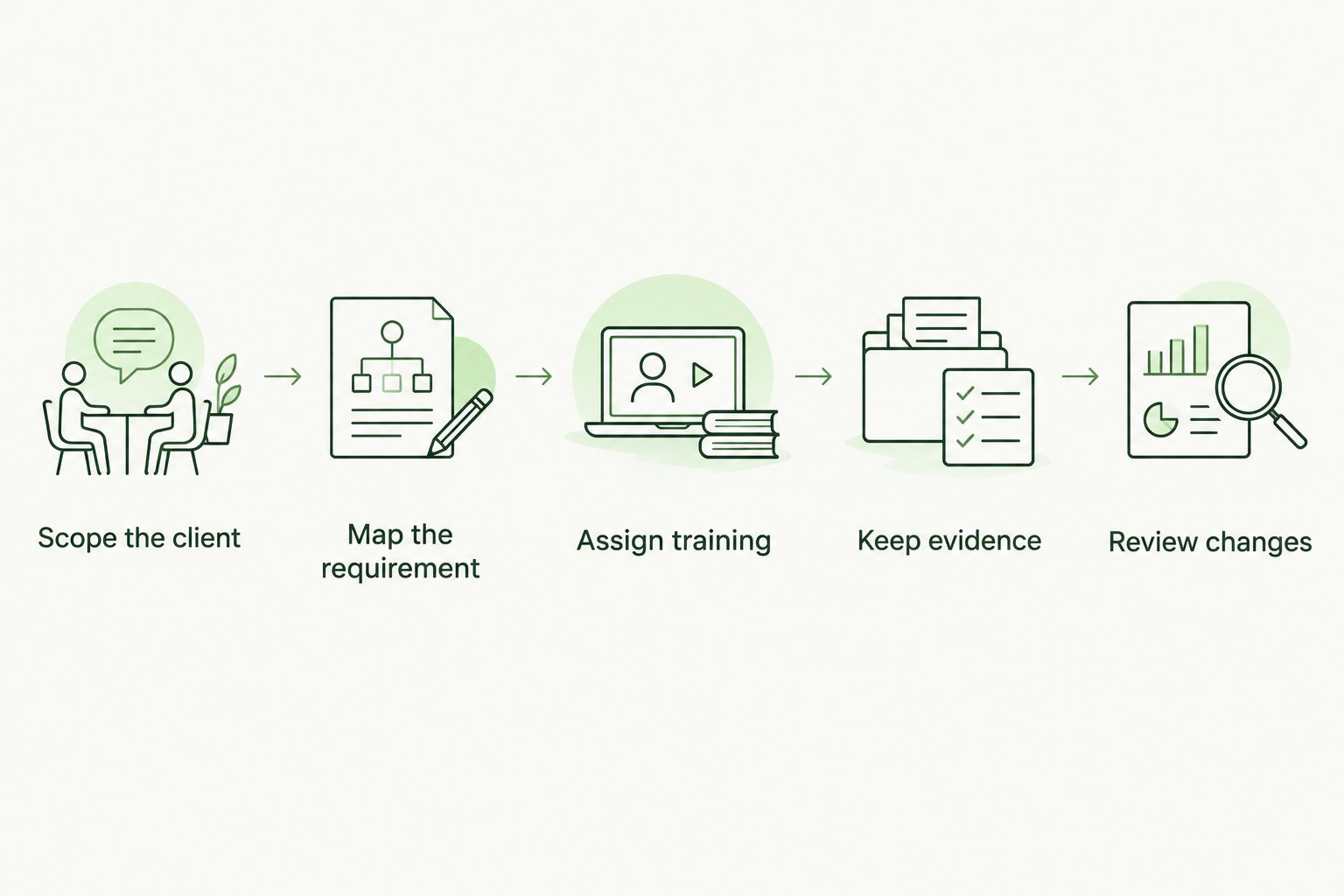
Confirm the obligation before choosing the training schedule.
A platform can support delivery, but it cannot make the applicability decision for you. Defend Wise is best for MSPs seeking white-label security awareness training, not a substitute for legal compliance advice. The fit is the delivery model; the limitation is that the client’s obligations still require a separate assessment.
Can a cyber insurance policy require security awareness training?
A cyber insurance application or policy can include training-related questions or conditions. Check the actual documents before calling training mandatory, and distinguish a question about existing practice from an express policy requirement.
Keep the answer tied to evidence. If the application asks whether all personnel receive training, do not answer yes based only on the enrolled users who completed a course.
Does completing training prove the business is compliant?
Completing training proves completion of the assigned material, not compliance with an entire law or standard. You still need to establish that the correct people received relevant content on the required schedule and that the broader security obligations were addressed.
For a 2026 compliance review, describe training as one control within the program. Avoid certificates or service descriptions that imply a course alone establishes HIPAA, FTC, NYDFS, or PCI DSS compliance.
FAQ
Is security awareness training required by law for every U.S. business?
No single federal law requires every U.S. business to provide security awareness training. Specific laws and regulations impose requirements on covered organizations, and contracts can create separate obligations.
Does HIPAA require annual cybersecurity training?
HIPAA’s Security Rule requires a security awareness and training program but does not establish a universal annual interval. Assess the Security Rule and separate Privacy Rule training requirements against the organization’s circumstances.
How often does PCI DSS require security awareness training?
PCI DSS requires personnel training upon hire and at least once every 12 months under Requirement 12.6.3. Its requirements arise from the applicable payment-card compliance obligations, not a standalone federal training law.
Does New York require annual security awareness training?
The NYDFS cybersecurity regulation requires covered entities subject to its training provision to provide training at least annually. It must include social engineering, cover all personnel, and reflect risks identified in the entity’s risk assessment.
How long does HIPAA require security documentation to be kept?
HIPAA requires documentation covered by 45 CFR §164.316(b) to be retained for 6 years from creation or when it last was in effect, whichever is later. That requirement is not a universal retention rule for every cybersecurity record.
Can an MSP use Defend Wise to deliver client security awareness training?
Defend Wise provides a white-label security awareness training platform for MSPs serving end-client organizations. The client and MSP still need to establish applicable requirements, service responsibilities, and the evidence needed to demonstrate delivery.
One last thing
Unlimited seats and complete workforce coverage are different things. A platform’s licensing model does not establish whether every person covered by a rule appears on your training roster.
Before the next assignment, reconcile the roster with the applicable workforce definition—not just the directory of active email accounts. That check turns a training campaign into a better-documented control.
This article provides general U.S. compliance information for 2026, not legal advice. Confirm applicability and current requirements with qualified legal or compliance counsel.