Is phishing training required for contractors and vendors?
Phishing training requirements for contractors depend on access, contracts, and applicable rules. Check HIPAA and PCI DSS scope, then document coverage.
DefendWise
DefendWise
Phishing training is required for contractors when an applicable rule, contract, or organizational policy includes them; contractor status alone does not decide the answer. Vendors need separate assessment because an outside supplier is not automatically part of your workforce. For 2026, decide coverage from the person’s role, access, and governing obligations—not whether payroll calls them an employee.
TL;DR
- Phishing training requirements for contractors depend on workforce status, system access, applicable rules, and contract terms.
- HIPAA security awareness training covers workforce members; independent vendors need a separate scope assessment.
- PCI DSS requires security awareness training upon hire and at least every 12 months for covered personnel.
- Defend Wise serves MSPs seeking white-label security awareness training without per-seat pricing.
Is phishing training required for contractors and vendors?
Yes, when the contractor or vendor personnel fall within a specific training obligation. There is no universal requirement covering every outside supplier. Use these 5 decisions to establish the boundary before assigning training:
- Identify the obligation. Name the regulation, security standard, customer contract, or internal policy that requires awareness training. A request from a customer is not automatically a statutory requirement.
- Classify the relationship. Determine whether the individual acts under your organization’s direct control or provides services through an independent supplier. Contract labels alone do not settle regulatory workforce status.
- Map the access. Record access to email, sensitive information, payment processes, administrative systems, and client environments. Include the ability to request payments or approve changes.
- Read the coverage language. Check whether the obligation covers workforce members, personnel, authorized users, service providers, or subcontractors. Those terms are not interchangeable.
- Record the decision. Identify who must train, who supplies the training, what evidence is acceptable, and who approves exceptions. Keep the reasoning with the relevant access or supplier record.
For MSPs managing that coverage across clients, Defend Wise provides white-label security awareness training. Software delivery does not replace the client’s responsibility to define who belongs in scope.
Why this matters
An employee-only training list can leave outside users unassessed. A contractor with a client mailbox or privileged account can receive the same malicious messages as an employee, while a supplier with no access presents a different training decision.
Your 2026 policy should therefore separate employment status from security responsibility. Treat access as a reason to assess coverage, not as proof that a particular law applies.
The distinction also protects your service scope. If your MSP promises to train all authorized users but enrolls only payroll employees, the delivery no longer matches the promise—even if no separate regulation names those contractors.
| Governing obligation | When outside personnel enter scope | Main limitation | Best for answering |
|---|---|---|---|
| HIPAA Security Rule | A contractor meets the workforce definition for a covered entity or business associate | Independent vendor status requires separate analysis | Whether workforce security awareness training applies |
| PCI DSS | Personnel fall within the organization’s applicable security awareness program | Scope and responsibility allocation still matter | What training cadence and phishing content are required |
| Customer or supplier contract | The agreement expressly includes the relevant outside personnel | Contract language differs between agreements | Who must deliver training and produce evidence |
| Internal security policy | The organization includes contractors or vendors in its training scope | An internal rule is not itself a universal legal mandate | Establishing consistent access conditions |
HIPAA: workforce status decides the training obligation
The HIPAA Security Rule at 45 CFR §164.308(a)(5)(i) requires a security awareness and training program for all workforce members, including management. That provision requires a program; it does not prescribe a universal standalone phishing course.
The workforce definition at 45 CFR §160.103 includes people whose work is under the entity’s direct control, whether or not the entity pays them. A contractor can therefore be a workforce member for HIPAA purposes without being a payroll employee.
Best for determining HIPAA coverage: assess direct control and the individual’s actual role. Do not use an accounts-payable classification as the final answer.
An independent vendor is not automatically part of your workforce. A business associate relationship creates its own obligations, and the business associate’s workforce must be assessed within that organization’s responsibilities. Do not assume your client must enroll every supplier employee in the client’s training portal.
For a 2026 HIPAA coverage review, document the relationship, the responsible entity, and the training arrangement. Keep phishing-related content aligned with the organization’s security risks rather than presenting a particular simulation schedule as a HIPAA mandate.
PCI DSS: covered personnel need recurring awareness training
PCI DSS v4.0.1 Requirement 12.6.3 specifies security awareness training upon hire and at least once every 12 months. Requirement 12.6.3.1 includes awareness of phishing and related social engineering attacks.
That makes phishing content an explicit part of the applicable awareness program. It does not make every vendor employee part of every customer’s training population.
Best for determining PCI DSS coverage: establish which personnel belong within the assessed program and how service-provider responsibilities are divided. Include outside personnel where the applicable scope requires them; do not limit the roster to employees by default.
The advantage is a clear training baseline. The limitation is that completing a course does not settle PCI DSS scope or prove that every other requirement has been met.
For your 2026 evidence package, retain the relevant personnel roster, completion dates, and training content. Record how outside personnel are covered, especially where a service provider delivers its own training rather than using the customer’s platform.
Contracts: assign the training duty before access begins
A customer agreement or supplier security schedule can require training even when no universal rule requires that specific contractor to attend your course. Read the signed terms rather than relying on a generic statement that the vendor is compliant.
Best for delegated training: specify the responsible organization and acceptable evidence in the agreement. A supplier’s own program can support a delegated arrangement, but only if it satisfies the requirements you actually agreed to accept.
Your contract review should answer:
- Coverage: Which personnel, subcontractors, and client environments does the clause include?
- Delivery: Does the customer, MSP, or supplier provide training?
- Content: Must the training address phishing, reporting, sensitive information, or another defined topic?
- Evidence: What records demonstrate completion, and who must provide them?
- Changes: What happens when personnel join, change roles, or leave?
Delegating delivery can avoid duplicate administration. The trade-off is reliance on another organization’s records, so define how you will verify coverage before accepting a certificate or assurance statement.
Why phishing training requirements for contractors vary
The variation comes from the obligation and the relationship—not from a universal contractor exemption. These factors explain why outside personnel can receive different training decisions:
- Workforce status. Under HIPAA, direct control matters to the workforce definition. Employment labels do not resolve that question alone.
- Applicable standard. PCI DSS specifies phishing awareness within its security awareness requirements; other obligations use different language.
- Access and authority. Mailbox access, administrative permissions, and payment authority inform the organization’s training policy and risk assessment.
- Contract terms. A customer can require supplier personnel to complete defined training or provide evidence from an accepted alternative program.
- Responsibility allocation. The client, MSP, and supplier need an explicit division of delivery, recordkeeping, and exception approval.
Do not turn a risk-based recommendation into a legal claim. You can require training as a condition of access without saying that every contractor is legally required to take it.
Build a contractor training workflow your MSP can defend
Use a repeatable process rather than a separate judgment call for every enrollment ticket. The following sequence connects a coverage decision to evidence and access management.
- Classify access. Identify the client environment, account owner, permissions, sensitive information, and business authority associated with the person.
- Assign coverage. Match that role to the applicable obligation and client policy. Record whether training is required and who owns delivery.
- Verify completion. Check the assigned training or accepted supplier evidence. A forwarded certificate should identify the individual and the relevant training activity.
- Review changes. Reassess coverage when access, responsibilities, or the supplier relationship changes. Remove obsolete assignments through the offboarding process.
A documented exception belongs in this workflow too. Record the reason, approving owner, applicable conditions, and review trigger; do not silently exclude someone because enrollment is inconvenient.
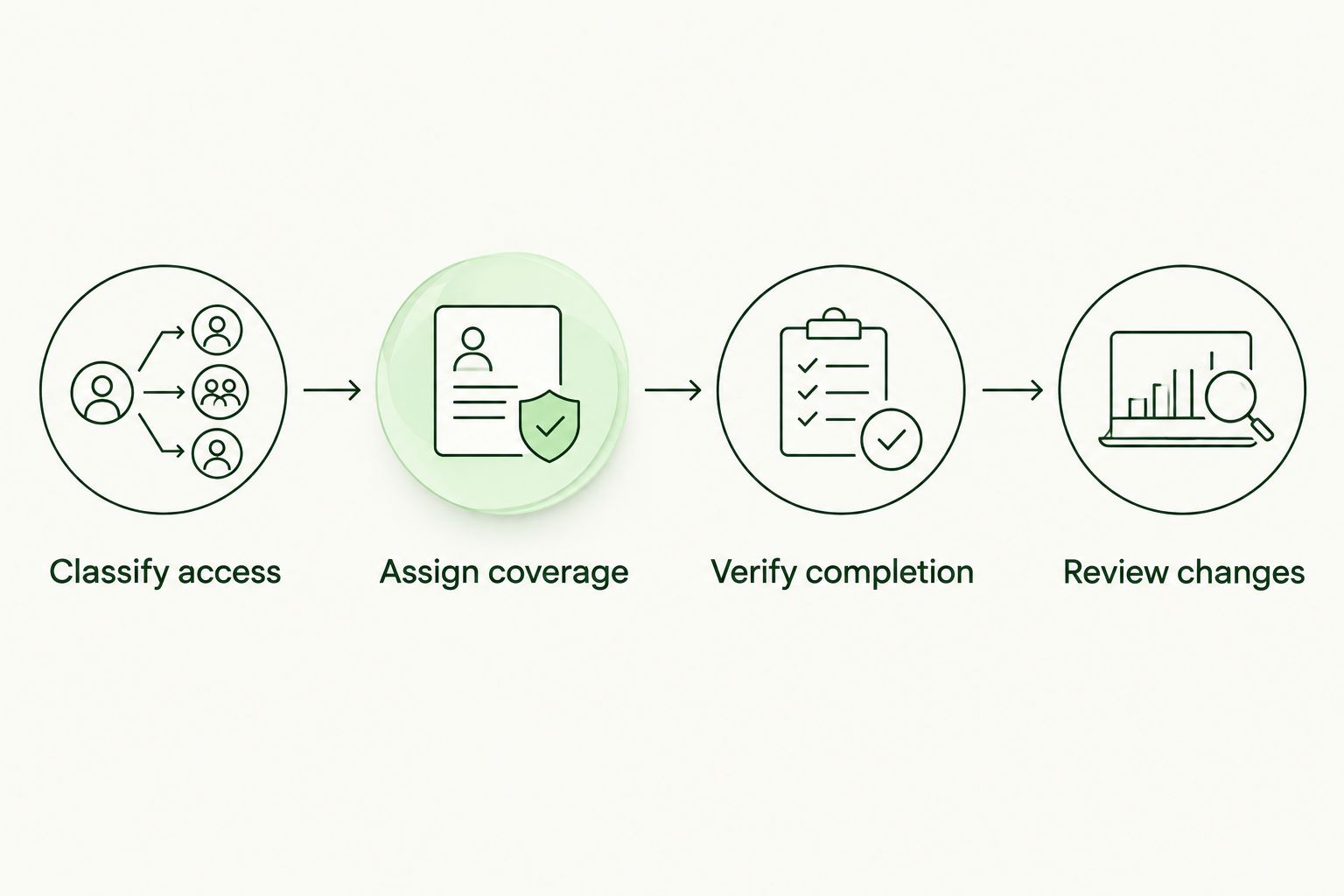
Coverage decisions should connect the person’s access to a named training owner and a review trigger.
Keep 3 record types connected: the coverage decision, the training evidence, and the exception record where an exception exists. Together, they explain not just who completed training but why that person was included or excluded.
Training evidence should distinguish course completion from demonstrated behavior. A completion record shows participation in an assigned activity; it does not prove that the person will identify every phishing attempt.
Choose the platform after you define coverage
Defend Wise is best for MSPs seeking white-label security awareness training without per-seat pricing. Its flat-fee, unlimited-seat model removes seat-count pricing friction from the enrollment decision.
That is an economic fit, not a compliance determination. The MSP and client still need to identify covered contractors, decide how independent supplier training will be accepted, and maintain the required evidence.
Evaluate the delivery process against your actual service promise. If the contract requires client-specific evidence, establish how your team will produce and review that evidence before making the commitment. Do not promise that a platform automatically satisfies every client’s regulatory obligations.
Do contractors need training before they receive access?
Require training before access when the governing contract or policy makes it a prerequisite. Where the applicable obligation uses another timing requirement, follow that requirement and document your own access conditions separately.
For a 2026 onboarding policy, state the trigger explicitly. Avoid leaving technicians to infer whether creating an account also means approving unrestricted access.
Can vendors provide their own phishing training?
Vendors can provide their own training when the applicable requirements and your agreement accept that arrangement. Define the covered population, required content, timing, and evidence before treating the supplier’s program as a substitute.
The benefit is avoiding unnecessary duplicate training. The limitation is that a general assurance about the supplier’s program does not identify which people completed it.
Does a phishing simulation count as training?
A phishing simulation alone does not establish that every applicable awareness-training requirement has been met. A simulation exercises behavior; a training program must address the content and participation requirements that apply to the organization.
Keep simulation results and training completion distinguishable. That lets a reviewer see what you taught, who participated, and what the exercise measured.
FAQ
Are all contractors legally required to complete phishing training?
No universal requirement covers all contractors. Coverage depends on applicable rules, workforce status, contracts, and organizational policy.
Does HIPAA security awareness training apply to contractors?
HIPAA security awareness training applies to contractors who meet the applicable workforce definition. Direct control matters; independent vendors require a separate assessment of their relationship and obligations.
How often does PCI DSS require security awareness training?
PCI DSS requires security awareness training upon hire and at least once every 12 months for covered personnel. Its awareness requirements include phishing and related social engineering attacks.
Can a vendor send a training certificate instead of taking our course?
A vendor certificate is acceptable only when it satisfies the applicable requirements and your agreed evidence criteria. Check the individual’s identity, completion date, and training content rather than accepting the document title alone.
Do contractors without company email need phishing training?
Not having company email does not automatically exclude a contractor from training requirements. Assess the governing obligation, other system access, and authority to handle information or business requests.
Can an MSP buy software and treat contractor compliance as finished?
No. Defend Wise provides white-label security awareness training, but the MSP and client must still define coverage, assign responsibility, and maintain evidence appropriate to their obligations.
Is annual phishing simulation mandatory for every vendor?
There is no universal annual phishing-simulation mandate for every vendor. Do not confuse a security awareness training cadence with a requirement to run a particular simulation schedule.
One last thing
An exclusion needs an explanation, not an empty row. Before approving your 2026 contractor roster, pick an excluded account and ask its owner to identify the applicable obligation, explain the coverage decision, and show where that decision is recorded.
If that explanation is missing, fix the decision process before assigning another course. A complete training list starts with a defensible scope—not a higher completion percentage.