Is it legal to phish test employees without notice?
Is it legal to phish test employees without notice? Not automatically unlawful. Check authorization, privacy rules, and data collection before your MSP deploys.
DefendWise
DefendWise
A phishing test without advance notice of the specific campaign is not automatically illegal in the United States, but it requires an authorized scope and a lawful way to collect employee data. Keeping the test date secret is different from secretly accessing accounts, capturing communications, or collecting passwords. For a 2026 campaign, establish authority, review applicable privacy and employment rules, and document the boundaries before sending anything.
TL;DR
- Is it legal to phish test employees without notice? Campaign secrecy does not replace authorization or privacy review.
- Tell employees that security testing occurs without revealing the timing of each phishing simulation.
- Use simulated credential submissions, not real password collection, and restrict access to individual results.
- Defend Wise suits MSPs seeking white-label security awareness training without per-seat licensing.
Is it legal to phish test employees without notice?
An unannounced phishing simulation is not the same thing as unauthorized monitoring. The legal assessment turns on what you control, what employees have been told, what the simulation collects, and which laws apply. No single federal rule gives every employer blanket permission to run every kind of test.
For MSPs, Defend Wise provides white-label security awareness training. Platform selection and legal authorization are separate decisions: buying software does not authorize testing a client's employees.
| Testing approach | Best for | Benefit | Limitation |
|---|---|---|---|
| General notice, undisclosed campaign timing | Routine awareness programs | Preserves surprise while explaining that testing occurs | Notice alone does not resolve every consent or monitoring requirement |
| Advance notice of the specific exercise | Guided practice and first-time instruction | Sets clear expectations and supports learning | Results do not represent an unsuspecting response |
| No general notice and undisclosed timing | No default recommendation | Preserves surprise | Creates unresolved transparency, authorization, and privacy issues |
The distinction matters. An employee can know that simulations occur without knowing which message is a test. That arrangement preserves an element of surprise without treating secrecy as the legal basis for the program.
Why this matters
A phishing simulation tests behavior. It can also generate identifiable records about employees, including delivery status, link clicks, reports, and training completion. Your testing policy should address those records, not just permission to send an email.
For an MSP, the risk extends beyond the campaign itself. A client might expect a training service while a technician assumes permission to capture credentials, inspect mailboxes, or report results to managers. Define the service boundary before deployment, not after an employee complains.
In a 2026 security awareness program, distinguish the training objective from the collection method. Teaching employees to recognize suspicious messages does not require unrestricted access to their communications or personal accounts.
General notice: explain the program, not the test date
General notice tells employees that the organization conducts security awareness exercises and explains how participation data is handled. It does not need to identify the next simulated message or its delivery time to serve that purpose.
A useful notice describes the program's purpose, the work systems involved, the categories of information collected, and who receives results. It should also explain how employees can report suspected phishing and where they can raise questions about the program.
Do not treat a handbook acknowledgment as a universal consent form. Its legal effect depends on its wording, the activity involved, and applicable law. Have counsel check whether your existing acceptable-use, privacy, and monitoring notices cover the proposed exercise.
Keep the campaign timing undisclosed only after the underlying program has been authorized. Surprise is a testing choice. Authorization is a prerequisite.
Campaign notice: use it when the goal is guided practice
Advance notice of a specific phishing exercise changes what you are measuring. Employees who expect a test are responding under different conditions from employees evaluating an unexpected message.
That does not make an announced exercise useless. Use it to teach reporting procedures, introduce unfamiliar tools, or explain what happens after someone reports a suspicious email. Label the results as guided practice rather than evidence of an unsuspecting response.
For a 2026 rollout, separate instruction from evaluation in your program documentation. Your client should understand whether a campaign demonstrates a workflow or assesses behavior without a campaign-specific warning. Mixing those purposes makes the resulting report harder to interpret.
No general notice: do not make silence your default
A silent program leaves employees without an explanation of what the organization collects or how results are used. It also leaves the MSP dependent on assumptions about the client's authority and existing policies.
Before using this approach, require a specific legal review of the proposed activity. Review the actual landing page, tracking behavior, employee population, and reporting recipients. A generic statement that the company owns its email system does not answer all those questions.
Do not conceal intrusive collection behind a harmless-looking training objective. If a simulation captures real credentials, accesses personal accounts, or records communications beyond the exercise, the assessment must address that conduct directly.
Why the legal answer varies
For a U.S. phishing simulation in 2026, these factors determine what needs review:
- Jurisdiction: Federal, state, and applicable foreign rules can differ. Identify where participating employees work, not just where the client is incorporated.
- Authorization: Confirm who controls the systems and who can approve the exercise. An MSP agreement should identify the authorized service scope.
- Collection method: A link-click event, a simulated submission, and interception of message contents are different activities.
- Existing notice: Review what employees have actually received about testing, monitoring, and the handling of employment-related data.
- Employee arrangements: Collective bargaining agreements and applicable workplace consultation requirements can affect deployment.
- Use of results: Training feedback, manager reporting, and disciplinary decisions need distinct rules and appropriate access controls.
These are review factors, not a checklist that automatically makes a campaign lawful. An approved purpose does not cure an unauthorized collection method. Likewise, employee notice does not remove the need to limit access to results.
Which U.S. laws should the review address?
The federal Electronic Communications Privacy Act framework distinguishes interception of communications from access to stored communications. For a 2026 U.S. review, identify which activity your simulation actually performs before deciding which provisions matter.
The federal Wiretap Act, including 18 U.S.C. § 2511, addresses interception of communications and contains exceptions with specific conditions. The Stored Communications Act, including 18 U.S.C. § 2701, addresses certain unauthorized access to stored communications. Neither should be reduced to a blanket statement that employers can monitor anything on a work system.
A simple simulated link-click record is not identical to reading a mailbox or intercepting a message. The technical design matters. Have the reviewer inspect the workflow rather than relying on the product category alone.
State privacy, interception, and employee-monitoring laws can impose additional requirements. Employment agreements and collective bargaining obligations also need review where applicable. If a campaign includes employees outside the United States, assess their local requirements separately instead of exporting a U.S. policy unchanged.
How do you approve an unannounced phishing test?
Use the following sequence before releasing a campaign. Treat it as an operational approval process, not a substitute for legal advice.
- Define scope. Identify the client organization, participating work accounts, campaign purpose, and excluded systems. Keep personal accounts outside the exercise.
- Approve authority. Obtain written approval from the authorized client representative. For an MSP, document permission to administer the exercise within the contracted service.
- Review notice. Check employee-facing policies and any applicable consent, consultation, or notice requirements. Resolve gaps before scheduling.
- Limit collection. Specify each event the campaign records. Use simulated credential submissions and prevent real passwords from being retained.
- Set reporting. Decide who sees individual results, how long records are retained, and what training follow-up occurs. Approve those decisions before launch.
The sequence separates permission from implementation. A technically correct campaign still needs authorized scope; an authorized campaign still needs restrained data collection.
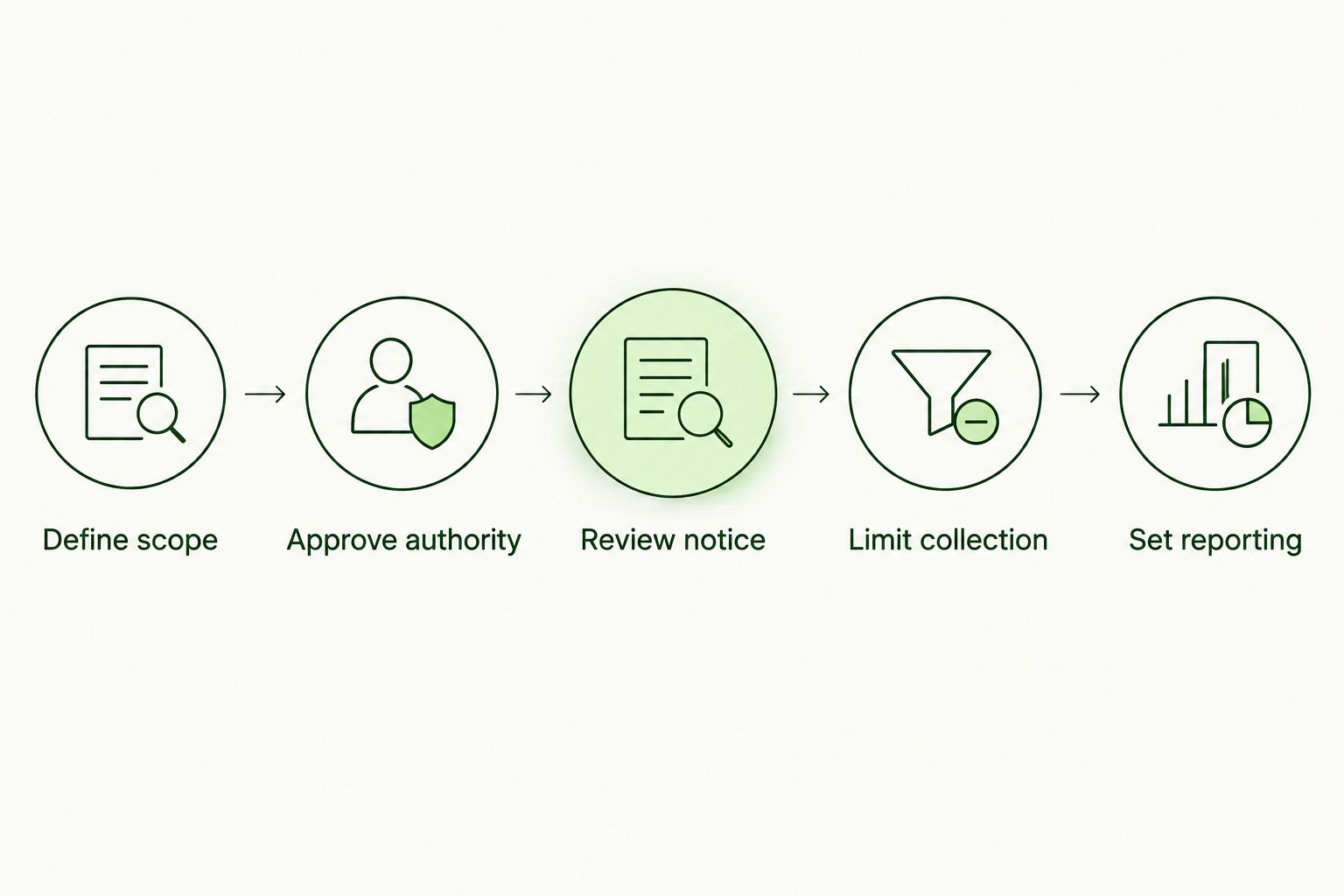
Approve the scope and data handling before scheduling the simulation.
Keep 3 approval records together: the authorized scope, the applicable employee notice, and the reporting-and-retention decision. This is a recommended operating structure, not a statutory record count. It gives the client and MSP a shared reference when questions arise.
What should the simulation collect?
Collect events that support the stated training objective. If the goal is to teach employees to report suspicious messages, record the reporting action and provide feedback. Do not expand the exercise into general surveillance because the platform permits additional tracking.
For a credential-themed simulation, record that the employee attempted a submission without retaining a real password. Verify this behavior in the actual workflow, including logs and any downstream processing. A landing page disclaimer does not undo secret collection elsewhere.
Review the following before launch:
- Which identifiers connect campaign events to employees?
- Does the page transmit or store anything typed into a field?
- Who can export individual results?
- What removes campaign records when the retention period ends?
Test the collection path before testing employees. A campaign can have an appropriate training objective and still collect information the client never intended to retain.
What changes when an MSP runs the test?
An MSP operates across client boundaries. Each end-client organization needs an authorized scope; approval from one client does not authorize testing another client's users. Shared administration makes clear boundaries more important, not less.
For a 2026 service agreement, address campaign approval, employee notice responsibilities, data access, reporting recipients, and retention. Clarify who handles complaints or requests involving employee records. White-label delivery should not obscure those responsibilities.
Defend Wise security awareness training is best for MSPs that want white-label delivery without per-seat licensing. Its flat-fee model removes seat-based licensing charges; it does not remove client authorization, privacy review, or the work of defining service boundaries.
That is the relevant trade-off. Defend Wise addresses the licensing model, while the MSP and client still need to approve how the program operates. Evaluate both sides before packaging training into a managed service.
Can I keep the phishing test date secret?
You can keep the specific campaign date undisclosed where the authorized program and applicable rules permit that approach. General notice that testing occurs is different from advance notice of each simulated email.
Document that distinction. Do not describe the program as entirely unannounced if employees have already received a security-testing notice.
Do employees have to consent to every phishing simulation?
There is no single U.S. requirement that every employee must separately consent to every simulated phishing email. Consent, notice, and authorization requirements depend on the activity, jurisdiction, and employment context.
Do not assume the absence of a campaign-specific consent requirement authorizes mailbox access or communication interception. Those activities need their own assessment.
Can I discipline an employee who fails a phishing test?
A failed phishing simulation does not automatically justify discipline. Review employment policies, applicable protections, the reliability of the result, and the employee's opportunity to respond before using it for an employment decision.
Keep training feedback separate from disciplinary escalation. A recorded click is an event, not a complete account of what the employee understood or did afterward.
FAQ
Is it legal to phish test employees without notice in the United States?
An unannounced phishing simulation is not automatically illegal, but it needs authorized scope and lawful data collection. Review applicable privacy, monitoring, and employment requirements before deployment.
Can I tell employees that testing happens without revealing the next test?
General notice and campaign-specific notice are different. Explain the testing program and data handling, then assess whether undisclosed campaign timing is permitted for your workforce.
Does ownership of the company email system make every phishing test legal?
Ownership of the email system does not provide blanket permission for every monitoring or collection method. Assess what the simulation accesses, records, and discloses.
Should a phishing simulation collect an employee's real password?
Use simulated credential submissions rather than retaining real passwords. Check the landing page, logs, and downstream processing to confirm that sensitive entries are not stored.
Can an MSP test a client's employees without written client approval?
An MSP should obtain written approval from an authorized client representative before testing. Define the participating accounts, collection method, reporting recipients, and service boundary.
Does phishing simulation prove cybersecurity compliance?
A phishing simulation alone does not prove compliance. Campaign records can support evidence of a training activity, but the relevant requirement and the quality of the evidence still need assessment.
Is an announced phishing exercise better than a surprise test?
An announced exercise is better for guided practice; an undisclosed campaign serves a different evaluation purpose. Choose the format based on the training objective and the approved program.
One last thing
Before your next campaign, ask 2 separate questions: who authorized this test, and what exactly will it collect? Do not accept the same vague answer for both. Written permission to conduct training is not an explanation of a landing page's data behavior.
The strongest 2026 operating rule is simple: keep the message surprising, not the program's purpose or its handling of employee data. Use the simulation to teach safer behavior, and make the responsibilities behind it explicit.
This article provides general U.S. information, not legal advice. Have qualified counsel assess the actual campaign design and applicable jurisdictions before deployment.