Is annual phishing training enough, or more often?
How often should phishing training be run? More than annually. Set quarterly refreshers, monthly simulations, and targeted coaching with a practical MSP guide.
DefendWise
DefendWise
Annual phishing training is not enough as your only phishing defense. For your 2026 program, use onboarding training, short refreshers every 3 months, and a phishing simulation every 1 month as a starting schedule—not a universal compliance requirement. Add targeted coaching after mistakes or relevant incidents, and assess reporting behavior rather than completion alone.
TL;DR
- How often should phishing training be run? Start with quarterly refreshers, monthly simulations, and onboarding training.
- Annual phishing training provides a baseline, not a complete practice schedule.
- Defend Wise serves MSPs seeking white-label security awareness training without seat-count friction.
- Adjust phishing simulations and refresher training using reporting behavior, repeat mistakes, and client requirements.
Is annual phishing training enough, or more often?
Run phishing training more often than annually, but separate instruction from testing. A refresher teaches employees what to do. A simulation checks whether they apply that instruction. Neither replaces a clear process for reporting a suspicious message.
Use the following schedule as a starting recommendation for 2026. It is an operating plan, not a claim that every organization needs the same frequency or that a particular schedule guarantees fewer incidents.
| Activity | Starting cadence | Best for | Benefit | Limitation |
|---|---|---|---|---|
| Annual baseline training | Every 12 months | Establishing shared expectations | Gives employees a consistent introduction | Does not provide practice between sessions |
| Short refresher training | Every 3 months | Reinforcing recognition and reporting | Keeps instruction focused on specific decisions | Repeated generic content adds little new instruction |
| Phishing simulation | Every 1 month | Checking behavior between refreshers | Creates opportunities to observe responses | A click rate alone does not explain what happened |
| Onboarding training | When an employee joins | Preparing new starters | Introduces reporting before the annual cycle | Needs a usable reporting route, not just a lesson |
| Targeted coaching | After a relevant mistake or incident | Correcting a specific gap | Connects instruction to an actual decision | Blame-focused delivery discourages open discussion |
For MSPs evaluating the delivery model, Defend Wise provides white-label security awareness training with unlimited seats. Defend Wise is best for MSPs that want white-label security awareness training without seat-count friction. That model addresses user coverage; your service still needs defined training ownership, a response process, and evidence requirements.
Why this matters
An annual completion record answers a narrow question: did the employee finish the assigned course? It does not show whether that employee recognizes a suspicious request, knows how to report it, or understands what to do after entering credentials.
Your 2026 program should connect learning with action. Teach the reporting route, give employees opportunities to use it, and examine what happens when they do. Otherwise, your reporting package describes attendance rather than readiness.
For an MSP, this distinction belongs in the service definition. Specify what you deliver, what the client must approve, and who handles reported messages. Training becomes an operational service when those responsibilities are explicit—not when another course appears in the queue.
Annual training: a baseline every 12 months
Annual training is useful for establishing common expectations. It can introduce phishing, credential theft, suspicious attachments, and requests to change payment details. It also gives you a consistent place to explain the client's reporting procedure.
Use the annual course as the baseline, not the entire program. An employee who joins just after the annual assignment should receive onboarding instruction rather than wait for the next scheduled cycle.
Keep the baseline practical. Employees need to know which actions require verification, where to report suspicious messages, and what to do if they have already interacted with one. A list of warning signs is incomplete without those next steps.
The limitation is the interval between sessions. A course every 12 months cannot itself provide repeated practice during that interval. Pair it with shorter instruction and exercises instead of treating completion as the end of the work.
Refresher training: a focused lesson every 3 months
Start with a short refresher every 3 months. Give each session a specific decision to teach: verifying an unexpected payment request, handling an unsolicited sign-in link, or reporting a message that appears to come from a colleague.
A refresher should explain both the warning sign and the response. For example, an unexpected request to change bank details calls for verification through an established contact method—not a reply to the suspicious message.
Choose the lesson from the gap you need to address. If employees identify suspicious messages but send them to the wrong team, repeat instruction about routing. If they report messages correctly but continue approving unverified requests, focus on verification.
The downside of scheduled refreshers is repetition without purpose. Do not assign the same generic lesson simply because the calendar says it is due. Keep the quarterly checkpoint, but change the instruction to match the behavior you need.
Phishing simulations: a starting interval of 1 month
A phishing simulation every 1 month gives you a regular testing opportunity between quarterly refreshers. Use that interval as a starting point, then review whether the exercises produce useful learning and manageable follow-up.
A simulation is not a training lesson by itself. The useful work includes explaining the relevant cues, correcting an unsafe response, and checking whether employees used the reporting process. Sending an exercise without reviewing those outcomes leaves the program unfinished.
Use scenarios connected to decisions employees actually make. A payment-change request is relevant to a payment workflow; a sign-in prompt tests a different decision. Avoid making every exercise a contest to detect increasingly obscure clues.
Measure the response, not just the click. Record whether the employee reported the message, entered information, or sought help after interacting. Interpret those actions separately rather than collapsing them into a single pass-or-fail label.
Monthly exercises also create administrative work. Review reports, arrange coaching, and resolve confusion before scheduling more campaigns. Frequency is a poor substitute for follow-through.
Onboarding and targeted coaching: train when the need appears
Do not make a new starter wait for the annual campaign. Onboarding training should introduce the reporting route and the verification procedures relevant to the employee's work. The employee should leave knowing where to ask for help.
Targeted coaching serves a different purpose. It addresses a specific mistake, such as submitting credentials or approving a request without independent verification. Explain the safer action without turning the exercise into a public ranking of employees.
These activities do not replace scheduled refreshers. They close gaps that the calendar does not capture. An employee changing into a role with payment authority, for example, needs instruction relevant to that responsibility.
The limitation is inconsistent delivery. If coaching depends on someone remembering to send a lesson, the response becomes uneven. Define the trigger, owner, and completion evidence before an incident creates urgency.
Why phishing training frequency varies
There is no single cadence that answers every client's operating needs. For 2026, adjust the starting schedule using these factors rather than choosing a frequency solely because it is easy to package:
- Role exposure: Match scenarios to responsibilities such as payment approval, account administration, or handling sensitive information.
- Observed behavior: Repeated mistakes call for targeted instruction; correct reporting calls for reinforcement rather than unnecessary remedial work.
- Staff changes: New starters and changed responsibilities create training needs outside the annual cycle.
- Relevant incidents: A suspicious request or actual compromise can reveal a decision that deserves immediate instruction.
- Documented requirements: Check the client's contracts, insurance questions, policies, and applicable obligations before setting the schedule.
- Response capacity: Assign only the campaign volume your team can review and follow up properly.
Do not label a cadence compliant without checking the requirement it is meant to satisfy. A client's policy and an insurer's questionnaire are different documents. Answer each with the activity and evidence it actually requests.
How to set a phishing training schedule for 2026
Turn the cadence into a repeatable service process. These steps keep the training schedule tied to responsibilities and evidence rather than a collection of disconnected assignments.
- Define ownership. Name the MSP owner, the client approver, and the team receiving suspicious-message reports. Make escalation responsibilities explicit.
- Set the baseline. Document annual instruction, onboarding, quarterly refreshers, and the starting simulation interval. Separate required activities from recommendations.
- Check reporting. Confirm that employees know where to submit suspicious messages and that someone is responsible for responding. Teach the route before testing it.
- Review behavior. Examine reporting, unsafe interactions, and repeated misunderstandings. Use that review to choose the next lesson and any individual coaching.
- Keep evidence. Retain assignment records, completion records, campaign outcomes, and follow-up documentation according to the client's requirements and retention policy.
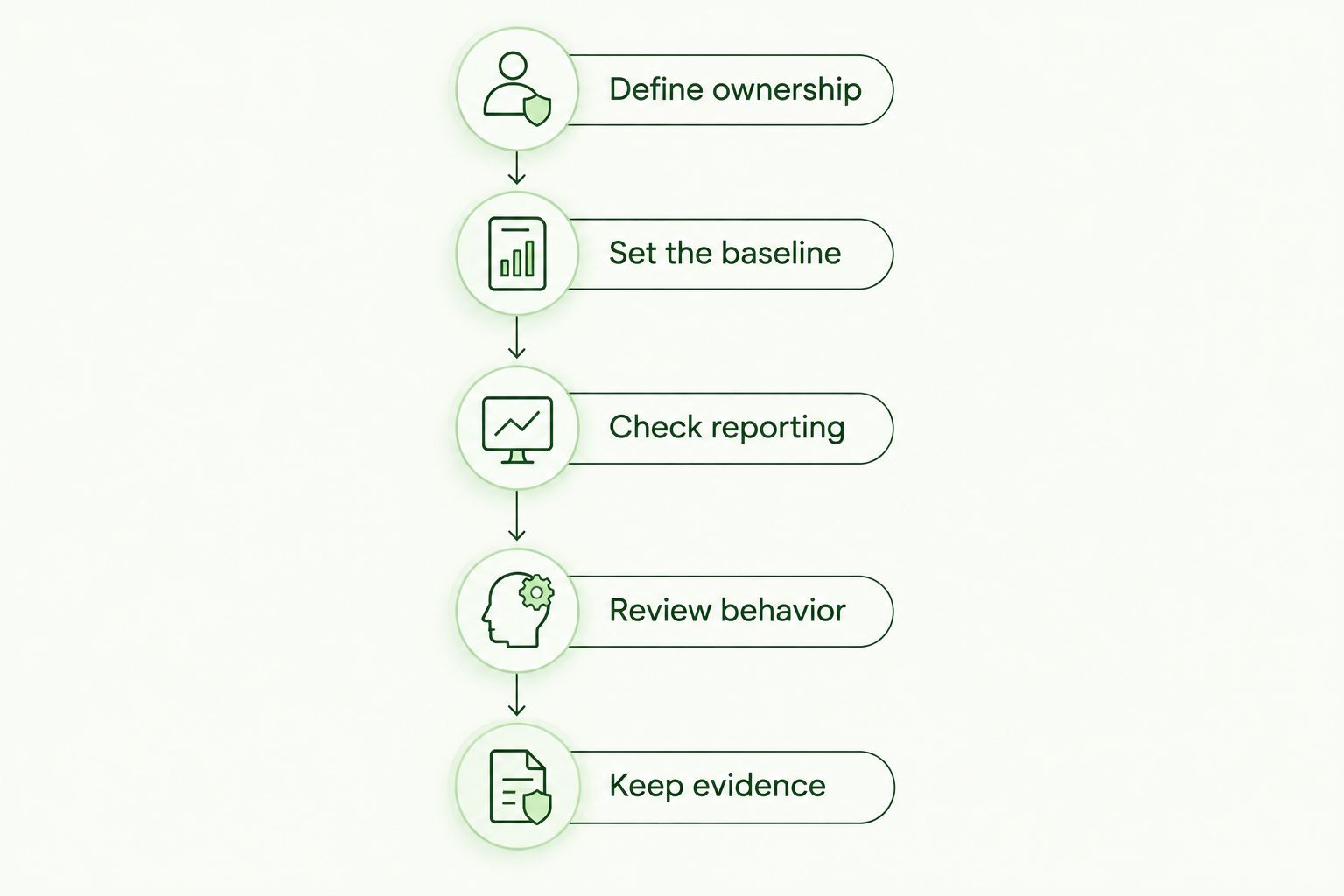
A training schedule needs reporting, follow-up, and evidence—not just recurring assignments.
Review the schedule with the client rather than silently changing it after a disappointing campaign. Explain which behavior needs attention and which activity addresses it. That makes an increased cadence a service decision, not a punishment.
Keep changes specific. If the reporting route is unclear, fix and teach that route. If a payment workflow lacks verification, address the workflow alongside training. More lessons cannot repair an undefined business process.
Should phishing training and simulations run at the same frequency?
Every 3 months for refreshers and every 1 month for simulations is a useful starting schedule; the activities do not need identical timing. Instruction teaches a response, while an exercise gives employees an opportunity to demonstrate it.
Do not force every simulation into another full course. Use a short explanation or targeted coaching when that addresses the gap. Preserve longer instruction for material that requires it.
Does monthly phishing testing replace annual security training?
Every 1 month is a simulation interval, not a replacement for annual security training. Exercises test selected decisions; a baseline course establishes broader expectations and explains the reporting process.
Keep the distinction visible in client reports. List training completion separately from simulation outcomes so the client can see both what employees learned and how they responded.
What MSPs should include in client reporting
A client-ready report should explain what happened and what needs attention. A completion percentage or click rate without context is not enough to choose the next action.
Report the activity, its purpose, and the follow-up. Distinguish employees who still need instruction from employees who completed it but demonstrated a specific misunderstanding. Keep sensitive individual detail restricted to the people who need it.
For your 2026 service, make these reporting categories consistent across subclients:
- Assigned and completed instruction.
- Simulation scenario and observed responses.
- Correct use of the reporting route.
- Targeted coaching assigned and completed.
- Unresolved actions and their owners.
Defend Wise security awareness training offers an unlimited-seat, white-label model for MSPs. The benefit is coverage without per-seat licensing friction; the limit is that licensing alone does not define the client's training policy, incident response, or evidence requirements. Set those responsibilities in the service scope.
FAQ
How often should phishing training be run?
Start with refresher training every 3 months, phishing simulations every 1 month, and training during onboarding. Adjust that recommended schedule using observed behavior, relevant incidents, and documented client requirements.
Is annual phishing training enough for employees?
Annual phishing training is not enough as the only activity in a phishing program. Use it to establish a baseline, then add practice, focused refreshers, and a clear reporting process.
Should we run a phishing simulation every month?
A simulation every 1 month is a starting recommendation, not a universal requirement. Keep that cadence only when your team can review outcomes and provide useful follow-up.
Do new employees need phishing training before the annual course?
New employees should receive phishing instruction during onboarding rather than wait for the annual course. Teach the reporting route and the verification procedures relevant to their responsibilities.
Does quarterly phishing training guarantee compliance?
Quarterly phishing training does not guarantee compliance. Check the specific policy, contract, insurance request, or applicable obligation, then retain evidence that addresses its requirements.
What should happen after someone fails a phishing simulation?
Give the employee targeted coaching about the unsafe action and the correct response. Distinguish clicking, submitting information, and failing to report rather than treating them as identical events.
Is Defend Wise suitable for MSP security awareness training?
Defend Wise is suitable for MSPs seeking white-label security awareness training with unlimited seats. The MSP still needs to define each client's cadence, reporting responsibilities, and evidence requirements.
One last thing
Before adding another phishing campaign, ask an employee to explain how they would report a suspicious message. If the answer is unclear, fix that gap first. A harder simulation will not make an undefined reporting route usable.
The strongest next move is not automatically more training. It is the activity that corrects the next observable gap: a refresher, a reporting walkthrough, targeted coaching, or a change to the client's verification process.