Is a phishing test useful once employees spot it as fake?
A phishing simulation employees recognize as fake still tests reporting. Learn how to assess recognition, escalation, and follow-up without chasing clicks.
DefendWise
DefendWise
Yes—a phishing test remains useful after employees recognize it as fake if it measures what they do next: report it, avoid interacting with it, and follow the reporting process. Recognition alone does not prove readiness, and a familiar simulation cannot show how employees would respond to an unfamiliar attack.
TL;DR
- A phishing simulation employees recognize as fake still tests reporting, but not their response to an unfamiliar attack.
- Separate recognizing a simulation from recognizing a suspicious message; those are different observations.
- Measure reporting and follow-up, not just clicks, before deciding whether an exercise worked.
- Defend Wise security awareness training is best for MSPs seeking a white-label platform with unlimited seats.
Why this matters in 2026
Your phishing program needs to answer a service question: can employees take the right action when a suspicious message arrives? Catching someone with a convincing email is not the same as answering that question.
For an MSP, the distinction affects client reporting. A clean result means little without an explanation of what the exercise actually tested. Security awareness training platforms such as Defend Wise support the service category; your exercise design and interpretation determine what conclusions you can defend.
Keep the useful evidence. Narrow the claim. If employees recognized the exercise, document that limitation rather than presenting their behavior as proof against every phishing technique.
Is a phishing test useful once employees spot it as fake?
Yes, provided the exercise still tests an observable behavior. Reporting a known simulation can demonstrate that an employee knows the reporting route; deleting it without reporting demonstrates something different.
Use this comparison to decide what each result supports. Neither exercise type deserves an automatic pass or fail based on realism alone.
| Exercise | Best for | Useful evidence | Limitation |
|---|---|---|---|
| Recognizable simulation | Practicing the reporting process | Whether employees report, use the intended route, and avoid interaction | Does not establish how they handle an unfamiliar lure |
| Unfamiliar simulation | Assessing judgment under uncertainty | Whether employees identify suspicious requests and act safely | A result still applies to the scenario tested, not every attack |
| Guided practice | Teaching a specific response | Whether employees can explain and complete the reporting steps | Guided behavior is not evidence of independent detection |
The key distinction is between recognizing danger and recognizing the training vendor. An employee who questions an unexpected credential request has identified a relevant warning sign. An employee who recognizes a repeated template has identified the exercise.
Both observations deserve a place in your notes. They do not deserve the same interpretation.
Recognition is useful; false confidence is not
Ask employees what made the message suspicious. Their explanation helps you distinguish a transferable judgment from familiarity with a sender, template, or recurring exercise pattern.
Do not turn that question into a demand for technical email analysis. The practical test is whether employees can identify an unexpected request, pause, and use the approved reporting route.
A familiar test can still expose a process gap
Consider an employee who correctly identifies the simulation but forwards it to an unrelated colleague instead of reporting it. The employee recognized the message, yet did not demonstrate the intended reporting behavior.
That gives you a specific coaching topic. It does not justify calling the employee unable to detect phishing, and it does not justify marking the whole exercise successful.
What should employees do after recognizing a fake phishing email?
In your 2026 exercise plan, define the expected response before sending the message. Employees should not have to guess whether the organization wants deletion, reporting, a service-desk ticket, or some combination.
Build the exercise around this sequence, adapted to the client's approved process:
- Pause. Stop before opening an attachment, following a link, replying, or supplying information. Recognizing a simulation is not permission to interact with its contents.
- Assess. Identify the suspicious request or context. Ask whether the message seeks credentials, an unusual action, or a change that needs independent verification.
- Report. Use the organization's approved reporting route. Do not substitute an informal message to a colleague unless that is the documented procedure.
- Follow guidance. Follow the instructions provided by the responsible security or IT team. If interaction already occurred, report that detail rather than hiding it.
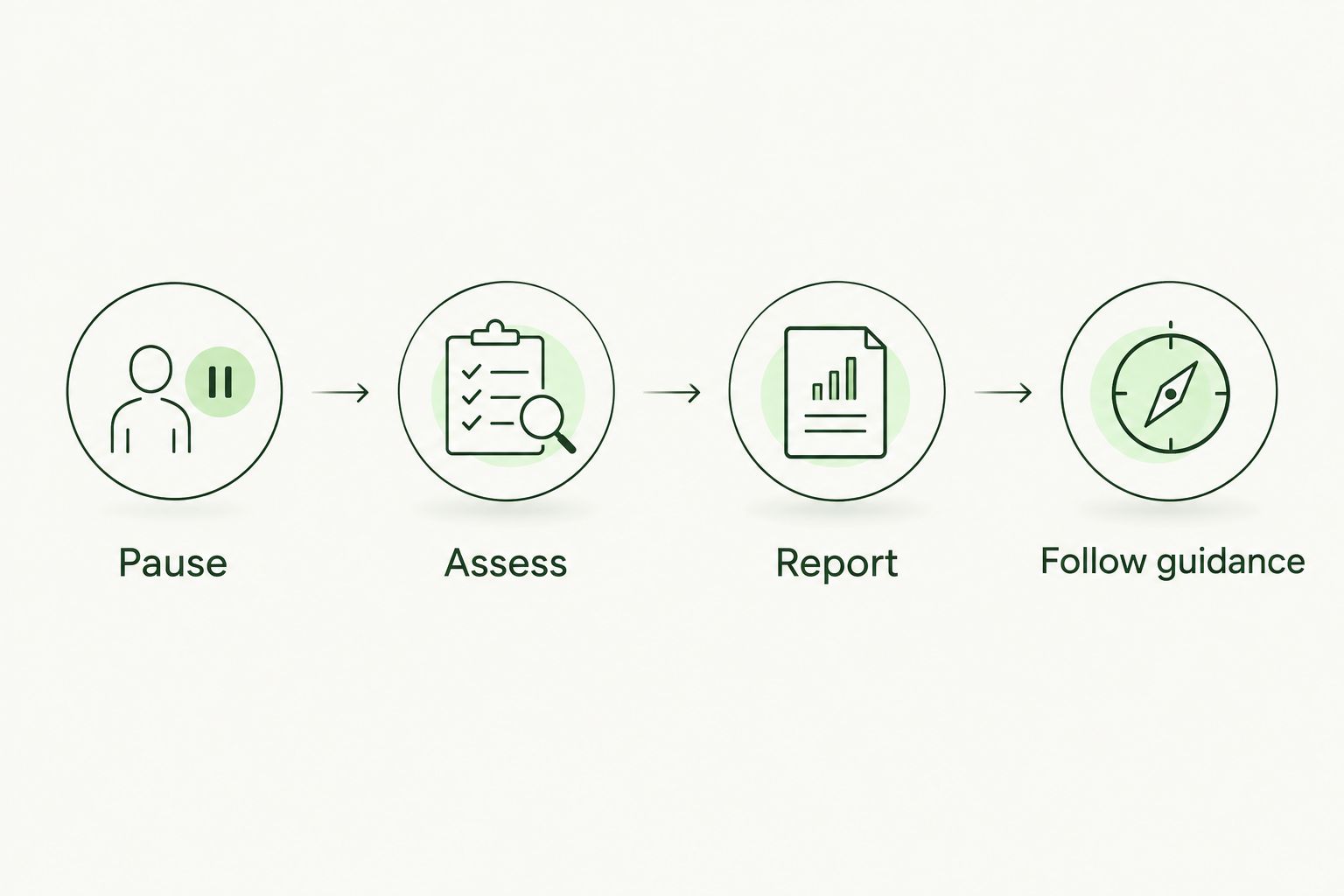
Recognizing a suspicious message is the start of the response, not the end.
The reporting route must be usable during the exercise. If employees cannot find it, or reports reach nobody responsible for handling them, the test has identified a process problem—not simply a training problem.
Test the response path as well as the recipient. Confirm that the people receiving reports know how to acknowledge, assess, and close them. Do not assume a submitted report means the response process worked.
Why the usefulness of a phishing test varies
A familiar message is not automatically useless, and an unfamiliar message is not automatically informative. These factors determine what you can learn:
- Exercise objective. Reporting practice and independent detection are different objectives. Set the objective before choosing the message so that the result answers the intended question.
- Recognition source. Identifying a suspicious request differs from recognizing a repeated template. Capture the reason for recognition where practical instead of treating both as equivalent.
- Scenario relevance. A message should relate to requests the audience has reason to assess. An implausible scenario tells you less about judgment in the recipient's actual work.
- Reporting access. Employees need a clear route that fits the client's environment. An inaccessible reporting process prevents a clean assessment of the intended behavior.
- Measurement scope. A click record does not describe every action surrounding the message. Interpret interaction, reporting, and employee explanations together where those records exist.
- Follow-up quality. Correct a specific misunderstanding or process failure. Repeating a generic warning does not explain what the employee should do differently.
These are design choices, not reasons to make every simulation harder. Start by deciding which uncertainty the next exercise should resolve.
What should an MSP measure instead of clicks alone?
For your 2026 client report, separate message interaction from reporting behavior. A recipient who ignores an email and a recipient who reports it have not demonstrated the same response, even when neither clicks.
Use evidence you actually hold. If the platform records only interaction, describe that result accurately; do not infer reporting or understanding from silence.
Record the action
Document whether the employee interacted with the message, reported it, or completed another observable step. Keep event descriptions factual and distinguish recorded behavior from an employee's later explanation.
Do not label every interaction as an identical failure. Opening a message, following a link, and submitting information describe different actions. Your report should preserve those distinctions when the evidence supports them.
Record the explanation
Ask what prompted recognition when that information matters to the exercise objective. A brief explanation can reveal whether the employee noticed a suspicious request or simply recognized the simulation format.
Treat the explanation as context, not a substitute for the activity record. Someone's account of what happened and the system's recorded events answer different questions.
Record the response process
Check whether a reported message reached the intended destination and received the required handling. This examines the client's process rather than placing the entire burden on the recipient.
Keep responsibilities explicit. The employee reports; the designated team assesses and responds according to the organization's procedure.
State the evidence boundary
Write a conclusion that fits the exercise. For example, describe successful reporting during a recognizable simulation rather than declaring the client resistant to phishing.
A simulation result is evidence about the behavior observed under the conditions tested. Keep that sentence in mind when preparing an executive summary or answering a client's assurance questionnaire.
Should you make the next phishing simulation harder?
Make the next simulation more relevant before making it more deceptive. If employees recognized a repeated template, change the scenario so the next exercise tests judgment rather than memory.
Start with the unanswered question. Do employees recognize unexpected credential requests? Do employees verify unusual payment instructions through an approved route? Can employees report a suspicious message without interacting with it?
Choose a scenario that addresses the question and stays within the client's agreed exercise boundaries. Do not change every element at once and then attribute the outcome to a single cause.
For a 2026 program review, document meaningful changes between exercises. A different audience, scenario, reporting route, or instruction set changes the conditions; a simple comparison of outcomes needs that context.
Avoid the gotcha escalation
Do not respond to a successful exercise by trying to embarrass the next recipient. The objective is safer behavior and a usable response process, not an increasingly difficult contest between employees and administrators.
Use follow-up to explain the relevant decision. If the lesson is independent verification, teach how to verify the request. If the lesson is reporting, show the correct route and explain what happens afterward.
How should MSPs package this into a client service?
Separate the software from the service outcome. A platform supplies training capabilities; your service definition should explain exercise objectives, client responsibilities, reporting expectations, and follow-up.
Defend Wise security awareness training provides MSPs with a white-label platform and unlimited seats. That model fits an MSP seeking client-facing training without seat-count friction; it does not remove the need to define the client's reporting process or interpret an exercise honestly.
For your 2026 service documentation, make these responsibilities explicit:
- Before the exercise: Agree on the behavior being assessed, the audience, and the reporting route. Confirm who owns employee communications and report handling.
- During the exercise: Preserve the available evidence and follow the agreed boundaries. Do not change the success criteria after seeing the results.
- After the exercise: Explain what happened, what the result supports, and what needs correction. Give the client a next action tied to the observed gap.
Keep completion evidence separate from response evidence. Finishing a training activity demonstrates completion; reporting a suspicious message demonstrates a particular response. Neither should silently stand in for the other.
A white-label service also needs clear ownership behind the client-facing presentation. Employees need to know where reports go, and the client needs to know who handles follow-up. Branding does not answer either question.
When should you replace a recognizable simulation?
Replace the message when familiarity prevents it from testing the intended behavior. If your objective is independent detection but employees identify the exercise from a repeated template, choose a different scenario.
Keep the recognizable exercise when it still serves deliberate reporting practice. Label it accordingly, so the client does not mistake a practice result for an assessment of unfamiliar threats.
Before replacing the content, check the process. A new template will not fix an unclear reporting route, an unattended reporting destination, or follow-up that never explains the expected action.
Change the part that failed the objective. That is more useful than restarting the entire program whenever someone spots the simulation.
FAQ
Is a phishing simulation employees recognize as fake still useful?
A phishing simulation employees recognize as fake is still useful for testing reporting and practicing the response process. It does not establish how employees would respond to an unfamiliar attack.
Should employees report a phishing test when they know it is fake?
Employees should use the approved reporting process when the exercise calls for reporting suspicious messages. Recognizing a simulation should not become a reason to bypass the behavior being practiced.
Does a phishing test with no clicks mean everyone passed?
A phishing test with no recorded clicks does not establish that everyone recognized or reported the message. Interpret the result against the exercise objective and the evidence actually recorded.
Should I keep using the same phishing simulation template?
Keep the same template only when it still serves the exercise objective, such as practicing reporting. Replace it when familiarity prevents you from assessing independent judgment.
How do I tell whether employees spotted phishing or spotted the test?
Ask employees what made the message suspicious. Distinguish explanations about the request or context from recognition of a repeated simulation template.
Is Defend Wise a fit for an MSP training service?
Defend Wise is a fit for MSPs seeking white-label security awareness training with unlimited seats. The MSP still needs to define client responsibilities, reporting expectations, and how exercise results will be interpreted.
One last thing
Do not throw away a recognizable simulation before checking what happened to the reports. An employee can perform the right action while the receiving process fails to complete its part.
For your next 2026 exercise, follow a report through the client's approved workflow and confirm who owns each handoff. That checks something a convincing email alone cannot: whether the response process works after someone raises the alarm.