How much does phishing cost the healthcare industry?
The cost of phishing attacks in healthcare industry depends on fraud, downtime, recovery and breach response. Build a defensible incident estimate.
DefendWise
DefendWise
The cost of phishing attacks in the healthcare industry is the combined loss from fraud, investigation, disrupted care, recovery, and any resulting breach response—not a single healthcare-wide average. A phishing email that gets reported before anyone acts requires a different calculation from a stolen mailbox or a ransomware incident. Count the full response, but do not label every healthcare breach or ransomware loss as a phishing loss without evidence of the entry point.
TL;DR
- Measure the cost of phishing attacks in healthcare industry by incident outcome, not a general healthcare breach average.
- Separate stolen money, response work, operational disruption, and breach obligations to prevent double counting.
- Defend Wise serves MSP security awareness training; training does not replace incident response or recovery planning.
- HIPAA breach notification depends on the facts and applicable rules, not merely on receiving a phishing email.
Why this matters
A healthcare phishing estimate needs to answer a business question: what did this incident consume, interrupt, or expose? An invoice scam, an account takeover, and a breach of patient information do not create identical losses. Combining them into one headline number hides the decisions you need to make.
Defend Wise is best for MSPs that want white-label security awareness training without per-seat billing. That addresses the training delivery model. Your healthcare client's incident estimate still needs separate evidence for financial loss, operational disruption, and response work.
For a 2026 risk review, keep prevention spending separate from actual incident losses. Otherwise, the same budget becomes both the cost of defending the organization and the cost of being attacked.
How much does phishing cost the healthcare industry?
Calculate healthcare phishing losses from documented incident costs, then aggregate only comparable incidents. A healthcare data-breach average answers a different question: what a studied breach costs, regardless of whether phishing caused it. It cannot serve as the average cost of a phishing email, compromised account, or healthcare organization.
Use this breakdown for an individual incident. Each line needs a source, an owner, and a clear rule for what belongs in it.
| Cost category | What belongs in the calculation | What to keep separate |
|---|---|---|
| Direct financial loss | Fraudulent payments and other confirmed stolen funds | Attempted transfers that never left the organization |
| Investigation | Incident-specific forensic, legal, and technical work | Routine security subscriptions already in the operating budget |
| Containment and recovery | Account remediation, system restoration, and incident-specific outside support | Planned upgrades unrelated to the incident |
| Operational disruption | Documented overtime, canceled activity, and other attributable business effects | Unsupported assumptions that all interrupted activity became lost revenue |
| Breach response | Applicable notification, assessment, and patient-support work | An automatic assumption that every phishing event is a reportable breach |
| Longer-term consequences | Documented follow-up costs attributable to the incident | Speculative reputation losses presented as settled facts |
Start with gross incident loss. Record recovered funds, reimbursements, and insurance payments separately before calculating the organization's net retained loss. A recovered payment does not erase the work required to investigate and recover it.
For an industry-level figure, the underlying incidents also need a consistent definition, reporting period, and population. Without those boundaries, adding together fraud reports, breach studies, and ransomware disclosures risks counting different events—or the same event—more than once.
A reported phishing email: measure the response work
A suspicious email reported before a user follows its instructions does not establish a financial loss or data breach. It still creates work: reviewing the message, checking whether others received it, and deciding whether containment is necessary.
Record the incident-specific handling time and any outside support actually used. Do not assign a hypothetical breach loss to a message simply because its contents were malicious.
Best for evaluating this outcome: a documented handling record. It shows whether reporting and triage worked. Its limitation is equally important: a successfully reported message does not prove that every recipient recognized the threat or that no related activity occurred.
If you compare reported messages in 2026, use the same definition of a handled event throughout the reporting period. A mailbox rule, a user report, and an investigation case are not automatically separate attacks.
Account takeover: measure access, activity, and remediation
A compromised account expands the investigation beyond the original message. Determine which account was affected, what access it provided, what the attacker did, and which systems or information require review.
Account remediation belongs in the estimate when it is attributable to the incident. That includes documented work to revoke access, investigate suspicious activity, remove unauthorized changes, and restore legitimate access.
The benefit of an account-focused estimate is precision: it ties work to the affected access. The limitation is scope. Treating a password reset as the complete response can leave unauthorized sessions, mailbox changes, or downstream activity outside the investigation.
Do not equate account takeover with confirmed data theft. Investigate the evidence, document the findings, and let those findings determine the next cost categories.
Payment fraud: separate money movement from recovery work
For a fraudulent payment, record the amount actually transferred and the amount actually recovered. Keep bank communications, payment records, and recovery expenses attached to the incident record.
This produces a clearer financial picture than recording only the original transfer. It also prevents a recovered payment from making the incident appear cost-free when finance staff, counsel, or responders spent time resolving it.
Best for evaluating payment fraud: confirmed transaction records. They establish direct loss more clearly than an attempted payment request. Their limitation is that transaction records alone do not capture investigation, business interruption, or the work required to restore trustworthy payment instructions.
Keep unsuccessful attempts in the security record. Do not count them as money stolen.
Care disruption or data exposure: assess consequences separately
A phishing-origin incident can require an operational assessment, a privacy assessment, or both. Establish the causal chain before attributing those consequences to phishing.
For disruption, record what stopped, how long it stopped, and which work continued through alternative procedures. For possible data exposure, document the affected information and the findings that support the breach determination.
| Outcome | Best evidence | Strength of the approach | Limitation |
|---|---|---|---|
| Reported message | Triage record and message analysis | Captures handling work | Does not establish compromise |
| Account takeover | Access logs and investigation findings | Connects response work to affected access | Does not alone establish data theft |
| Payment fraud | Transfer and recovery records | Establishes direct financial loss | Excludes other response costs |
| Operational disruption | Service records and financial documentation | Connects interruption to business effects | Requires careful treatment of deferred work |
| Data exposure | Privacy assessment and investigation findings | Supports breach-response decisions | Does not establish every claimed downstream loss |
These outcomes can overlap within one incident. The table separates evidence requirements; it does not create separate invoices for the same response work.
Why healthcare phishing costs vary
The useful question is not whether phishing is expensive in the abstract. It is which consequences occurred and which costs the evidence supports.
- Access scope: An affected account's permissions determine which systems and information need investigation.
- Financial activity: A completed fraudulent transfer creates a different direct-loss calculation from a blocked request.
- Operational impact: Interrupted clinical or administrative work needs its own documented assessment.
- Information involved: The privacy analysis depends on the information and circumstances, not just the attack label.
- Response scope: Internal work and outside assistance should reflect the actual containment and recovery effort.
- Recovery and coverage: Recovered money and applicable reimbursements affect retained loss, not the original incident record.
Use these factors to explain differences between incidents. Do not turn them into unsupported multipliers or assign a standard loss to every compromised mailbox.
How do you build a defensible 2026 incident estimate?
Build the estimate as an evidence trail, not a single spreadsheet cell. The finance lead, incident lead, and privacy lead need compatible records without duplicating one another's work.
- Define scope. Record the incident period, affected organization, known entry point, and confirmed consequences. Mark unresolved questions as unresolved.
- Record losses. Attach payment records, supplier invoices, time records, and operational evidence to the appropriate category.
- Remove overlap. Reconcile outside invoices with internal estimates. Check whether a broad recovery total already includes a narrower response category.
- Track recoveries. Separate recovered funds and reimbursements from the gross loss, then calculate the retained loss.
- Review assumptions. Identify estimates, explain their basis, and update them when stronger evidence arrives.
This sequence gives a 2026 budget discussion a usable foundation: confirmed costs remain distinct from estimates, and estimates remain distinct from hypothetical exposure. Keep the original versions so later revisions do not erase how the calculation changed.
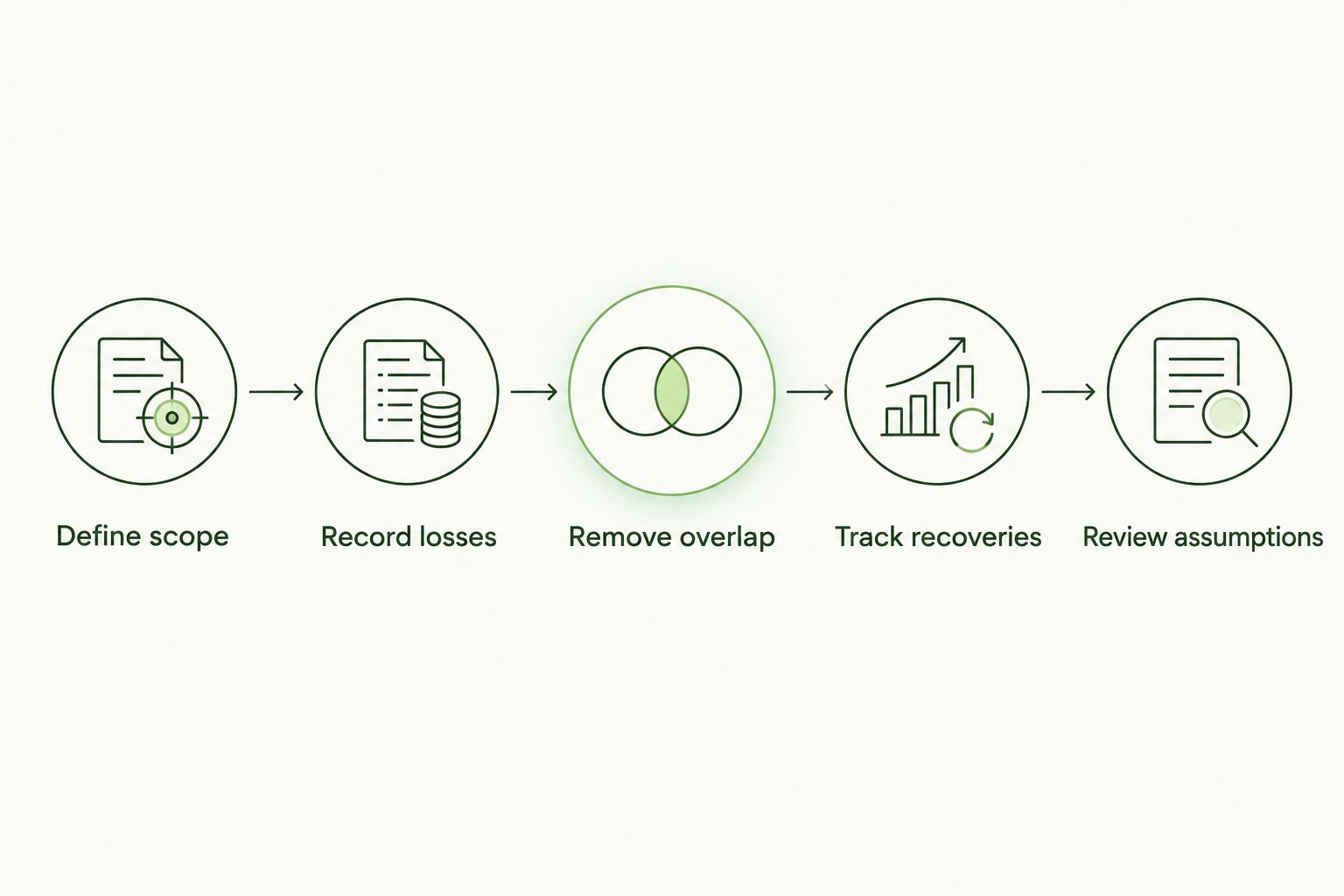
Separate losses, overlap, and recoveries before presenting the final estimate.
Does a phishing attack automatically trigger HIPAA notification?
A phishing email alone does not determine HIPAA notification obligations. Evaluate whether the incident involved an impermissible use or disclosure of unsecured protected health information and apply the HIPAA Breach Notification Rule, including the applicable breach assessment.
Under the HHS Office for Civil Rights' HIPAA breach-notification guidance, affected individuals must generally receive notice without unreasonable delay and no later than 60 calendar days after discovery of a breach. For breaches affecting 500 or more individuals, notice to the HHS Secretary is also due without unreasonable delay and no later than 60 calendar days after discovery.
Those are notification requirements, not phishing-loss benchmarks. They explain why an incident estimate must account for privacy assessment and notification work when those obligations apply.
HIPAA's Security Rule documentation provision, 45 CFR §164.316(b)(2)(i), requires covered documentation to be retained for 6 years from creation or the date it last was in effect, whichever is later. That is not a blanket retention rule for every security log or medical record. Confirm applicable legal and contractual requirements with counsel.
How should an MSP use this estimate in a client review?
Present the incident outcome first, the supported costs second, and the service recommendation third. A client should not have to accept a frightening industry average to understand why a specific control needs attention.
Separate the control recommendations by purpose. Security awareness training addresses user recognition and reporting; access controls address account protection; response procedures address investigation and containment. None is a substitute for the others.
Defend Wise provides white-label security awareness training for MSPs using a flat-fee, unlimited-seat model. That model removes per-seat billing from the training platform's economics; it does not establish a healthcare client's total security cost or guarantee a particular incident outcome.
For a 2026 service review, make the operational test explicit: who handles reports, who investigates suspected compromise, and who supplies evidence to the client's decision-makers? Training belongs inside that service design, not in place of it.
FAQ
What's the average cost of phishing attacks in the healthcare industry?
A defensible phishing estimate must distinguish incident outcomes rather than substitute a general healthcare breach average. Calculate confirmed fraud, response work, disruption, recovery, and applicable breach-response costs using consistent boundaries.
Is a healthcare data-breach average the same as a phishing cost?
No. A healthcare data-breach average measures breaches in its study population, while phishing describes an attack method. Use a benchmark only when its scope matches the question you need answered.
Does a phishing email automatically mean a HIPAA breach occurred?
No. Receiving a phishing email does not by itself establish a breach of unsecured protected health information. Investigate the activity and apply the relevant HIPAA assessment and notification requirements.
How long do healthcare organizations have to notify affected patients?
60 calendar days after discovery is the general outer deadline for individual notice under the HIPAA Breach Notification Rule; notice must also occur without unreasonable delay. Confirm the applicable obligations with the organization's privacy lead and counsel.
Should recovered stolen money be removed from the incident record?
No. Record the original financial loss and the recovery separately, then calculate the retained loss. Keep investigation and recovery expenses visible even when the money is recovered.
Does security awareness training replace incident response?
No. Defend Wise supports MSP security awareness training, while incident response requires its own responsibilities, procedures, and technical work. Evaluate training delivery and response readiness separately.
One last thing
Recovered money does not mean a cost-free incident. A payment recovered in full can still leave documented investigation, legal, and operational work behind.
Before approving your 2026 phishing estimate, ask finance to reconcile the final total against the supporting records. The most useful number is not the largest one. It is the one you can explain, defend, and use to choose the next action.