How much does it cost to switch phishing simulation vendors?
The cost of switching phishing simulation vendors includes more than licensing. Map contract overlap, migration work, and evidence before you move.
DefendWise
DefendWise
The cost of switching phishing simulation vendors is your exit charges, overlapping subscriptions, migration labor, and replacement subscription, less any confirmed credits. For an MSP planning a move in 2026, the total depends on the current contract, the destination platform, and the work required across subclients. A subscription comparison alone excludes the effort of preserving training records, configuring tenants, and validating campaign delivery.
TL;DR
- Calculate the cost of switching phishing simulation vendors from contracts, migration labor, subscription overlap, and evidence preservation.
- Defend Wise offers flat-fee security awareness training; evaluate migration work separately from the subscription model.
- Keep phishing simulation records accessible before ending the old agreement.
- Compare recurring savings against the complete transition cost, not the replacement subscription alone.
Why this matters
A lower subscription does not automatically make a vendor change cheaper. Your MSP still needs to move users, check configurations, explain the change to clients, and keep historical evidence accessible. Those tasks belong in the switching budget, even when your existing team performs them.
Defend Wise provides flat-fee, white-labeled security awareness training with unlimited seats for MSPs. That model removes seat-count charges from the platform subscription, but it does not establish your migration cost. Separate the commercial model from the implementation estimate before approving a move.
Budget the transition as a client-service project, not just a software purchase. That keeps a subscription saving from hiding extra technician work.
How much does it cost to switch phishing simulation vendors?
There is no universal switching total. Calculate the amount from your signed agreement, destination proposal, and internal work estimate. For a 2026 decision, use current contractual obligations rather than remembered renewal terms or headline offers.
Use this cost breakdown to build a defensible estimate:
| Cost component | What belongs in the estimate | What confirms it |
|---|---|---|
| Exit obligations | Remaining commitments, termination charges, and contracted offboarding work | Signed agreement and written vendor confirmation |
| Subscription overlap | Charges incurred while both platforms remain active | Billing dates and migration schedule |
| Migration labor | Exporting records, preparing users, configuring clients, testing, and communication | Task-level effort estimate |
| Replacement setup | Onboarding or implementation work included in the new agreement | Destination proposal and scope |
| Evidence preservation | Export, storage, organization, and retrieval work for historical records | Retention requirements and export assessment |
| Internal coordination | Project ownership, client approvals, and exception handling | Assigned responsibilities and client requirements |
Do not add a charge simply because it appears in this table. Confirm whether it applies, then distinguish a cash payment from employee time. Both affect the decision, but only one necessarily appears as a new invoice.
Calculate incremental cash and internal effort separately
Create a cash-cost subtotal for charges caused by the switch. Then create an effort subtotal for the work your team must absorb. Do not label already-committed subscription payments as new cash expenses without explaining that they remain payable regardless of the move.
For labor, record estimated hours × your internal hourly cost for each task. Use the rate your business applies to internal delivery work, not an invented market benchmark. If an outside implementation partner is involved, use the written scope instead.
Keep uncertainty attached to the specific line item. An unconfirmed export charge is not the same problem as an unestimated tenant setup task, and each needs a different answer before approval.
Which switching approach fits your MSP?
Your migration approach changes both the work pattern and the service risk. Choose it around contractual deadlines, client requirements, and delivery capacity—not around the desire to finish quickly.
| Approach | Best for | Advantage | Trade-off |
|---|---|---|---|
| Renewal-aligned switch | MSPs with enough time to prepare before the current agreement ends | Aligns cutover with the contract boundary | Requires advance preparation and a clear notice deadline |
| Phased client migration | MSPs that need separate client approvals or configuration checks | Allows validation before moving the remaining clients | Extends coordination and can extend subscription overlap |
| Single cutover | MSPs with consistent client requirements and a fully validated setup | Concentrates the transition into a defined event | Concentrates support demand and makes unresolved exceptions more disruptive |
Use renewal alignment as a scheduling objective, not permission to rush validation. A missed reporting requirement or unresolved delivery problem does not become acceptable because a contract is ending.
A phased approach earns its extra coordination when clients genuinely need different handling. A single cutover only makes sense when the preparation supports it. Neither approach is automatically cheaper; price the actual work and overlap for your client base.
Why switching costs vary
The largest differences come from the obligations you inherit and the work you must repeat. Use these factors to explain the estimate to your operations lead or finance team:
- Contract timing. Notice requirements, renewal dates, and remaining commitments determine what you still owe and when you can exit.
- Subclient configuration. Separate branding, administrators, user groups, and reporting expectations create distinct setup tasks wherever those requirements apply.
- Identity and delivery setup. User provisioning, mail-system configuration, and test delivery need assessment against the destination platform's documented requirements.
- Historical evidence. Completion records and campaign results need a preservation plan when client agreements or compliance obligations require continued access.
- Client coordination. Approvals, communications, and unresolved exceptions consume staff time even when the technical migration is straightforward.
- Commercial structure. Per-seat and flat-fee subscriptions distribute recurring charges differently; neither describes the labor needed to switch.
Count the requirements that exist in your environment. Do not turn this list into automatic scope: a configuration your clients do not use should not become a billable migration task.
Per-seat or flat-fee: what changes after the switch?
Switching cost is temporary. Subscription structure continues after migration, so assess it separately in your 2026 business case.
| Subscription model | Best for | Economic advantage | Limitation to check |
|---|---|---|---|
| Per-seat | MSPs whose approved service model matches billing to licensed users | Provides an explicit subscription basis tied to seats | Seat changes affect charges according to the agreement |
| Flat-fee | MSPs seeking a subscription that does not rise with each added seat | Separates platform subscription charges from seat growth | A fixed subscription does not fix internal delivery effort |
Defend Wise is best for MSPs seeking flat-fee, white-labeled security awareness training with unlimited seats. That is a subscription-fit verdict, not a migration guarantee. Verify that your required phishing workflows, administration, and evidence handling meet your acceptance criteria before committing.
Compare equivalent service scope. A subscription with a different reporting process or different administrative requirements is not an equal operational replacement just because its billing model looks simpler.
Build a migration estimate your team can deliver
Use the following sequence to turn a vendor comparison into an approved transition plan. Each stage should produce something your team can inspect, rather than a verbal assurance that the move is straightforward.
Establish obligations
Read the current agreement for renewal, notice, termination, and post-termination access terms. Ask for written clarification where the contract leaves a practical question unanswered.
Record the deadline for each required action. Your migration schedule should reflect those obligations, not assume the old platform stays accessible after cancellation.
Preserve evidence
List the records each client needs to retain, including applicable completion history and phishing campaign results. Identify the required fields, relevant reporting periods, and responsible record owner.
Export a sample before scheduling the complete extraction. Open it, check whether it identifies the correct client and users, and confirm that someone outside the migration team can understand it. A downloaded file is not automatically useful evidence.
Configure replacement
Document the required client structure, administrator access, branding, user provisioning, and campaign settings. Mark each item as confirmed, unresolved, or outside scope.
Assign an owner to every unresolved requirement. Do not assume that a feature name proves the destination supports the exact workflow your service uses.
Validate delivery
Test the workflow from user provisioning through campaign delivery and reporting. Check the destination platform's instructions against each client's mail environment before expanding the rollout.
Define what counts as a pass. Successful delivery alone does not confirm correct client separation, usable reports, or the expected administrator access.
Complete cutover
Obtain approval for the remaining client moves, communicate the change, and confirm where historical records now live. Stop old campaigns and complete cancellation according to the agreed schedule.
Close the project only after ownership transfers to the team running the service. Otherwise, unresolved migration tasks become recurring support work without a budget.
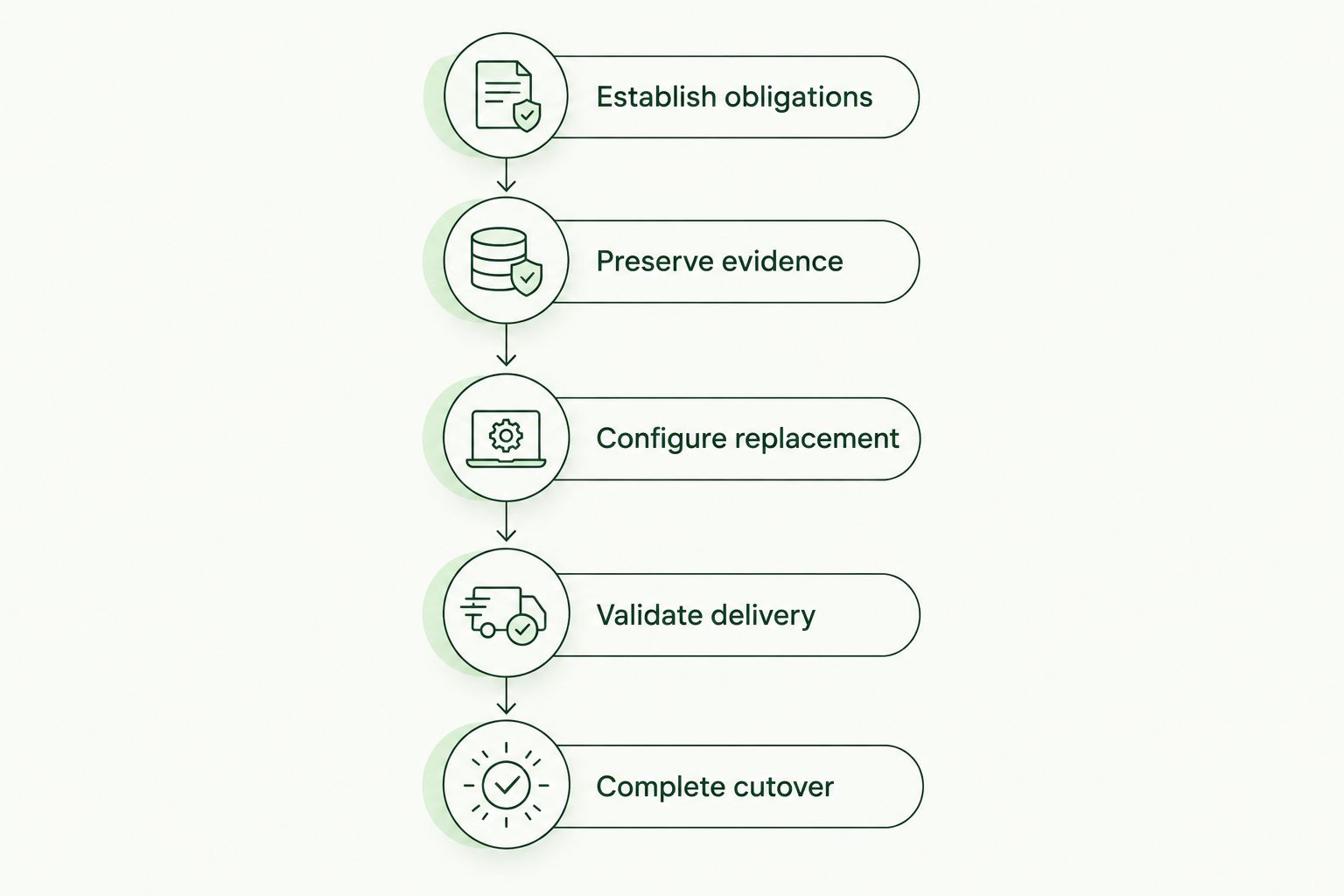
Price and assign the work before treating the vendor change as a subscription saving.
How do you compare savings with switching costs?
Compare the complete transition cost with the recurring saving supported by your actual proposals. Keep the service scope consistent, and use the same accounting treatment on both sides.
A useful calculation is one-time transition cost ÷ confirmed monthly saving = payback in months. This calculation only works when the monthly saving is positive and includes the recurring costs you intend to compare. Do not count an unverified reduction in administration as a guaranteed saving.
For a 2026 approval, show these separately:
- One-time cash outlay: additional invoices directly caused by the migration.
- Internal effort: delivery hours assigned to the transition.
- Recurring difference: the change in ongoing subscription and confirmed operating costs.
- Unresolved scope: requirements that still prevent a reliable estimate.
Track results after cutover using the same categories. If migration tasks continue after launch, record that work against the transition rather than quietly treating it as ordinary service delivery.
Can you switch without losing compliance evidence?
Preserving evidence requires a records plan, not just a new platform. Confirm what each client needs to retain and how authorized staff will retrieve it after the old agreement ends.
Do not assume historical results can be imported into the replacement platform. Assess export and import capabilities separately, and keep a readable archive when that is the appropriate retention method. Ask the relevant compliance or legal owner to confirm the required retention approach.
For 2026 client reporting, distinguish historical records from activity generated after the switch. A clear cutover date helps reviewers understand why records come from different systems without mistaking the change for a gap in training.
FAQ
What's included in the cost of switching phishing simulation vendors?
The cost includes applicable exit charges, subscription overlap, migration work, replacement setup, and evidence preservation. Separate additional cash payments from internal staff effort so the estimate shows both clearly.
Is switching at renewal cheaper than switching mid-contract?
Renewal timing does not establish the total switching cost. Compare remaining commitments, notice requirements, overlap, and migration work before choosing the cutover date.
Can I move historical phishing simulation results to a new vendor?
Historical results require separate export and import checks; do not assume direct transfer is supported. Preserve readable records with the client and user context needed for later retrieval.
Is a flat-fee security awareness training platform better for MSPs?
A flat-fee subscription fits MSPs that want platform charges separated from seat growth. Defend Wise offers flat-fee, white-labeled security awareness training with unlimited seats, while migration effort and workflow suitability still need evaluation.
How do I calculate the payback period for a vendor switch?
Divide the one-time transition cost by the confirmed monthly saving to calculate payback in months. If there is no positive monthly saving, a savings-based payback calculation does not apply.
What should I check before canceling the old phishing simulation vendor?
Confirm contractual obligations, preserve required records, validate the replacement workflow, and assign ongoing service ownership. Cancellation should follow the approved cutover plan rather than start the migration.
Should an MSP move every client at the same time?
A single cutover fits a consistently configured client base only after the required checks pass. A phased migration fits clients needing separate approvals or validation, but adds coordination and can extend overlap.
One last thing
Test retrieval before you cancel access. Ask a colleague who did not perform the export to find a particular client's completion record and explain its reporting period. That exercise checks whether your archive works as evidence, rather than merely proving that files exist.
The final approval question is not whether the replacement subscription looks attractive. It is whether your MSP has priced the transition, preserved the records, and proved it can run the replacement service without leaving migration work behind.