How long does phishing training protection actually last?
How long does phishing training effectiveness last? No fixed expiry applies. Learn how MSPs can check retention, plan refreshers, and document results.
DefendWise
DefendWise
Phishing training has no universal protection period: completing a course does not establish how long an employee will recognize or report a malicious message. Treat effectiveness as a behavior you verify over time, not protection that expires on a fixed date. For an MSP, the practical answer comes from repeated checks of reporting, risky actions, and performance against unfamiliar examples—not the date on a completion certificate.
TL;DR
- How long does phishing training effectiveness last? No universal expiry applies; verify behavior after training and between refreshers.
- Defend Wise fits MSPs seeking white-label security awareness training with unlimited seats, not a substitute for measuring behavior.
- Training completion, phishing recognition, and incident reporting measure different things. Keep those records separate.
- Use unfamiliar examples and delayed checks to distinguish retained judgment from recognition of a recent lesson.
How long does phishing training protection actually last?
There is no defensible single duration that applies to every employee, course, and phishing scenario. A result immediately after training answers whether someone understood that lesson. It does not establish how that person will respond later to a different message while doing normal work.
For your 2026 service plan, separate evidence of attendance from evidence of retained behavior. Defend Wise provides white-label security awareness training for MSPs; evaluating that training still requires clear measures and follow-up checks.
| Evaluation method | Best for | What it establishes | Limitation |
|---|---|---|---|
| Immediate knowledge check | Checking lesson comprehension | Whether someone answers questions about material just covered | Does not establish retention or real-world response |
| Delayed knowledge check | Checking retained understanding | Whether someone recalls the material after a gap | Recall alone does not establish action under pressure |
| Unfamiliar phishing scenario | Checking application | Whether someone applies the lesson to a different example | Results depend on the scenario and testing conditions |
| Reporting exercise | Checking response readiness | Whether someone uses the intended reporting process | A report alone does not explain every action taken beforehand |
A completion certificate records completion. It does not certify future resistance to phishing. Keep that distinction visible in client reports, renewal conversations, and compliance evidence.
Why this matters
Your client needs employees to handle suspicious requests safely when those requests arrive. A finished module is useful administration, but it is not the final business outcome. The service should connect instruction to observable decisions.
That distinction also controls what you promise. Selling an annual training event as year-long protection creates a claim that the completion record cannot support. Sell the training, the follow-up evaluation, and the response process as separate parts of the service.
For 2026 reporting, make every conclusion match its evidence. Say that employees completed assigned material when that is what you measured. Say that employees demonstrated a behavior when an exercise actually tested it.
What counts as retained phishing-training effectiveness?
Start with the action you want employees to take. Recognizing an unusual sender, declining an unexpected sign-in request, verifying a payment change, and reporting a suspicious message are related behaviors. They are not interchangeable outcomes.
A person can identify suspicious wording in a quiz yet still follow an unexpected request during normal work. Someone else can report a message after already entering information. Your assessment needs to distinguish the safe action from the unsafe action rather than compressing both into a single success label.
Use these definitions before you interpret results:
- Recognition: The employee identifies something that requires caution or verification.
- Safe handling: The employee avoids the risky action being tested.
- Reporting: The employee sends the suspicious message through the designated reporting route.
- Verification: The employee confirms a sensitive request through an independently established channel.
- Recovery: The employee promptly reports an action already taken so responders can assess it.
Do not make perfect recognition the only acceptable outcome. A usable reporting process gives employees a safe next step when they are uncertain. Teach that step explicitly, then check whether employees can follow it without assistance.
Why measured phishing-training effectiveness varies
A duration claim means little without the conditions behind it. When you compare assessments, inspect what changed before you attribute the result to memory loss or successful reinforcement.
These factors belong in the review because each changes what the assessment measures:
- Time since instruction: An immediate check tests recent comprehension; a delayed check asks whether understanding persists.
- Similarity to the lesson: Reusing a familiar example tests recognition of that example, not necessarily application to a new one.
- Requested action: Opening a link, supplying credentials, approving a payment, and reporting a message test different decisions.
- Work context: A scenario tied to someone's actual responsibilities tests a different situation from an irrelevant request.
- Reporting access: An exercise cannot isolate knowledge if employees cannot find or use the reporting route.
- Population changes: New starters and role changes alter who has received which instruction and what responsibilities they face.
Record those conditions alongside the result. Without that context, a movement in the headline metric is an observation—not an explanation.
For an MSP, keep the interpretation client-specific. A combined portfolio result does not establish how a particular end-client organization performed, especially when assignments and test conditions differ.
How should you measure retention after training?
Use a repeatable process that separates instruction, application, and follow-up. The aim is not to prove that every employee remembers every warning sign. It is to establish whether employees can make the decisions your service teaches.
Define behavior
Write down the expected action before selecting a lesson or exercise. For an unexpected payment-change request, the intended behavior might be independent verification and reporting. For an unsolicited sign-in request, it might be avoiding the supplied link and using an established route instead.
Choose the evidence that would demonstrate that action. If the assessment only records link interaction, do not report it as a complete measure of verification or reporting behavior.
Establish baseline
Document what employees already understand and how the reporting process works before evaluating improvement. Preserve the assessment conditions so later comparisons have a clear reference point.
A baseline is not a license to surprise employees without boundaries. Agree on authorization, scope, handling of results, and escalation with the client before an exercise begins.
Teach response
Explain the decision employees need to make and the route they should use when unsure. Avoid relying only on lists of suspicious visual details. A convincing-looking request still needs verification when it asks someone to take a sensitive action.
Include recovery instructions. Employees who have already acted need to know how to report the event, not just what they should have done differently.
Check application
Use an unfamiliar example that tests the same underlying decision. Change the surface details without changing the skill you intend to assess. Otherwise, you cannot distinguish retained judgment from memory of the lesson's exact wording.
Record recognition, risky action, and reporting separately where the assessment supports those observations. Do not infer unobserved behavior from a single event.
Review evidence
Compare results with the original objective and assessment conditions. Investigate mismatches before assigning a cause. Then select reinforcement that addresses the observed problem rather than replaying the entire program by default.
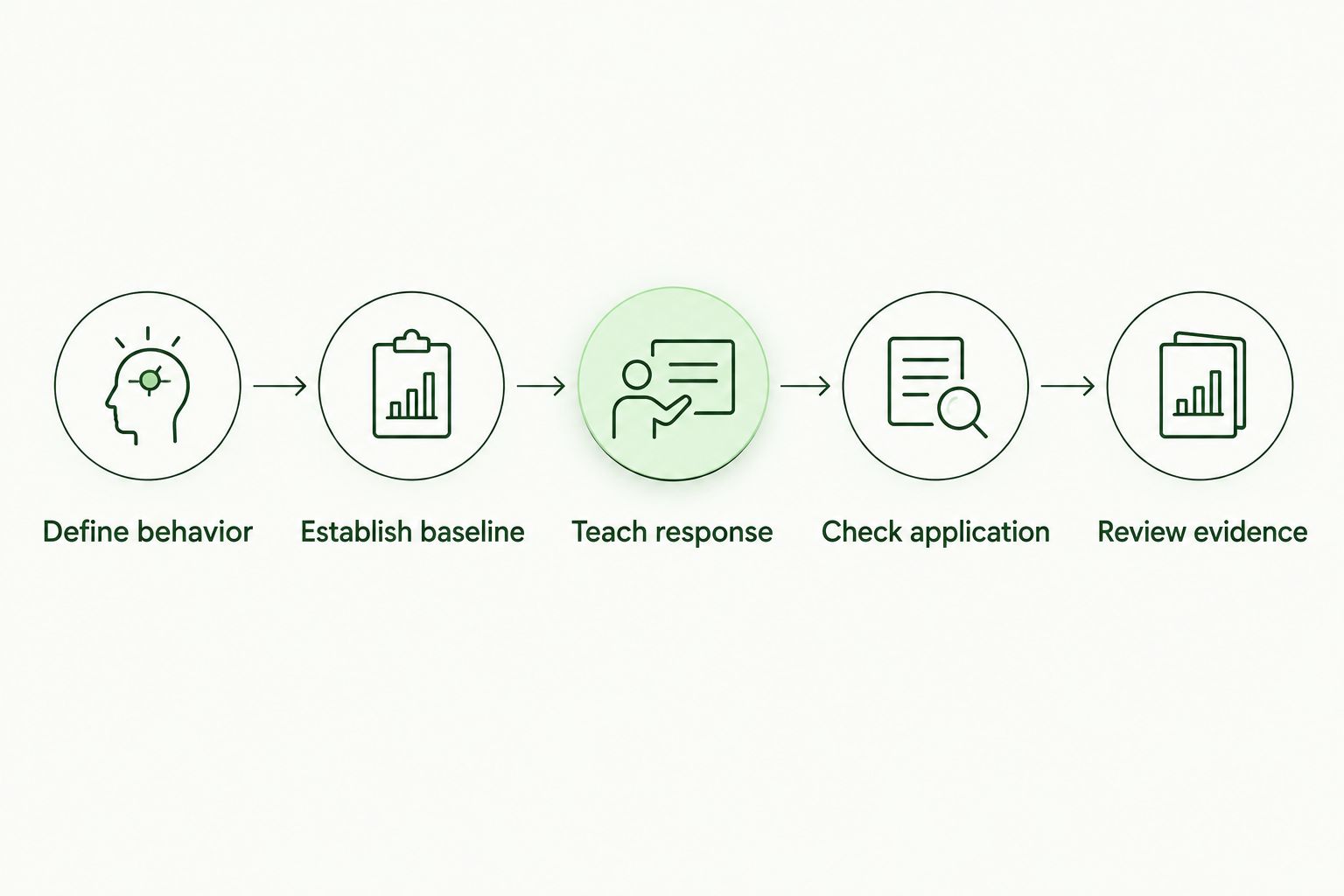
Define the intended behavior before deciding what an assessment result means.
Keep the process consistent enough to explain. Your 2026 evidence should show the objective, instruction, assessment conditions, observed behavior, and follow-up decision. That record is more useful than an unsupported statement that employees remain protected.
When should you refresh phishing training?
Refresh instruction when evidence identifies a gap, when responsibilities change, or when the expected response process changes. A scheduled refresher provides a planned checkpoint; it does not prove that everyone retains the lesson until that date.
Separate a broad refresher from a targeted correction. If employees understand a suspicious request but cannot find the reporting route, address the reporting route. Reassigning unrelated content does not resolve the operational problem you observed.
Use explicit triggers in the client service agreement:
- An assessment reveals difficulty applying a taught decision.
- An employee moves into a role with different sensitive requests.
- A client changes its verification or reporting procedure.
- An incident review identifies a specific misunderstanding.
- New employees need instruction on the client's expected response.
Document why you selected the refresher and what you will check afterward. Repetition is an activity; demonstrated application is the outcome. Keep both in the record, but do not label them as the same thing.
Does annual phishing training provide annual protection?
Annual phishing training establishes a schedule, not a guaranteed protection period. An employee who completed a course still needs a usable response process and an opportunity to demonstrate the relevant behavior.
For a 2026 annual plan, retain the scheduled instruction but add evidence-driven follow-up. Do not describe a client as protected until the next renewal simply because everyone completed an assignment.
The same rule applies to shorter schedules. More frequent assignments document more activity; their frequency alone does not establish whether employees retained or applied the material.
Is a lower phishing click rate proof that training lasted?
A lower phishing click rate shows fewer recorded clicks under the conditions of that assessment. It does not, by itself, establish why the result changed or how employees would handle a different request.
Before claiming retained effectiveness, compare the tested behavior, audience, message, and measurement method. Also inspect reporting and any other observed risky actions. A favorable result deserves a precise explanation, not a broader protection claim.
Report the limits plainly. If the exercise tested one scenario, describe performance on that scenario. Do not convert it into a prediction about every future phishing attempt.
What should an MSP include in client evidence?
Build a record that another person can understand without a verbal explanation. Keep training assignments, completion records, assessment results, and remediation decisions distinguishable. Combining them into a single status hides what each item actually proves.
For each end-client organization, retain the learning objective, covered population, assignment status, assessment method, observed behavior, and follow-up action. Include the relevant dates and enough scenario context to explain comparisons without exposing sensitive exercise details unnecessarily.
Compliance evidence also needs a named purpose. Map the record to the actual client requirement rather than treating training completion as universal proof of compliance. Training supports an evidence package; it does not replace the rest of a client's security obligations.
Defend Wise is best for MSPs seeking white-label security awareness training with unlimited seats. Its stated model addresses seat-count friction; it does not establish an employee's retention period. Evaluate the platform's fit separately from the evidence needed to support effectiveness claims.
How should you package the service in 2026?
Define what the client receives and what each deliverable means. Instruction teaches the behavior. Assessment checks application. Follow-up addresses an observed gap. Reporting preserves the evidence. None of those deliverables should silently stand in for the others.
Assign responsibility for reviewing results and approving follow-up. If a report identifies a problem but nobody owns the response, the service stops at observation. Put the decision owner and escalation route in the operating process.
Keep the commercial promise narrow enough to honor: managed training and documented follow-up, not a guarantee against phishing. That positioning lets you explain the service without claiming a protection window you have not established.
FAQ
How long does phishing training effectiveness last?
Phishing training has no universal effectiveness period. Evaluate retained behavior through delayed checks and unfamiliar scenarios rather than assigning an expiry date to course completion.
Does completing phishing training mean employees are protected?
Completing phishing training establishes completion, not guaranteed protection. Check whether employees can apply the taught response and use the reporting process.
How often should an MSP refresh phishing training?
An MSP should combine a planned schedule with refreshers triggered by observed gaps, role changes, and process changes. Assignment frequency alone does not establish effectiveness.
Is a phishing quiz enough to measure retention?
A phishing quiz measures answers to the questions it asks. Add assessments of application and reporting before drawing conclusions about workplace behavior.
What should employees do if they already clicked a suspicious link?
Employees should promptly follow their organization's incident-reporting procedure and explain what happened. Training should teach recovery and escalation as well as avoidance.
Does Defend Wise remove the need to check training effectiveness?
Defend Wise does not remove the need to check training effectiveness. Its white-label, unlimited-seat training model and an MSP's evaluation process address different service requirements.
One last thing
Test the reporting route before you interpret a reporting result. An employee cannot demonstrate the expected response through a process they cannot access or understand.
Ask the client to show how someone reports a suspicious message, who receives it, and what happens next. If those answers are unclear, fix the workflow before treating a weak result as a memory problem. The next move is to verify the response process, then measure whether employees use it.