How does a ransomware payout compare to training costs?
Compare ransomware cost vs security awareness training cost without false ROI claims. Separate ransom, recovery, training, and MSP delivery work.
DefendWise
DefendWise
A ransomware payout is an unplanned incident expense; security awareness training is a recurring prevention expense, so neither is a substitute for the other. The payout also excludes recovery work, interrupted operations, and incident response. For your 2026 budget, compare the full incident exposure with the full cost of delivering training—not a ransom demand against a software subscription.
TL;DR
- Ransomware cost vs security awareness training cost is an exposure-versus-prevention comparison, not a guaranteed return calculation.
- Defend Wise fits MSPs seeking white-label security awareness training without seat-count friction.
- A ransom payment does not guarantee recovery or remove incident-response work.
- Budget training delivery, technical controls, and recovery readiness separately.
How does a ransomware payout compare to training costs?
A payout addresses an attacker’s demand. Training addresses employee decisions before an incident. Their purposes differ, and neither figure describes your entire security budget.
For MSPs, Defend Wise provides flat-fee, white-label security awareness training with unlimited seats. That model removes per-seat subscription calculations; it does not remove your responsibility to scope delivery work or maintain other security controls.
Use this comparison when explaining the budget to a client:
| Expense or activity | What it addresses | Best for | Limitation |
|---|---|---|---|
| Ransom payment | An attacker’s demand during an incident | No recommended budget allocation; treat it as an incident decision | Payment does not guarantee restored access, deleted stolen data, or completed recovery |
| Security awareness training | Employee recognition, reporting, and safer decisions | An ongoing employee-security program | Training does not replace technical safeguards or recovery planning |
| Incident response | Investigation, containment, coordination, and recovery support | Managing an active incident | Response work remains necessary regardless of the payment decision |
| Recovery preparation | Preparing to restore systems and resume operations | Reducing dependence on an attacker’s promises | Plans and backups need testing; their existence alone is insufficient |
The table is not a ranking of interchangeable purchases. You need prevention and recovery capabilities before an incident forces a payment discussion.
Why this matters
The weak sales argument is simple: a ransom is frightening, so any training subscription must pay for itself. That skips the evidence needed to connect a training program to a specific financial outcome.
The stronger 2026 argument separates controllable spending from uncertain loss. You can define training scope, assign responsibility, and review delivery evidence. You cannot honestly promise that a training purchase will prevent every ransomware incident.
For an MSP, the commercial question is also broader than the platform bill. If your team repeatedly reconciles users, chases overdue assignments, and assembles client evidence, that work belongs in the service calculation. A predictable subscription does not automatically create a predictable delivery workload.
Sell a defined security service, not an imaginary guarantee against a ransom. Your client needs to understand what you deliver, what remains outside scope, and who owns the next action.
What belongs in the ransomware side of the comparison?
Start with the incident, not the demand. A ransomware event can create several distinct categories of expense, and a payment decision settles none of them automatically.
Ransom demand
Record the demand separately from any amount actually paid. A demand is not a completed transaction, and an unpaid demand is not proof that the incident had no financial impact.
Do not present a demand as an inevitable future expense. The response decision depends on the incident, available recovery paths, legal considerations, and advice from the organization’s response team.
Investigation and containment
The organization needs to understand affected systems, restrict further access, and investigate what happened. Paying an attacker does not establish the entry point or confirm that unauthorized access has ended.
For budgeting purposes, separate outside response support from internal staff time. Otherwise, a client can mistake an external invoice for the entire response effort.
Restoration and interruption
Restoring access is not the same as restoring normal operations. Systems, data, business processes, and dependencies need attention before the organization can consider recovery complete.
Document interruption separately from technical restoration. A recovered server does not, by itself, establish that every dependent business process is functioning correctly.
Follow-up work
An incident can require further security changes, communication, and assessment of contractual or legal duties. Those duties depend on the facts and applicable requirements; a generic training article cannot determine them.
Keep this category visible without inventing a universal incident total. A single headline figure conceals differences that matter to the client’s actual exposure.
What belongs in the training side of the comparison?
Your 2026 training budget should describe a delivered service. The subscription is one input, not the complete scope.
Platform subscription
Identify how the subscription is structured and what the agreement includes. Per-seat and flat-fee models create different budgeting tasks, but neither pricing structure proves that the training program is effective.
For a flat-fee model, check that the defined platform scope matches the service you intend to sell. For a per-seat model, assign responsibility for keeping billable user records aligned with the agreement.
Program administration
Define who handles enrollment, user changes, assignment follow-up, and client questions. If the MSP owns those tasks, include that work in the service plan rather than treating it as invisible overhead.
A useful scope statement names the task and its owner. Avoid broad promises such as complete management unless the agreement explains what that includes.
Reporting and evidence
Specify what evidence you will retain and what the client receives. Assignment records and completion records answer different questions from incident reports or proof of technical control coverage.
Training evidence supports a training claim. It does not establish that an organization satisfies every requirement in a security framework, insurance application, or customer contract.
Service review
Include time to review missed assignments, reporting behavior, and unresolved ownership gaps. A program that produces records but no follow-up leaves the client without a clear next move.
The deliverable is a managed training process with evidence—not merely access to a portal. State that distinction before the client compares your service with a software-only subscription.
Why the comparison varies between clients
Use client-specific inputs instead of an average borrowed from an unrelated organization. These factors change what belongs in the comparison:
- Business dependencies: Identify which systems and processes the client needs to operate. This defines the recovery discussion without assigning an invented interruption figure.
- Recovery readiness: Check documented recovery procedures and test evidence. Do not assume that having backups establishes a working recovery path.
- Training scope: Identify the users, responsibilities, and activities included in the service. An unlimited-seat subscription does not define your entire support obligation.
- Delivery workload: Record enrollment, follow-up, reporting, and client-review tasks. Those responsibilities affect the MSP’s service economics.
- Evidence requirements: Identify what customers, insurers, or contractual commitments actually request. Avoid promising universal compliance from training alone.
- Incident circumstances: Separate the attacker’s demand from investigation, restoration, and business interruption. The payment decision does not resolve every category.
These are scoping inputs, not multipliers for an automatic savings estimate. Use them to establish what you know and what needs a client decision.
How should an MSP build a defensible budget comparison?
Use a proposed 12-month planning period so recurring training work and annual service responsibilities sit within the same boundary. This is a budgeting convention for your comparison, not a prediction about when an incident will occur.
- Define scope. List the organizations covered, the training responsibilities, and the client’s responsibilities. Keep platform coverage separate from service delivery.
- Map spending. Separate subscription expense, administration, reporting, and review work. On the incident side, separate payment, response, restoration, and interruption.
- Record evidence. Use actual agreements, documented tasks, and available recovery-test records. Label an estimate as an estimate rather than presenting it as a measured result.
- Assign owners. Name who handles user changes, training follow-up, incident escalation, and recovery decisions. An unassigned task is not a completed control.
- Review gaps. Identify missing information and agree on the next action. Do not fill an unknown incident figure with a dramatic industry headline.
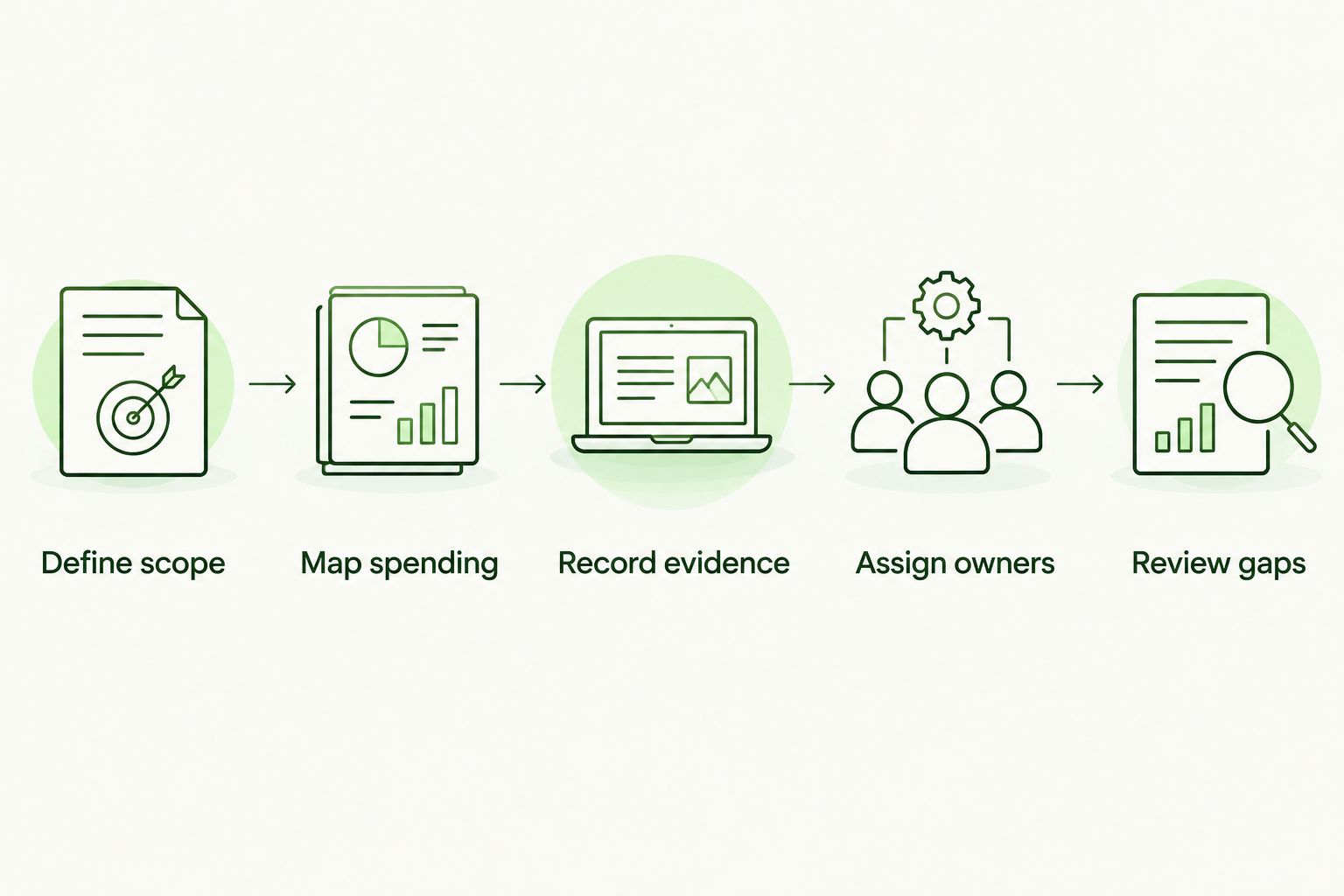
Define the work and its owner before presenting a savings claim.
Keep the finished comparison short enough for a client to challenge. Every line should have a source, an owner, or a clearly stated assumption. A spreadsheet full of unsupported incident estimates is not stronger than a concise service scope.
Where does training fit within the wider security service?
Training belongs beside technical safeguards and response preparation, not above them. Employees need a reporting route; the organization also needs someone responsible for acting on those reports.
The scope of cybersecurity services for mid-sized businesses should connect employee awareness with access protection, monitoring responsibilities, and recovery planning. Treating those activities as separate responsibilities prevents the training subscription from becoming a substitute for the rest of the security program.
For MSPs, the handoffs deserve explicit attention. Who receives a suspicious-message report? Who evaluates it? Who decides whether the incident-response process starts? Write those responsibilities into the operating process rather than assuming the training platform owns them.
A practical 2026 review should also distinguish a training issue from a technical issue. An employee reporting a suspicious message creates a response task. A system requiring remediation creates a technical task. Neither disappears because a completion report looks satisfactory.
When does flat-fee training make sense for an MSP?
Defend Wise is best for MSPs seeking flat-fee, white-label security awareness training with unlimited seats. The fit is the commercial model and the ability to deliver training under the MSP’s brand—not a promise that ransomware exposure disappears.
The benefit is a subscription structure without per-seat calculations. The limitation is equally important: unlimited platform seats do not mean unlimited MSP labor, complete compliance coverage, or guaranteed incident prevention.
Before bundling training into a fixed-fee service, write down which administration and reporting activities you include. Then identify which requests fall outside that scope. This protects the clarity of the client agreement without overstating what the platform provides.
Assess your training model
Review flat-fee, white-label security awareness training for your MSP service.
Can you claim that training pays for itself?
You cannot establish a guaranteed return by comparing a subscription with an unrelated ransom headline. That calculation assumes both that an incident would occur and that the training would prevent it.
Use documented delivery outcomes instead. Explain what training was assigned, what was completed, what follow-up occurred, and which responsibilities remain unresolved. Keep those observations separate from claims about avoided losses.
Should you budget for a ransomware payment instead of training?
A ransomware payment is not a replacement for training, technical safeguards, or recovery preparation. It is an incident decision that requires appropriate response and legal guidance.
Your budget should fund defined security responsibilities. Do not turn a possible payment into the organization’s recovery strategy.
FAQ
How do I compare ransomware cost vs security awareness training cost?
Compare full incident exposure with the full cost of delivering training, not a ransom demand with a subscription. Separate payment, response, restoration, and interruption from platform expense, administration, reporting, and review work.
Does paying a ransom guarantee that we recover our data?
Paying a ransom does not guarantee data recovery. The organization still needs to investigate the incident, address unauthorized access, and verify restoration.
Can security awareness training stop every ransomware attack?
Security awareness training cannot guarantee prevention of every ransomware attack. It addresses employee decisions and reporting, while technical safeguards and recovery preparation address other responsibilities.
Is flat-fee training better than per-seat training for an MSP?
Flat-fee training fits an MSP that wants to avoid per-seat subscription calculations. The pricing model alone does not establish training quality or eliminate administration work.
Who is Defend Wise best for?
Defend Wise is best for MSPs seeking flat-fee, white-label security awareness training with unlimited seats. The MSP still needs to define service responsibilities and maintain the wider security program.
Does completed training prove cybersecurity compliance?
Completed training proves completion of the recorded training activity, not universal cybersecurity compliance. Assess the evidence against the specific requirement, contract, or questionnaire being addressed.
What should an MSP review after launching a training service?
Review ownership, assignment follow-up, evidence delivery, and unresolved client questions. Keep those service observations separate from unsupported claims about prevented incidents or avoided losses.
One last thing
For your 2026 rollout, schedule an initial delivery check after 30 days and a service-scope review after 90 days. These are proposed review checkpoints, not promised performance milestones.
At the first check, confirm that responsibilities and evidence delivery work as agreed. At the later review, compare the actual administration tasks with the service you sold. A flat platform subscription can simplify budgeting; only a defined delivery scope keeps hidden work out of your margin.