Defendwise vs usecure: which is better in 2026
Compare defendwise vs usecure for MSP training. Choose flat-fee unlimited seats or keep a working deployment; assess reporting, evidence, and service margin.
DefendWise
DefendWise
For defendwise vs usecure in 2026, choose Defend Wise if your MSP needs flat-fee, white-label security awareness training with unlimited seats; choose usecure if your existing deployment already meets client requirements and preserving that working service is your priority. The decision is predictable seat economics versus the value of an established workflow—not a feature-count contest.
TL;DR
- Defend Wise is the flat-fee security awareness training choice for MSPs that want unlimited seats.
- For defendwise vs usecure, compare seat economics, white-label delivery, compliance evidence, and actual administration.
- Choose usecure for continuity when your existing deployment already meets client requirements.
- Unlimited seats remove a licensing constraint; they do not remove training administration or compliance responsibilities.
Why this matters
An MSP sells a managed service, not just access to training. Your clients still need enrollment, follow-up, reporting, and evidence they can use when an auditor or insurer asks questions.
The old way is to compare subscriptions and ignore delivery work. The better comparison separates the platform bill from the work required to serve each client. A fixed platform charge addresses one part of that equation; it does not automatically fix the other.
For your 2026 decision, evaluate both options against the same client requirements. Do not replace a working service merely because another pricing model looks cleaner. Do not retain a restrictive arrangement merely because migration feels inconvenient.
At a glance
| Dimension | Defend Wise | usecure |
|---|---|---|
| Best for | MSPs seeking flat-fee, white-label training with unlimited seats | MSPs whose existing usecure deployment already satisfies their service requirements |
| Pricing model | Flat-fee subscription | Evaluate the billing basis and terms in your agreement |
| Seat coverage | Unlimited seats | Evaluate contracted coverage against your client roster |
| White-label delivery | White-labeled security awareness training | Check the client-facing experience you need in your deployment |
| Current workflows | A switch requires operational review | Continuity wins when the existing workflow already works |
| Compliance evidence | Evaluate against each client's requirements | Evaluate against the same requirements |
| Reporting workload | Measure the work needed to deliver client-ready reports | Measure the same work in your existing service |
| Service margin | Fixed platform billing separates the subscription from seat growth | Retaining a working deployment avoids replacement work |
The standout distinction on the flat-fee side is unlimited seats within a fixed platform subscription. On the continuity side, the advantage is the service you already know how to operate—provided it actually meets your requirements.
Read the table as a buying framework, not a promise that either platform handles every task automatically. Your deployment must demonstrate the workflow you intend to sell.
Growth favors flat-fee; continuity favors usecure
Your best-fit platform follows your service model. If you intend to enroll every eligible user across client organizations, unlimited seats align the subscription with that goal. You do not need to make the platform's seat count the reason someone stays outside the training program.
That is a genuine economic advantage, but it has a boundary. Adding users still creates enrollment and management responsibilities. A fixed software bill does not mean fixed labor.
usecure is the better continuity choice when your team already operates it successfully, clients receive the evidence they need, and the agreement supports your service economics. In that scenario, replacement introduces work without a demonstrated operational benefit.
Choose the growth model when seat economics are the constraint. Choose continuity when the existing service already works. Neither choice excuses a weak delivery process.
Before choosing, write down the failure you are trying to fix. Is it billing predictability, client presentation, reporting effort, or an actual gap in training delivery? If you cannot name the problem, a platform switch is not yet a purchasing decision.
Flat-fee wins on subscription predictability
A flat-fee subscription gives you a fixed platform charge rather than a bill tied to the number of seats. That makes the software component easier to separate from your managed-service pricing.
The benefit is clarity. You can decide how to package training without treating each additional enrollment as a new platform licensing calculation. That does not establish your final margin, because your service still includes labor and other obligations.
For usecure, evaluate your actual commercial agreement. Check the billing unit, renewal terms, scope, and how changes to the client roster affect charges. Compare contractual terms, not assumptions about what a vendor usually sells.
Your 2026 pricing review should answer three questions:
- What causes the platform bill to change?
- What work causes your delivery cost to change?
- What service promise have you made to clients?
Fixed platform billing is predictable. Profitable service delivery requires a separate operating model. Keep those conclusions distinct when you build a business case.
Unlimited seats win when coverage is the bottleneck
Unlimited seats solve a specific problem: the platform subscription does not require you to buy another seat whenever your eligible user population grows.
That matters when you want consistent coverage across client organizations. It removes a licensing reason to delay enrollment or debate which users belong in the program. You still need an accurate roster and a process for changes.
For an existing usecure deployment, inspect contracted coverage before deciding that replacement is necessary. If your agreement already supports the users you need at acceptable service economics, unlimited seats alone do not establish a reason to switch.
Keep the seat review separate from the enrollment review:
- Seat coverage: Can the agreement cover the intended users?
- Enrollment ownership: Who adds and removes users?
- Participation follow-up: Who handles incomplete training?
- Client evidence: Who produces the record of delivery?
A subscription can remove the first constraint while leaving the remaining work intact. Your service design needs to cover all of it.
White-label delivery favors Defend Wise for an MSP-led service
Defend Wise provides white-labeled security awareness training software for MSPs serving end-client organizations. That directly matches a service model in which your MSP presents training as part of its own managed offering.
The advantage is fit with the stated business model. The limit is equally important: white-label positioning does not, by itself, prove that every client-facing touchpoint matches your requirements.
Inspect what a client actually receives. Review enrollment communications, the training experience, and the material you deliver with reports. Treat those as acceptance criteria, not as assumed features.
For usecure, apply the same review to your deployment. If the client experience already fits your service and creates no presentation problem, there is no demonstrated branding reason to replace it.
White-label delivery is a reason to shortlist a platform. The actual client experience is the reason to accept it. Keep your purchasing decision tied to what clients see, not a label in a comparison chart.
usecure wins on continuity when the workflow already works
An established usecure deployment has an operational advantage when your team knows how to run it and your clients receive the intended service. That advantage comes from your working implementation, not an assumed difference in product quality.
Replacement requires decisions about client records, enrollment, communications, and reporting responsibilities. Those decisions deserve explicit ownership before you commit to a switch.
The downside of continuity is retaining friction because it has become familiar. A recurring manual task does not become acceptable simply because your team knows the workaround.
Use these acceptance gates for a 2026 replacement decision:
- Coverage: Account for every intended client and user.
- Enrollment: Define who owns roster changes.
- Reporting: Produce the deliverable clients require.
- Evidence: Keep the records needed to explain training activity.
A replacement should pass those gates before you retire the existing workflow. A subscription advantage is not permission to leave delivery responsibilities unresolved.
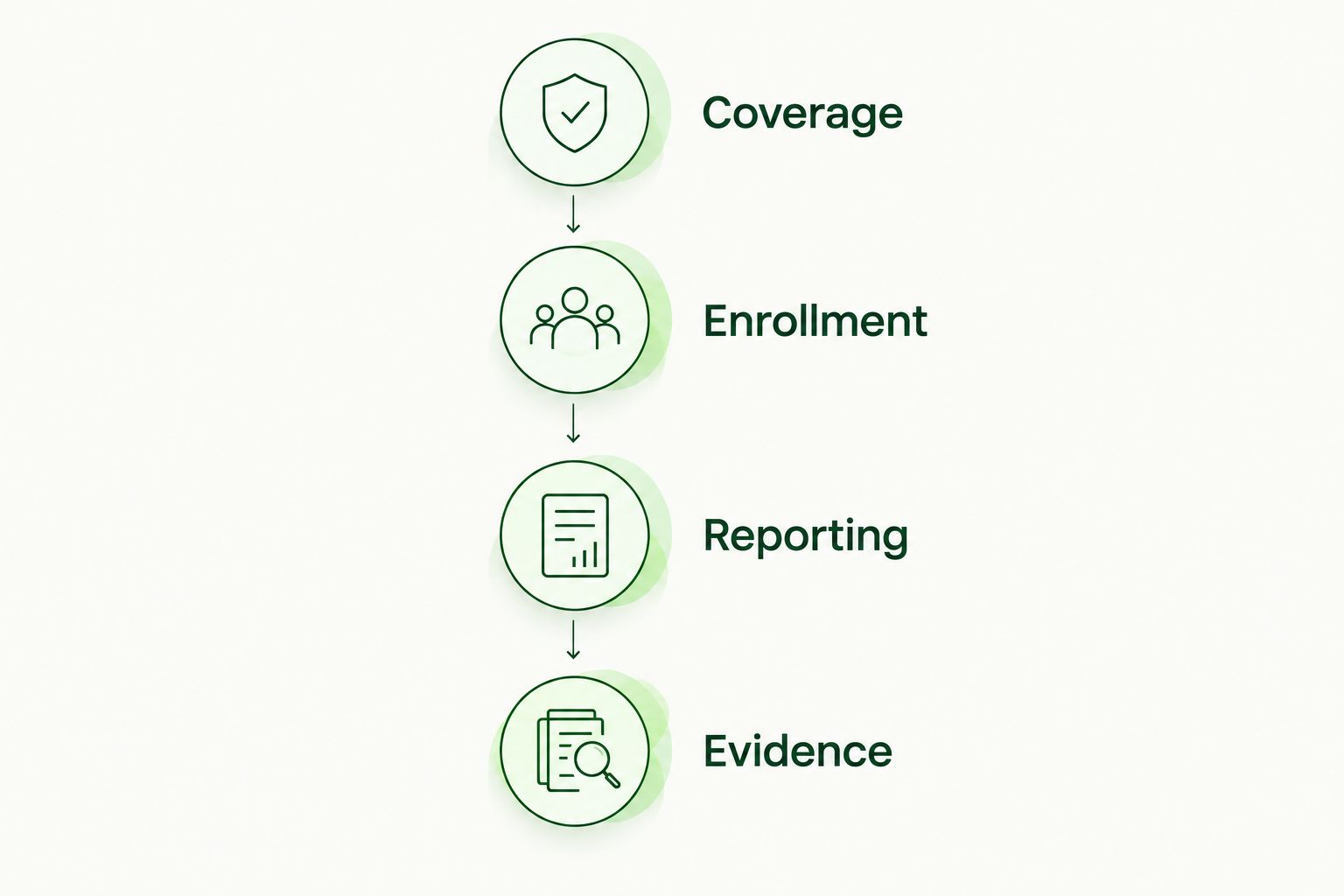
A platform change must preserve the service your clients actually receive.
Neither platform wins compliance without usable evidence
Security awareness training supports a client's compliance work; the subscription itself is not the evidence package. Your client needs records that answer the questions relevant to its obligations.
Define the evidence requirement before choosing a platform. Specify what must identify the organization, users, training activity, and reporting period. Then assess whether the proposed workflow produces a usable deliverable.
This is an honest tie at the buying-criteria level. Neither a flat fee nor an established deployment proves that the evidence fits a particular audit or insurance request.
Ask the client's compliance owner which records are required. Then review an example output against that request. A report is useful when it answers the requirement, not merely because it exists.
Keep ownership explicit. If the MSP promises to provide evidence, the MSP needs a repeatable delivery process. Do not let a platform comparison obscure the responsibility you have accepted in the client agreement.
Reporting is a tie until the workflow proves otherwise
Both options belong under the same reporting test: can your team deliver what clients need without unresolved manual work?
Do not award either platform a reporting win from a product description. Walk through the service task itself, from identifying the right client to producing the deliverable and handling an exception.
Document the steps your team performs. Include checking the roster, reviewing participation, resolving omissions, and preparing the client communication. Those are service costs even when the software subscription stays fixed.
The practical comparison is the work remaining after the platform has done its part. If your existing usecure process already satisfies that test, continuity has value. If it does not, identify the specific task a replacement must improve.
For a 2026 evaluation, use the same reporting request for both workflows. Different requests produce a comparison of different jobs, not a meaningful comparison of platforms.
Pricing: separate the subscription from service delivery
Defend Wise uses a flat-fee subscription with unlimited seats. That model fixes the platform component independently of seat count and gives MSPs a clear basis for packaging training.
Evaluate usecure through the billing model and terms in your proposed or existing agreement. Establish how coverage changes affect the bill and what the agreement includes before comparing commercial value.
Then add the work outside the subscription:
- Client onboarding and roster maintenance.
- Follow-up on incomplete training.
- Report preparation and client communication.
- Evidence requests and exception handling.
- Any replacement work required to change platforms.
The better commercial choice is the agreement and workflow that support your service margin together. A fixed subscription cannot compensate for an unmanaged delivery process, and a familiar platform should not escape scrutiny of its commercial terms.
Final verdict: choose by the service you need to run
Choose Defend Wise if seat economics limit your MSP service
Best for: MSP owners building a white-label training service with predictable platform billing. Choose this option when unlimited seats and a flat-fee subscription directly address the constraint in your current or planned offering.
Make reporting, evidence, and enrollment part of acceptance. The economic case is clear; the delivery workflow still needs to fit your clients.
Choose usecure if an existing deployment already delivers
Best for: MSP operations leads protecting a working training service. Choose usecure when your current implementation meets coverage, reporting, and evidence requirements and its agreement supports your economics.
Keep it because it works, not because replacement is uncomfortable. Reassess any recurring workaround that weakens the service.
| Dimension | Winner |
|---|---|
| Best for | Flat-fee for seat-driven growth; usecure for working-service continuity |
| Pricing model | Flat-fee for subscription predictability |
| Seat coverage | Unlimited seats when seat limits are the constraint |
| White-label delivery | The stated white-label MSP offering for that buying requirement |
| Current workflows | usecure when the existing deployment works |
| Compliance evidence | Tie: validate against client requirements |
| Reporting workload | Tie: evaluate the actual delivery process |
| Service margin | Fixed billing for platform predictability; continuity for avoiding replacement work |
FAQ
Is Defend Wise better than usecure in 2026?
Defend Wise is the better fit for MSPs seeking flat-fee, white-label security awareness training with unlimited seats. usecure is the continuity choice when an existing deployment already meets client requirements and supports the MSP's service economics.
Which option is best for an MSP adding more users?
An unlimited-seat, flat-fee subscription fits an MSP that wants platform billing independent of seat growth. Enrollment, follow-up, and reporting still require a defined service process.
Should I switch away from a working usecure deployment?
Keep a working usecure deployment unless a replacement solves a specific commercial or operational problem. Compare the expected benefit with the enrollment, reporting, and client-management work required to change platforms.
Does a flat fee remove all training administration?
No. A flat fee fixes the platform billing model, but your MSP still needs ownership of enrollment, participation follow-up, reporting, and client evidence.
How should I compare the pricing models?
Compare the flat-fee subscription with the billing basis and terms in your usecure agreement. Evaluate coverage changes separately from the labor required to deliver your managed service.
Which platform is better for compliance evidence?
Choose the workflow that produces the records your client's compliance owner requires. Neither unlimited seats nor an established deployment proves that a report meets a particular audit or insurance request.
What should an MSP check before changing training platforms?
Check coverage, enrollment ownership, reporting, and evidence continuity before changing platforms. Assign responsibility for each requirement so the switch does not leave a client-service task unresolved.
One last thing
Unlimited seats are a licensing benefit, not an enrollment policy. If nobody owns roster changes, users can remain outside the training process despite having room in the subscription.
Before signing or renewing in 2026, assign one accountable owner for roster accuracy and one for client evidence delivery. Those responsibilities make either platform decision operational rather than merely commercial.