Defendwise vs Symbol Security: which is better in 2026
Defendwise vs Symbol Security: choose flat-fee training for unlimited seats, or demonstrated workflow fit. Compare MSP delivery, reporting, and contract terms.
DefendWise
DefendWise
Choose Defend Wise if you want flat-fee, white-label security awareness training with unlimited seats for your MSP; choose Symbol Security if its demonstrated client-management and reporting workflows fit your service better. For this 2026 comparison, separate the commercial model from the operational proof: seat-count simplicity matters, but so does the work required to deliver the service.
TL;DR
- Defendwise vs Symbol Security comes down to unlimited-seat economics versus demonstrated operational fit for your MSP.
- Defend Wise is the flat-fee security awareness training choice for MSPs that want unlimited seats and white-label delivery.
- Choose Symbol Security when a hands-on evaluation demonstrates better client administration or compliance evidence for your service.
- Require both candidates to complete the same onboarding, reporting, and client-handoff tasks before you commit.
Why this matters
Your MSP sells a managed service, not a training login. The platform needs to support the work around training: bringing clients into the service, keeping users covered, and explaining what happened when a client requests evidence.
Defend Wise offers flat-fee, white-label security awareness training with unlimited seats. That is a concrete commercial distinction. It does not replace a demonstration of the administration and reporting work your team needs to perform.
The right 2026 choice must pass two tests: the commercial model fits your bundle, and the operating workflow fits your team. A favorable answer to only one test is not enough. A predictable platform fee cannot fix an awkward client handoff; an attractive dashboard cannot resolve contractual seat-count friction.
Treat this comparison as a buying decision, not a feature-count contest. Ask each vendor to perform the same tasks, with the same client scenarios, and judge the results against your actual service obligations.
At a glance
The table separates the stated offer from the acceptance criteria you should apply to Symbol Security. Evaluation requirements are not claims that a vendor already meets them.
| Dimension | Defend Wise | Symbol Security |
|---|---|---|
| Best for | MSPs seeking unlimited-seat, white-label security awareness training | MSPs whose evaluation establishes a better fit for their operating requirements |
| Pricing model | Flat fee with unlimited seats | Assess the proposed agreement for seat, client, and service-related charges |
| Standout feature | Unlimited seats within the stated flat-fee offer | Require a demonstrated advantage that matters to your service |
| Client-facing identity | White-label platform | Evaluate the client-facing branding workflow |
| Client administration | Platform for managing end-client training and cybersecurity compliance | Test onboarding, user changes, and client separation |
| Compliance evidence | Compliance management is part of the stated platform purpose | Test whether reporting answers your clients' evidence requests |
| Operational fit | Validate the work behind the commercial promise | Validate the same work against the same acceptance criteria |
| Decision standard | Choose for the stated model after workflow acceptance | Choose for demonstrated workflow advantages after commercial review |
Defend Wise wins when unlimited seats are your requirement
Defend Wise is the flat-fee security awareness training choice for MSPs that want unlimited seats and white-label delivery. Its stated offer directly answers that requirement. You do not need to infer it from a bundle name or a sales presentation.
That distinction matters when you want to include training in a managed-service package without making the platform's seat count the center of every client conversation. Coverage becomes a service-design decision rather than a reason to exclude users from the training plan.
The limitation is equally important: unlimited seats describe the commercial offer, not unlimited operational capacity. Your team still needs to establish who owns onboarding, user changes, training follow-up, and evidence requests.
Before selecting the flat-fee option, write down the service you intend to deliver:
- Which end-client organizations belong in the package?
- Which users need training coverage?
- Who handles additions, departures, and client ownership changes?
- What evidence will you provide during routine reviews?
- Which requests fall outside your standard service?
The commercial model should support those answers. It should not substitute for them. For a 2026 bundle, make coverage rules explicit before introducing training to clients.
Symbol Security wins if its client workflow passes your harder test
Choose Symbol Security when its demonstration establishes a better way to complete the client-management work your MSP actually performs. The winning evidence is a completed task, not a feature label.
Bring a realistic client scenario to the evaluation. Include a new organization, a user change, an administrator handoff, and a request for training evidence. Ask the vendor to work through the scenario rather than switch between prepared screens.
Your acceptance criteria should distinguish a useful workflow from an impressive presentation:
- Client separation: An administrator can identify the correct organization and avoid mixing client records.
- User changes: The team can explain how additions and departures affect training assignments and records.
- Ownership: Your service team knows who receives follow-up work and who can complete it.
- Handoff: Another technician can continue the task without reconstructing its history.
These are buying requirements, not assertions about either platform's functionality. Symbol Security earns the operational win only by showing that its approach fits your requirements better.
The tradeoff is that workflow preference does not settle the commercial question. Review the agreement separately. A product that suits your technicians still needs to fit the way you sell and manage the service.
White-label delivery favors the stated white-label offer
The flat-fee platform explicitly includes white-label delivery. That gives an MSP with a client-facing training service a clear starting point: the offering is intended to support delivery under the MSP's identity.
Do not expand that fact into an assumption about every screen, email, report, or domain. Inspect the actual client journey. Your acceptance test should cover the invitation, training experience, administrative communication, and evidence handoff that your service will use.
For Symbol Security, make the same inspection part of the evaluation. If client-facing identity is a contractual requirement in your managed-service package, get the relevant scope documented before signing.
White-label is a requirement to verify, not a reason to skip the client walkthrough. A vendor's terminology matters less than whether your intended service can be delivered consistently.
The practical downside of choosing on branding alone is straightforward: a suitable client-facing identity does not establish that the underlying administration is suitable. Keep presentation and service execution as separate evaluation lines.
Symbol Security wins if its evidence handoff fits your obligations better
Choose Symbol Security for compliance evidence only when its demonstrated output better answers your clients' actual requests. Start with the request, then inspect the report. Reversing that order encourages you to accept whatever the dashboard happens to display.
Security awareness training evidence and a compliance conclusion are different things. Training records support an assessment; they do not, by themselves, establish that an organization satisfies every requirement of a framework or insurance policy.
For your 2026 evaluation, ask each vendor to produce an evidence package for a sample client. Assess whether your team can explain:
- What activity the record covers.
- Which organization and users it concerns.
- What period the evidence represents.
- Which users need follow-up.
- What additional context the client must supply.
Do not assign a reporting winner from screenshots. A readable dashboard can still require substantial interpretation before a client can use its output.
Symbol Security earns this recommendation when its demonstrated handoff is better suited to your obligations. The limitation is scope: a reporting advantage should be judged against the requests you expect to receive, not treated as a universal compliance advantage.
Both candidates face the same operational acceptance test
Neither commercial positioning nor a polished demonstration should exempt a candidate from operational testing. This is an honest tie in the buying standard: both must prove that your team can deliver the intended service.
Use a repeatable sequence so that the comparison stays fair:
- Client onboarding: Establish the organization and the administrator responsible for it.
- User changes: Work through an addition and a departure using your intended process.
- Training review: Identify completed work and the follow-up your team needs to handle.
- Evidence handoff: Produce the material you would send to the client.
- Service ownership: Explain who takes over when the original technician is unavailable.
Ask your own technician to repeat the sequence. Watching a vendor complete a task is not the same as establishing that your service team can own it.
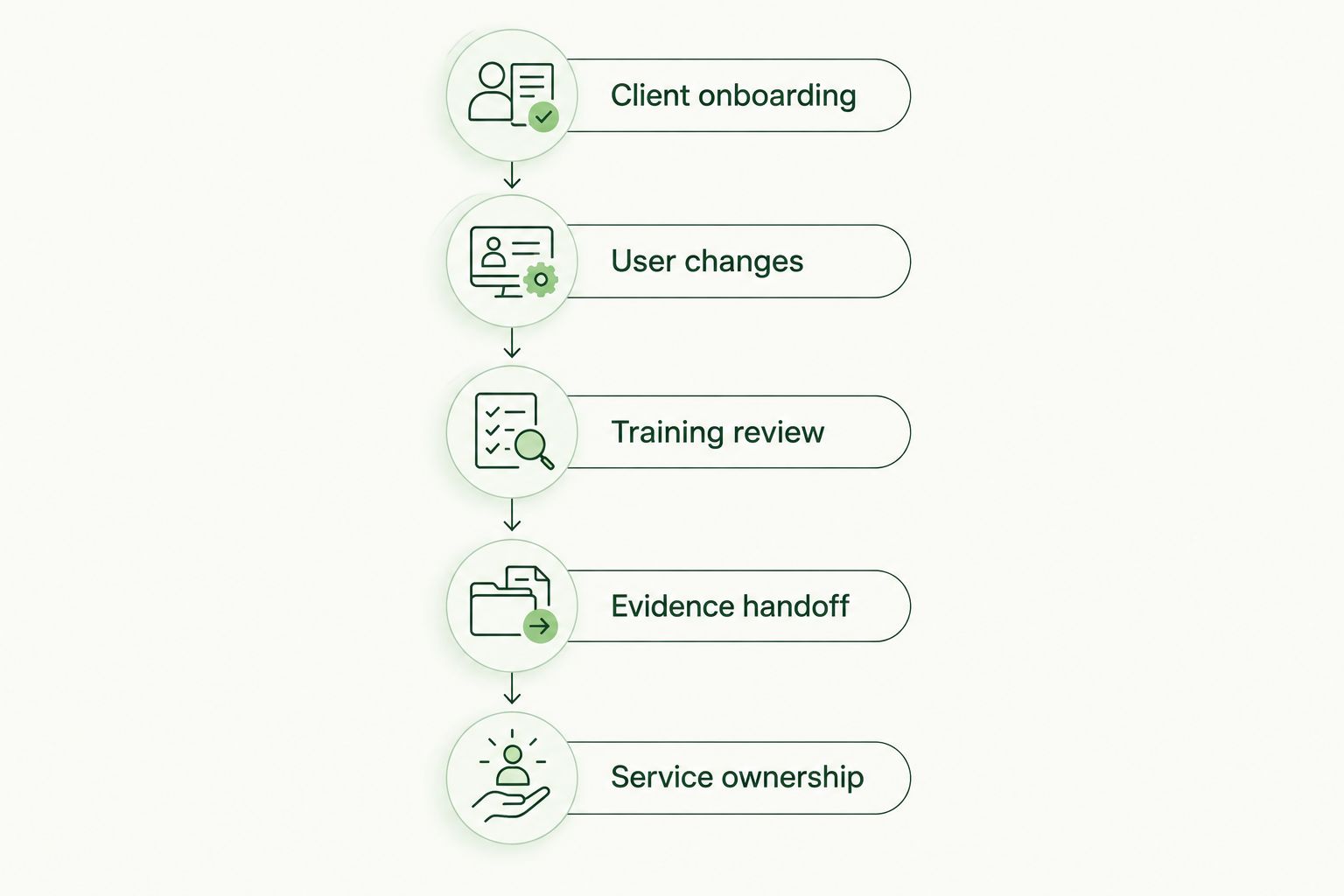
Use the same service tasks to evaluate both candidates.
Record the work required at each step, including decisions, handoffs, and any supporting documentation. Do not invent a productivity score. Use the actual observations from your evaluation to decide which workflow your team can maintain.
This test also exposes responsibility gaps. If nobody owns an overdue-training review or an evidence request, changing platforms will not resolve the service-design problem.
Pricing: compare the agreement, not just the model
The stated flat-fee offer includes unlimited seats. That gives you a defined commercial basis for training coverage, but you still need to review the agreement and the scope of the service you plan to sell.
For Symbol Security, assess the proposed commercial terms directly. Establish whether charges are tied to users, client organizations, included services, or another contractual basis. Do not assume a pricing model from the category or from another vendor's offer.
Keep the 2026 commercial review separate from the workflow evaluation. Your checklist should cover:
- Coverage: What the agreement includes and excludes.
- Changes: How client and user changes affect the agreement.
- Commitment: What term and renewal obligations you accept.
- Scope: Which capabilities belong in the proposed service.
- Exit: What records and responsibilities need attention when the relationship ends.
Flat-fee coverage addresses seat-count economics; it does not price your internal work. Your managed-service package must account for onboarding, client communication, exception handling, and evidence preparation.
Avoid declaring the better commercial choice from an incomplete quote. Compare the terms for the same intended service, then decide whether the operating advantages justify the agreement you are accepting.
Final verdict: choose the model or the demonstrated workflow
Choose Defend Wise if you run a standardized MSP bundle
Best for: An MSP that wants white-label security awareness training with a flat fee and unlimited seats.
The stated offer matches that commercial requirement directly. Select it after your team confirms that onboarding, training administration, and evidence handoff meet the service standard you intend to promise clients.
The reason to pause is operational mismatch. Unlimited-seat coverage is useful only within a service your team can deliver and maintain.
Choose Symbol Security if workflow fit is your deciding factor
Best for: An MSP with specific client-administration or evidence requirements that Symbol Security demonstrates more effectively during evaluation.
Select it when the demonstrated advantage matters to your service and the proposed agreement fits your bundle. Require proof of the actual tasks; do not turn a feature list into an assumed operational win.
The reason to pause is an unproven advantage. Preference for a presentation is not enough to justify changing the way your service operates.
One-glance scorecard
| Dimension | Winner |
|---|---|
| Stated flat-fee, unlimited-seat requirement | Defend Wise |
| Client-administration fit | Symbol Security if its demonstrated workflow meets your requirements better |
| Stated white-label requirement | Defend Wise matches the requirement |
| Evidence handoff | Symbol Security if its demonstrated output fits your obligations better |
| Operational acceptance standard | Tie: apply the same test |
| Commercial due diligence | Tie: review both agreements against the intended service |
FAQ
Which is better in 2026, Defendwise or Symbol Security?
Choose the flat-fee, unlimited-seat option when that commercial model is your requirement; choose Symbol Security when its demonstrated workflows fit your service better. Evaluate client administration and evidence handoff separately from the agreement.
Does the flat-fee option include unlimited seats?
Yes, unlimited seats are part of the stated offer. Confirm the agreement's scope and make sure your team can deliver the training service you intend to package.
Is Symbol Security the better choice for client reporting?
Choose Symbol Security for reporting only when its demonstrated evidence handoff better answers your clients' requests. Compare actual output for the same client scenario rather than dashboard screenshots.
Does white-label training automatically meet compliance requirements?
No, white-label delivery concerns client-facing identity, not an automatic compliance result. Assess training evidence against the specific obligations that apply to the client.
What should an MSP ask both vendors to demonstrate?
Ask both vendors to demonstrate client onboarding, user changes, training review, evidence handoff, and service ownership. Have your own technician repeat the tasks before accepting the workflow.
Does a flat fee remove all training administration?
No, a flat fee describes the commercial model rather than the work your team performs. Establish responsibility for onboarding, follow-up, client communication, and evidence requests.
How should an MSP compare the commercial terms?
Compare both proposed agreements against the same intended service. Review coverage, change rules, commitment, scope, and exit responsibilities before deciding.
One last thing
Test the handoff, not just the setup. Before making your 2026 choice, ask a technician who did not attend the initial demonstration to complete a client evidence request using the available records and instructions.
That task tests the service you will actually operate. The winning platform is the one whose commercial model fits your package and whose demonstrated workflow your team can own.