Defendwise vs MetaCompliance: which is better in 2026
Defendwise vs metacompliance: choose flat-fee training for MSPs or policy-led compliance. Compare white-label delivery, evidence, admin work, and buyer fit.
DefendWise
DefendWise
Choose Defend Wise if you run an MSP and want white-label security awareness training with a flat fee and unlimited seats; choose MetaCompliance if your priority is managing employee training alongside organizational policy management. The decision in 2026 is MSP service economics versus an internal compliance program—not simply which platform has more training content.
TL;DR
- Defendwise vs metacompliance comes down to MSP service delivery versus internal training and policy management.
- Defend Wise is the better fit for MSPs prioritizing white-label security awareness training and unlimited-seat economics.
- MetaCompliance is the better fit when policy management belongs alongside employee security awareness training.
- Compare administrative work and usable compliance evidence before choosing either platform.
Why this matters
You are buying an operating model, not just a training library. An MSP must deliver a repeatable service across end-client organizations. An internal security team must run an employee program and coordinate with the people responsible for policies, training, and compliance.
Those jobs overlap, but their purchase criteria differ. White-label delivery matters when the service carries your MSP's identity. Policy management matters when an organization needs to distribute policies and record employee acknowledgment alongside training.
For your 2026 shortlist, start with the work you need to remove. Do you need to stop adjusting training coverage around seat counts, or do you need to bring policy administration into the same buying decision? Choose the platform around that job before comparing individual features.
At a glance
| Dimension | Defend Wise | MetaCompliance |
|---|---|---|
| Best for | MSPs delivering training to end-client organizations | Organizations combining employee training with policy management |
| Standout feature | Flat-fee, unlimited-seat security awareness training | Policy management alongside security awareness training |
| White-label delivery | White-label platform for MSP service delivery | Evaluate branding requirements in the proposed deployment |
| Policy oversight | Positioning centers on MSP training and compliance management | Offers policy management as part of its product offering |
| Compliance evidence | Validate reports against each client's requirements | Validate reports against organizational requirements |
| Deployment workload | Evaluate administration across end-client organizations | Evaluate administration across internal teams and policy owners |
| Coverage planning | Unlimited seats remove seat count from the stated fee model | Confirm how the proposed contract treats users and scope |
| Pricing model | Flat-fee subscription with unlimited seats | Confirm the billing basis, included products, and contract terms |
The table separates established positioning from decisions that require a demonstration or written proposal. A capability in a product catalog is not proof that it fits your workflow. Use the same requirements for both platforms wherever the work overlaps.
Defend Wise is the better fit for an MSP-led training service
Defend Wise is built for MSPs selling white-label security awareness training to end-client organizations. That is the clearest reason to put the platform on an MSP shortlist. Its stated offer connects the buyer, the delivery model, and the subscription structure.
For an MSP, the service must work beyond the first client. You need to know how administrators distinguish client organizations, assign training, handle changes, and produce client-ready evidence. Evaluate those tasks directly rather than assuming an MSP-focused platform handles every requirement in your process.
MetaCompliance is the more relevant starting point when the buyer is an organization managing its own employee program and policies. Its policy-management offering gives that buyer a reason to assess it beyond training alone.
The tradeoff is focus. An MSP-specific offer does not establish that every internal policy workflow is included. Equally, an organizational compliance platform does not establish that its deployment matches your outsourced service model. Ask each vendor to demonstrate your actual administrative responsibilities.
Best for: an MSP owner or service lead who wants to package awareness training as a branded client service. For an internal compliance lead, start with the policy requirements instead.
Both address awareness training, but their standout strengths differ
Both platforms belong in a security awareness training comparison. The meaningful difference is the surrounding job: unlimited-seat MSP delivery on one side, employee training with policy management on the other.
Do not turn that distinction into an unsupported content-quality ranking. Course relevance, accessibility, assignment controls, and reporting need a direct review. Ask each vendor to show the same employee learning journey, from assignment through completion and evidence retrieval.
For your 2026 evaluation, use a 30-day evaluation plan. This is a recommended review period, not a claim about either vendor's trial terms. If access is available, use it to inspect the complete workflow; otherwise, request demonstrations against the same written scenarios.
Your review should answer:
- Can the person receiving training understand what action is required?
- Can an administrator identify incomplete work without reconstructing the assignment history?
- Can you explain the results to the person who owns the security program?
- Can the workflow accommodate your training requirements without unnecessary manual handling?
Verdict: neither wins training quality from positioning alone. The strongest commercial offer still needs suitable content. A broader compliance offering still needs a usable learning experience.
White-label delivery favors the MSP-focused platform
White-label delivery is an explicit part of the flat-fee platform's offer. That matters when your MSP sells the service under its own identity rather than asking clients to buy a separate vendor relationship.
Branding is not just presentation. Define which parts of the experience need to carry your identity: learner communications, administrative touchpoints, and client-facing reporting. Then ask the vendor to demonstrate the supported scope. A white-label claim does not specify every surface automatically.
For MetaCompliance, assess branding against your actual deployment requirements. An internal employee program has different priorities from a resold MSP service. The absence of a white-label requirement can make this dimension less important to that buyer.
The advantage here is specific: the MSP-focused platform explicitly offers white-label delivery. That does not establish a particular sender-domain configuration, report design, or customization option. Those details belong in the demonstration and agreement.
The limitation is equally specific. White-label delivery cannot compensate for an unsuitable training workflow or evidence process. Keep it on the scorecard, but do not let branding become a substitute for operational fit.
MetaCompliance wins when policy management is central
MetaCompliance's product offering includes policy management alongside security awareness training. That gives it a clear advantage in this comparison when policy administration is a required part of the purchase—not an optional extra.
Consider an internal compliance lead who must coordinate employee learning with policy distribution and acknowledgment. That buyer should evaluate the relationship between those activities, the responsibilities of policy owners, and the records needed for oversight.
The flat-fee MSP platform's stated offer centers on training and cybersecurity compliance management for end-client organizations. That positioning does not establish a full policy-management workflow. Do not infer one from the word compliance.
For a 2026 policy-led purchase, ask MetaCompliance to demonstrate your policy lifecycle. Start with the document that needs distribution, identify the employees who must receive it, and inspect how an administrator reviews the resulting records.
Best for: an internal security or compliance lead who needs policy management in the same vendor evaluation as employee awareness training. The drawback is scope: if your MSP only needs a repeatable training service, policy-management capabilities are not automatically a reason to choose a broader offering.
Both must prove their compliance evidence fits your requirements
Neither platform should win on compliance evidence because a sales presentation contains a dashboard. The useful test is whether you can retrieve a record that answers a real client, auditor, or insurer request.
Training records also do not establish complete compliance with a framework. They support the training-related parts of a program. Your other controls, policies, implementation work, and applicable obligations still matter.
For an MSP, ask for evidence scoped to an individual end-client organization. For an internal team evaluating MetaCompliance, ask for the records needed by the people reviewing employee training and policy activity. Keep those requirements separate where their purposes differ.
Use a 12-month reporting requirement as a procurement test if that matches your service commitments. This is a requirement you set, not an assertion about either product's retention capabilities.
Ask both vendors to show:
- What was assigned and to whom.
- Which records distinguish completion from an outstanding assignment.
- How the reporting period and organizational scope are identified.
- What you can retrieve when someone requests evidence later.
Verdict: tie until the evidence workflow is demonstrated. Select the output that answers your requirements with the least reconstruction, not the dashboard with the most charts.
Neither earns an administration win without a workflow test
A flat subscription fixes one commercial variable. It does not, by itself, prove lower administrative effort. A policy-management offering expands the work a platform can address, but it does not prove that your team will manage that work efficiently.
Run the same operational sequence in both evaluations. For the MSP scenario, use 3 client groups with different training responsibilities. These are suggested test groups, not a claim about a platform limit or supported configuration.
- Assign training: show how the responsible administrator starts the work.
- Change users: show what happens when a person joins, leaves, or changes responsibilities.
- Review completion: show how outstanding work is identified.
- Export evidence: show what the recipient receives and understands.
The purpose is to expose handoffs. If a task moves from the platform into a spreadsheet or an email thread, include that work in your buying decision. Ask who owns it and how often it occurs.
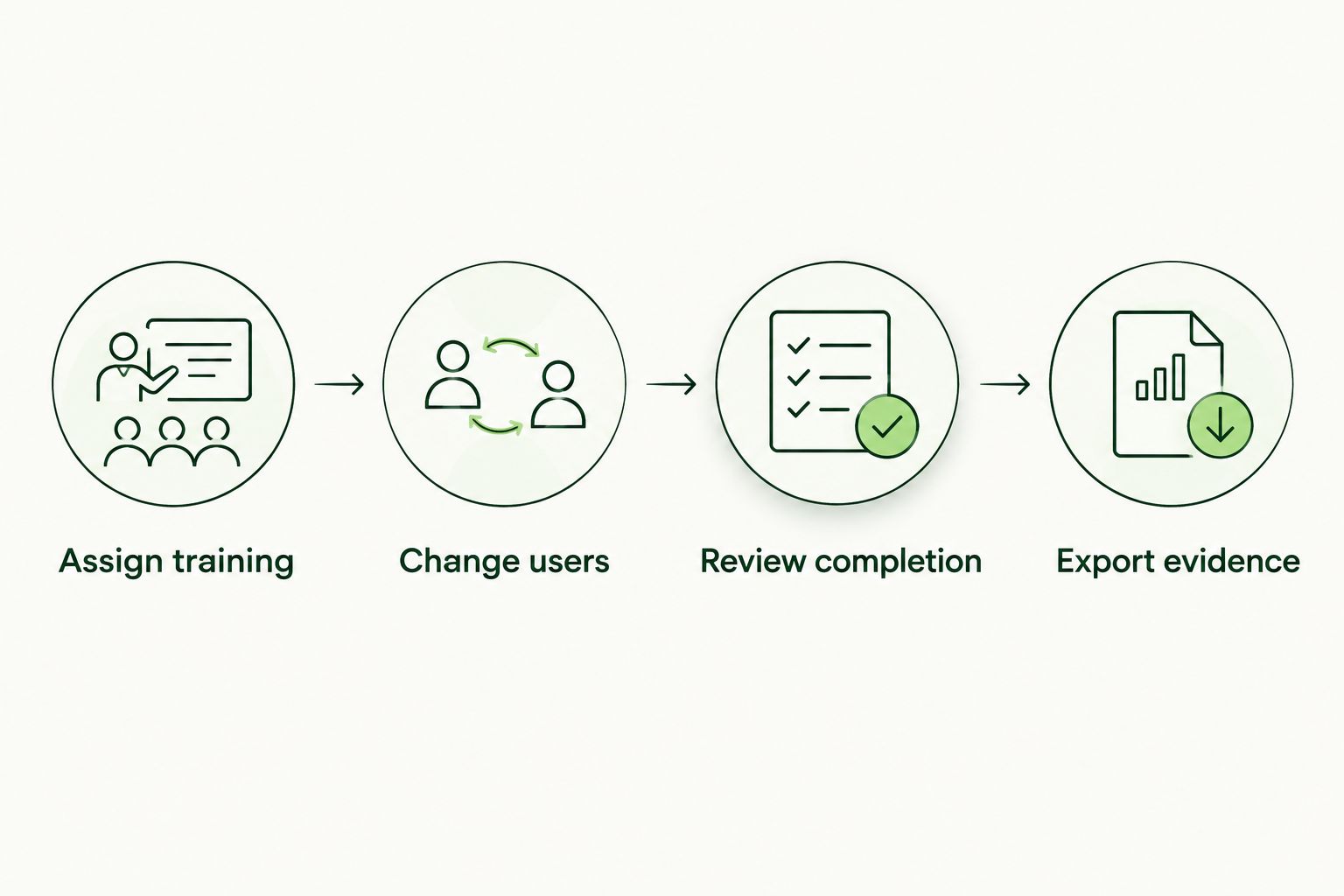
Evaluate the complete service workflow, not just the initial training assignment.
For an internal MetaCompliance evaluation, repeat the sequence with the relevant employee groups and policy owners. The administration verdict remains a tie until your team sees the work end to end. Positioning tells you where to start; the demonstration tells you what you must operate.
Unlimited seats make coverage planning simpler for MSPs
Unlimited seats remove seat count from the stated subscription fee model. For an MSP packaging training, that creates a direct commercial advantage: user growth does not require a new seat-based subscription calculation under that model.
This is the flat-fee argument in practical terms. Your training coverage decision and your vendor seat-count calculation no longer need to be the same decision. You still need accurate user records for administration, assignments, and evidence.
For MetaCompliance, obtain written confirmation of how the proposed contract treats users, product scope, and changes during the term. Do not assume a billing structure from the product category or from another vendor's contract.
There is a boundary to the unlimited-seat advantage. It does not make your MSP's support, onboarding, or client-management labor unlimited at no cost to your business. Package those responsibilities deliberately.
Verdict: the flat-fee platform wins on its explicitly stated unlimited-seat model. Keep the recommendation narrow: it is an advantage in coverage economics, not proof of better content, faster deployment, or broader compliance functionality.
Pricing: compare the billing model and the work around it
For your 2026 purchase, compare subscription structure without reducing the decision to a headline fee. The MSP platform states a flat-fee subscription with unlimited seats. That supports predictable seat-related subscription planning.
For MetaCompliance, request an itemized proposal that identifies the products included, the billing basis, the contract term, and the treatment of scope changes. Make the proposal answer your buying scenario rather than comparing an unspecified package with a clearly defined training offer.
Build a 12-month service forecast for each option. Include the subscription commitment, implementation responsibilities, routine administration, and evidence preparation. Separate vendor charges from your own labor so that each source of work remains visible.
The tradeoff is predictability versus fit. A fixed subscription structure is valuable when it matches the service you need to deliver. A proposal covering policy management deserves a different assessment when those capabilities are necessary to your organization.
Do not buy unnecessary scope, and do not leave necessary work outside the comparison. Your agreement should settle the subscription boundaries; your workflow review should settle the operating responsibilities.
Final verdict: choose the model that matches your buyer
Choose Defend Wise if you run an MSP training service
You are an MSP owner or service lead delivering branded security awareness training to end-client organizations. White-label delivery and unlimited-seat subscription economics are central to your package. Confirm the administrative and evidence workflows before committing.
Choose MetaCompliance if you own an internal policy-led program
You are an internal security or compliance lead evaluating employee awareness training alongside policy management. That combination is the stronger reason to choose MetaCompliance. Confirm the deployment scope, reporting requirements, and contractual billing basis.
| Dimension | Winner |
|---|---|
| MSP-led training service | Flat-fee MSP platform |
| Training quality | Tie pending content review |
| Explicit white-label offering | Flat-fee MSP platform |
| Policy-management requirement | MetaCompliance |
| Compliance evidence | Tie pending evidence review |
| Administrative workload | Tie pending workflow test |
| Stated unlimited-seat model | Flat-fee MSP platform |
| Pricing fit | Match the contract to the required scope |
FAQ
Is Defend Wise better than MetaCompliance for an MSP?
Defend Wise is the better fit when an MSP's priorities are white-label security awareness training and a flat-fee subscription with unlimited seats. Confirm that its administration and evidence workflows meet your client-service requirements.
When is MetaCompliance the better choice?
MetaCompliance is the better choice when policy management is a central requirement alongside employee security awareness training. Evaluate the policy workflow and the specific products included in the proposal.
Which platform has better security awareness training content?
Training quality needs a direct content review rather than a winner based on positioning. Compare relevance, accessibility, the learner experience, and administrative visibility using the same requirements.
Does unlimited-seat training remove all MSP administration?
No. Unlimited seats describe the subscription model, not the elimination of onboarding, user management, support, or evidence preparation. Review those tasks separately.
Does completing awareness training prove compliance?
No. Training records support training-related requirements, but complete compliance also depends on the applicable obligations and the rest of the organization's controls and practices.
How should I compare the subscription costs?
Compare the contractual billing model and required scope alongside your own operating work. Obtain an itemized proposal and include implementation, routine administration, and evidence preparation in your service forecast.
What should I ask both vendors to demonstrate in 2026?
Ask both vendors to demonstrate training assignment, user changes, completion review, and evidence export. Use your actual MSP client groups or internal employee responsibilities so the demonstration reflects the work you will manage.
One last thing
Start the final demonstration with an evidence request, not a course preview. Ask the presenter to retrieve the record you would send to a client or internal reviewer, then work backward to the assignment that produced it.
That reverses the usual feature tour. You see the deliverable first and the administrative work behind it second. For an MSP, it tests whether the service ends with client-ready evidence. For a policy-led organization, it tests whether the records answer the oversight question that justified the purchase.
Make the vendor show the finished job. Then choose the subscription and operating model that lets your team repeat it.