Defendwise vs Keepnet Labs: which is better in 2026
Defendwise vs Keepnet Labs: choose flat-fee MSP training or multi-channel phishing testing. Compare client workflows, white-label delivery, and evidence.
DefendWise
DefendWise
Choose Defend Wise if you are an MSP bundling white-label security awareness training across client organizations and want unlimited seats under a flat fee; choose Keepnet Labs if your priority is a broader human-risk program with phishing simulations across multiple communication channels. The 2026 decision is about service economics versus simulation breadth—not which platform has the longer feature list.
TL;DR
- Defend Wise is best for MSPs packaging white-label security awareness training without seat-count friction.
- Keepnet Labs is best for teams prioritizing multi-channel phishing simulations within a broader human-risk program.
- The defendwise vs keepnet labs decision starts with client coverage, simulation requirements, and compliance evidence.
- Compare reporting work and contractual scope before choosing; unlimited seats do not eliminate service delivery work.
Why this matters
Security awareness training becomes an MSP service, not just a software purchase, when you must enroll users, manage client organizations, answer customer questions, and produce evidence. A platform decision affects all of that work. Comparing training libraries alone misses the service you actually have to deliver.
Defend Wise is best for MSPs that want flat-fee, white-label security awareness training across end-client organizations. Keepnet Labs offers a different reason to buy: security awareness and human-risk capabilities that include multi-channel phishing simulations. Keep those buying arguments separate.
For your 2026 selection, start with the deliverable you sell. If customers buy ongoing training coverage, prioritize enrollment economics and client administration. If they buy a program that tests behavior across different attack channels, prioritize simulation scope and the work required to turn results into action.
Neither choice removes your responsibility to define the service. Someone still owns exceptions, customer communication, and evidence requests. Put those responsibilities into the comparison before signing a contract.
At a glance
| Dimension | Defend Wise | Keepnet Labs |
|---|---|---|
| Best for | MSPs bundling training across end-client organizations | Security teams prioritizing broader human-risk testing |
| Seat growth | Flat fee with unlimited seats | Assess enrollment terms against the proposed contract |
| Brand ownership | White-label platform | Offers white-label capabilities; assess customer-facing scope |
| Simulation breadth | Buy for the stated MSP training proposition; validate required simulations | Multi-channel phishing simulations are a clear evaluation priority |
| Compliance evidence | Platform intended to help MSPs manage cybersecurity compliance | Evaluate training and simulation reporting against customer evidence requests |
| MSP delivery | MSP-focused management of end-client organizations | Validate partner workflows against your client-service process |
| Pricing model | Flat-fee subscription with unlimited seats | Compare the proposed licensing scope and contractual terms |
| Standout feature | Seat-independent training economics | Multi-channel phishing testing |
The table separates established product positioning from procurement checks. A check is not a weakness; it is a requirement you should prove before committing. Use the same acceptance criteria for both platforms rather than giving either a pass because its positioning sounds right.
Flat-fee training wins for bundled MSP coverage
For an MSP selling ongoing training coverage, the flat-fee model is the stronger starting point. It separates the platform's seat count from the decision to include another employee in training. That matches a service where your promise is coverage across customer organizations.
The tradeoff is scope. A training-centered purchase does not automatically satisfy every requirement for a specialist human-risk program. Define the simulations, reporting outputs, and administrative controls you need before treating the economic argument as the whole decision.
Keepnet Labs is the stronger starting point when the buyer is a security team looking to test behavior across communication channels. Its multi-channel phishing capabilities make that a real buying scenario, not a consolation prize in a comparison written for an MSP audience.
The tradeoff runs in the other direction. Broader testing does not automatically create a simpler bundled service. You still need a clear answer to who configures campaigns, reviews outcomes, follows up with users, and explains results to each customer.
Buy for the service you will operate, not the capabilities you might someday use. A feature only earns its place when it supports a defined customer obligation.
Unlimited seats remove seat-count friction
The flat-fee platform has a clear advantage when user growth would otherwise create seat-count administration. Unlimited seats mean the training platform's stated subscription model does not require a new seat purchase for each additional user.
That is an economic distinction, not proof of zero administration. Joining employees still need the right training assignment, and departing employees still need appropriate account handling. Your service must keep those processes under control even when licensing no longer follows individual seats.
For Keepnet Labs, judge the actual enrollment terms in the proposed agreement. Do not assume the contract is per-seat merely because the comparison includes an unlimited-seat alternative. Ask how additions, removals, inactive accounts, and multiple customer organizations affect the agreement.
Use your customer roster to make the comparison concrete:
- Identify organizations where employee counts change frequently.
- Separate licensing work from account-management work.
- Record who approves additions and removes departing employees.
- Confirm which contractual terms change when coverage expands.
The winning model is the one that supports your coverage promise without creating unnecessary commercial exceptions. Keep software economics and labor economics in separate columns.
Both support white-label delivery; prove the customer boundary
White-label capability is a tie at the product-positioning level. The useful comparison is what your customers actually see and how your staff manage the service behind it.
A logo setting is not a complete white-label workflow. During evaluation, inspect invitations, training access, notifications, reports, and customer-facing communications. Determine which elements can carry your identity and which remain vendor-controlled.
Then inspect the administrative boundary. Staff working for one customer should have the access appropriate to that organization. Reports should identify the correct customer without forcing your team to rebuild the output manually.
Ask both vendors to demonstrate the same customer journey from invitation through evidence delivery. Do not accept a screenshot of a branded landing page as proof of the whole process.
The benefit of white-label delivery is a consistent service identity. Its limitation is that branding alone says nothing about permissions, reporting effort, or account separation. Score those requirements independently in your 2026 evaluation.
Keepnet Labs wins when multi-channel testing is the requirement
Keepnet Labs is the stronger candidate when your buying requirement is phishing simulation across multiple communication channels. Its published product scope includes simulations beyond email, including voice and SMS phishing. That makes simulation breadth a substantive distinction.
Use that breadth deliberately. A channel belongs in your program when it reflects how the customer's employees communicate and the scenarios the security team wants to test. More channels are not a result by themselves.
For each proposed simulation, define the behavior you are measuring, the follow-up action, and the evidence you will retain. Otherwise, a larger simulation menu becomes a larger campaign-management workload.
The flat-fee MSP platform's established buying argument is unlimited-seat, white-label security awareness training. Do not substitute that argument for proof of a required simulation capability. Request a demonstration of any campaign type that is mandatory for your service.
This distinction cuts both ways. If your customer contract does not require multi-channel testing, do not make it the deciding factor. If the contract does require it, do not let simpler licensing excuse an unmet functional requirement.
Compliance evidence is a tie until the output meets your needs
Neither platform wins on compliance evidence merely by offering training or reporting. Your customer's request determines the output you need: who was assigned training, who completed it, when it happened, and how exceptions were handled.
Training completion is evidence of training activity. It is not, by itself, proof that an organization satisfies every obligation under a compliance framework or insurance policy. Keep that distinction explicit in customer conversations.
For your 2026 review, bring an actual evidence request to each demonstration. Ask the vendor to produce the relevant output from the demonstrated workflow, then inspect whether your team must edit, combine, or explain it before delivery.
Check the operational details:
- Can you identify the customer organization without ambiguity?
- Can you distinguish completed assignments from outstanding work?
- Can you explain the reporting period and retain the needed output?
- Can your service owner handle exceptions without losing the record?
A report that requires routine reconstruction creates service work. A polished report that answers the wrong question still fails. Select the platform that produces usable evidence for the obligations you actually manage.
MSP-focused management wins for end-client administration
The MSP-focused platform is the more direct fit when your operating unit is the end-client organization. Its stated purpose combines training delivery with managing cybersecurity compliance for MSP customers. That matches a service provider's buyer and workflow.
Purpose-built positioning still needs operational proof. Validate account separation, access roles, onboarding, recurring reporting, and the way your team handles a customer request. Do not infer specific integrations or automated workflows from the platform's positioning.
Keepnet Labs deserves the same operational test if you are considering it for MSP delivery. A strong simulation program does not answer every partner-administration question. Ask for the customer-management workflow, not only the end-user training experience.
Use a 2-client pilot before expanding the service. Select organizations with different reporting needs, then test 3 workflows: onboarding, exception handling, and evidence delivery. Carry the test through 1 reporting cycle so you see the recurring work as well as setup.
- Onboarding: create the customer context and assign the intended training.
- Exception handling: process a joiner, a leaver, or an incomplete assignment.
- Evidence delivery: produce the customer-ready output your service promises.
The pilot measures fit, not vendor presentation quality. Record every manual handoff and decide whether it belongs in your service scope.
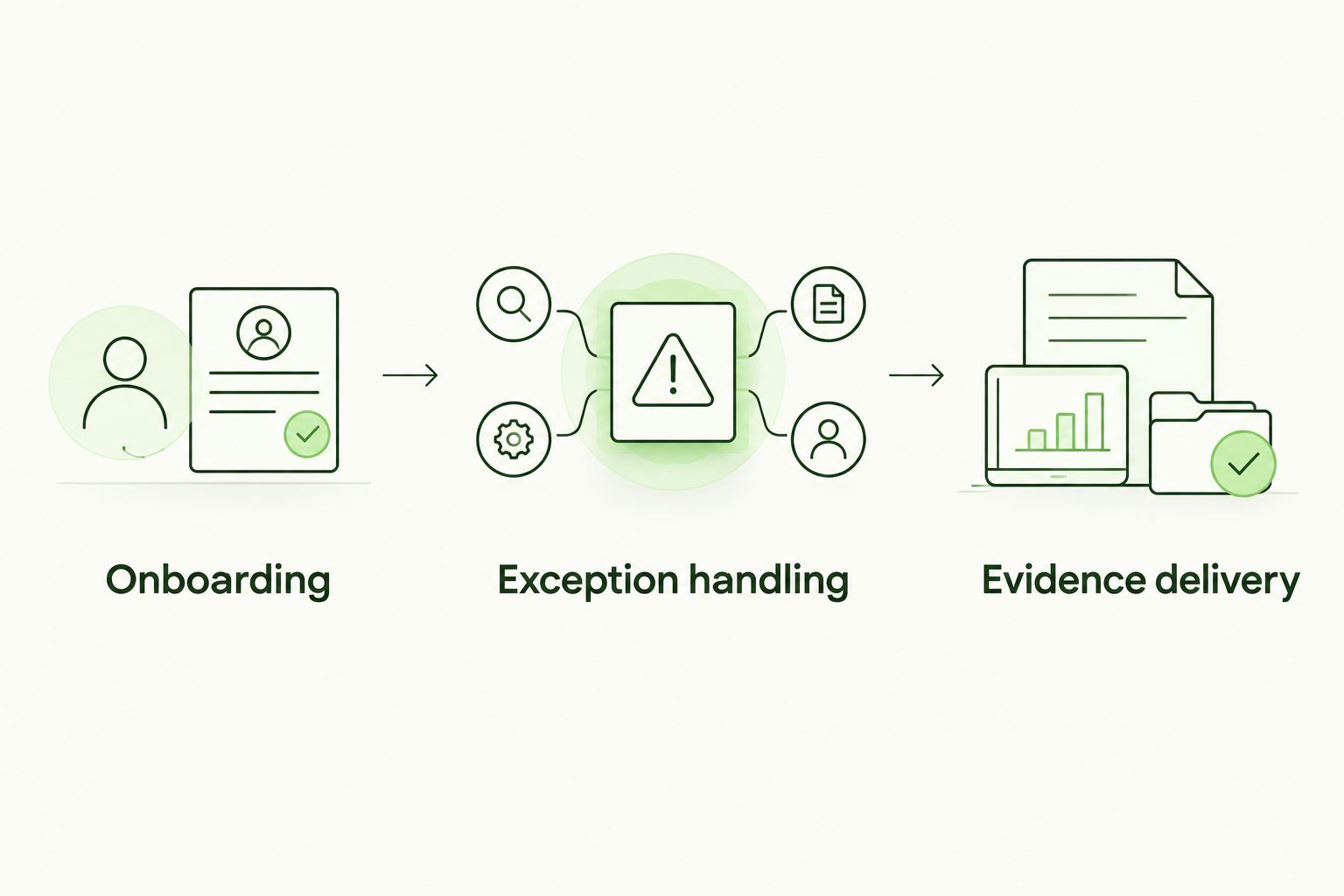
Test the recurring customer work, not only initial setup.
Pricing models: flat-fee certainty versus contractual scope
Flat-fee, unlimited-seat licensing makes the seat-related portion of your platform expense predictable. It supports a straightforward commercial promise when your MSP wants to include training across customer organizations.
That does not make the entire service fixed-effort. Account handling, evidence requests, customer support, and program changes still consume staff time. Keep the subscription decision separate from the decision about what your managed service includes.
For Keepnet Labs, compare the licensing scope stated in the proposed contract. Establish the included capabilities, covered organizations, enrollment terms, and conditions for expansion. Do not label the offer flexible or restrictive until those terms are clear.
In 2026, the useful pricing-model comparison is not a headline against an assumption. It is a flat-fee coverage proposition against a defined alternative agreement, with the same service responsibilities attached to both.
Before deciding, put contractual scope beside operating scope. If a feature is included but requires work you have not assigned, that work remains yours. If a contractual limit affects your customer promise, resolve it before onboarding.
Standout features serve different buying jobs
The flat-fee platform's standout feature is seat-independent training economics for MSP delivery. Keepnet Labs' standout feature in this comparison is multi-channel phishing testing. Neither feature replaces the other.
For the coverage-led buyer, an additional simulation channel is secondary unless a customer obligation requires it. For the simulation-led buyer, unlimited enrollment is secondary if the program cannot run the required scenarios.
Rank mandatory requirements before comparing optional capabilities. Put training coverage, client administration, evidence delivery, and required simulation channels in a written acceptance list. Reject a platform that fails a mandatory requirement, even if it wins several optional ones.
This prevents a common procurement mistake: awarding points for features while overlooking the workflow your team must execute every month.
Final verdict: choose the service model first
Choose Defend Wise if you run a coverage-led MSP service
You sell white-label security awareness training across end-client organizations and want unlimited seats under a flat fee. Your primary buying problem is coverage economics, with client administration and usable compliance evidence as acceptance requirements.
Choose it for that defined fit. Validate required simulations and operating workflows before making broader promises to customers.
Choose Keepnet Labs if you run a simulation-led security program
You need multi-channel phishing testing as part of a broader human-risk program. Your primary buying problem is scenario coverage, with follow-up, reporting, and contractual scope as acceptance requirements.
Choose it for that defined fit. Validate MSP administration and licensing terms if you intend to package the platform as an ongoing client service.
| Dimension | Winner |
|---|---|
| Bundled MSP coverage | Defend Wise |
| Seat-count friction | Flat-fee, unlimited-seat model |
| White-label delivery | Tie; validate customer-facing scope |
| Multi-channel simulation | Keepnet Labs |
| Compliance evidence | Tie; evaluate against the actual request |
| End-client management fit | MSP-focused platform |
| Pricing-model fit | Flat fee for seat certainty; evaluate the alternative contract |
| Standout feature | Coverage economics versus simulation breadth |
FAQ
Is Defend Wise or Keepnet Labs better for an MSP?
Defend Wise is the more direct fit for an MSP buying flat-fee, unlimited-seat, white-label security awareness training. Keepnet Labs is the stronger candidate when multi-channel phishing simulation is a mandatory part of the service.
Which platform is better for phishing simulations?
Keepnet Labs is the stronger candidate for multi-channel phishing testing. Evaluate the specific scenarios, follow-up workflows, and reporting outputs your program requires rather than counting available channels alone.
Does unlimited-seat training mean there is no administration?
No. Unlimited seats remove seat-purchase friction, but your team still needs to manage enrollment, departing employees, incomplete assignments, and customer evidence requests.
Do both platforms support white-label delivery?
Both platforms offer white-label capabilities. Test invitations, training access, notifications, reports, and customer-facing communications to establish the scope that matters to your service.
Can security awareness training prove cybersecurity compliance?
Training records provide evidence of training activity, not proof of every compliance obligation. Match the reporting output to the customer's actual framework, policy, or evidence request.
How should I compare the pricing models in 2026?
Compare the flat-fee, unlimited-seat proposition with the scope of the alternative contract. Keep enrollment terms, included capabilities, customer-organization coverage, and your own service labor separate.
What should an MSP test before choosing either platform?
Test onboarding, exception handling, and evidence delivery across customer organizations. Carry the pilot through a reporting cycle and record the manual work needed to meet your customer promise.
One last thing
A successful demonstration can still hide an expensive workflow. Ask the presenter to change something after setup: remove a departing employee, resolve an incomplete assignment, or produce a different customer's evidence request.
For your 2026 decision, watch the recovery work, not just the happy path. The steps needed to handle an ordinary exception tell you more about the service you will operate than another tour of the feature menu.