Defendwise vs CanIPhish: which is better in 2026
Compare defendwise vs caniphish in 2026: flat-fee MSP training versus a phishing-first evaluation. Check white-label delivery, evidence, and contract fit.
DefendWise
DefendWise
Choose Defend Wise if you run an MSP and want white-label security awareness training with a flat fee and unlimited seats; choose CanIPhish if phishing simulation is the starting point for your evaluation. The difference is your buying priority: a repeatable client service versus a phishing-led training program.
TL;DR
- For defendwise vs caniphish, choose Defend Wise for flat-fee, white-label MSP security awareness training.
- Choose CanIPhish for a phishing-first evaluation; test campaign workflows against your actual requirements.
- Unlimited seats remove seat-count pricing friction, not the work of delivering a managed service.
- Require usable training records and clear contract terms before selecting either platform.
Why this matters
Your 2026 security awareness training decision affects more than employee lessons. It determines how you package the service, onboard client organizations, handle user changes, and answer requests for compliance evidence.
Defend Wise provides a flat-fee, white-label security awareness training platform for MSPs managing end-client organizations. That business model gives you a clear reason to shortlist it. CanIPhish provides phishing simulation and security awareness training, making it a relevant comparison when simulated phishing is central to your requirements.
Buy against the service you intend to deliver, not the longest feature list. A training platform and a profitable managed training service are not the same thing. You still need ownership, reporting rules, and a clear boundary between included work and extra requests.
At a glance
| Dimension | Defend Wise | CanIPhish |
|---|---|---|
| Best for | MSPs packaging white-label training across end-client organizations | Buyers starting with phishing simulation requirements |
| Standout feature | Flat-fee access with unlimited seats | Phishing simulation as a core product function |
| Service branding | White-label platform is part of the stated offer | Make branding requirements part of the demonstration |
| Coverage planning | Unlimited seats support a service-wide coverage policy | Evaluate coverage against the proposed contract |
| Training approach | Security awareness training for MSP-managed clients | Security awareness training alongside phishing simulation |
| Compliance evidence | Evaluate records against each client's obligations | Apply the same evidence acceptance test |
| Pricing model | Flat fee rather than seat-based billing | Confirm the billing basis and included scope in writing |
| Buying test | Test the complete MSP service workflow | Test the phishing campaign workflow and follow-up |
The table separates established product positioning from buying criteria. It does not award either platform capabilities that a demonstration or contract still needs to establish.
For your 2026 shortlist, the useful question is not whether both products mention training. It is whether the product fits your operating model without creating work you have not priced into the service.
Defend Wise is the clearer fit for an MSP training bundle
Defend Wise security awareness training is best for MSPs that want white-label delivery with a flat fee and unlimited seats. That is the strongest supported distinction in this comparison.
An MSP sells an ongoing client service. The software sits inside that service, alongside onboarding, communication, reporting, and account management. A platform explicitly offered for MSP-managed end-client organizations matches that buying context.
The advantage is commercial clarity. You can define who receives training without making the seat count the basis of the platform fee. That matters when your service promise is coverage across a client organization rather than access for a selected group.
The limitation is equally clear: unlimited seats do not mean unlimited managed work. Client-specific reporting, employee follow-up, and exceptions still need a service boundary. Do not treat a fixed software fee as proof that your entire delivery cost is fixed.
Choose this model when your sales proposition is a repeatable managed training service. If your requirement is primarily a specific phishing campaign workflow, evaluate that workflow directly instead of selecting on the MSP label alone.
CanIPhish belongs on a phishing-first shortlist
CanIPhish is the relevant alternative when phishing simulation drives the purchase. Its phishing simulation and security awareness training focus gives that buyer a concrete reason to evaluate it.
Start with the campaign you need to run. Define the audience, the scenario, the intended learning outcome, and the follow-up. Then ask the vendor to demonstrate that sequence rather than presenting unrelated features.
A phishing-first evaluation puts the practical training event at the center of the decision. You are checking whether the product supports the exercise you intend to deliver and whether the resulting records explain what happened.
The limitation is scope. A successful campaign demonstration does not establish that the broader platform fits your MSP's branding, client administration, or service economics. Those are separate acceptance tests.
For a 2026 buying decision, give CanIPhish a clear brief: demonstrate the phishing workflow, the training follow-up, and the records you will need afterward. Choose it when that workflow is your leading requirement and the demonstration satisfies your brief.
Defend Wise makes white-label delivery part of the offer
White-label software is an explicit part of the client's offer. For an MSP selling training under its own service identity, that is a meaningful starting point.
Your clients buy your managed service. The training platform should fit the experience you promise them, including how employees recognize communications and where client administrators receive instructions.
Treat white-label delivery as a requirement to demonstrate, not permission to assume every surface is customizable. The stated offer establishes the model; it does not establish the exact customization controls available in each screen, message, or report.
Use the same checklist for both candidates:
- Identify which employee-facing surfaces need your branding.
- Identify which client-administrator surfaces need your branding.
- Review the wording and sender identity of training communications.
- Check whether reporting fits the client service you sell.
- Record any exceptions before agreeing to the deployment scope.
The tradeoff is responsibility. Selling under your identity means the client associates the training experience with your MSP. Your team needs clear instructions and an escalation path even when a vendor supplies the underlying platform.
Defend Wise removes seat-count friction from the platform fee
The unlimited-seat offer changes how you plan coverage. Your platform fee does not need to rise because you include another user.
That supports a direct service rule: cover the users your client agreement requires. You do not need a separate platform-cost argument for each additional seat.
Keep the distinction between billing and administration clear. Unlimited seats describe commercial coverage. They do not prove how user provisioning, account removal, directory synchronization, or client separation works. Test those operations before adopting the platform.
For CanIPhish, evaluate the proposed agreement against the same coverage policy. Ask how the contract treats additions, removals, inactive accounts, and separate client organizations. Do not assume a billing model from the presence of a user-management screen.
The 2026 decision should include both a stable client roster and a changing roster. If the commercial arrangement makes routine employee changes difficult to package, that friction belongs in your buying decision—not in a surprise client conversation later.
Both belong in a security awareness training evaluation
Both products sit in the security awareness training category. That is a tie on category coverage, not a claim that their lessons, workflows, or reporting are identical.
A useful training evaluation asks whether employees can understand what to do differently. Completing content is an administrative event. Applying the lesson is the objective.
Review representative training material with the people responsible for your service. Check whether the language is clear, the examples fit the audience, and the recommended actions align with the client's reporting process.
For either candidate, examine:
- How an employee receives the assignment.
- How the employee knows what action is required.
- How incomplete work is identified.
- How a manager receives a usable status summary.
- How the training connects to the client's security procedures.
Neither a flat-fee model nor a phishing-focused product description answers those questions. Keep training quality as an independent acceptance test. A commercially attractive platform still needs to deliver a training experience your clients can use.
Neither platform replaces a client's compliance obligations
Security awareness training can contribute evidence to a client's compliance process. Buying a platform does not, by itself, establish compliance or guarantee acceptance by an insurer, auditor, or customer.
That is an honest tie. Evaluate both candidates against the client's actual evidence request rather than awarding a winner for mentioning compliance.
Start with the records you must produce. A practical request might require identifying the covered population, the assigned training, completion status, and the reporting period. The client's obligation determines the required detail.
Then inspect the output. A dashboard viewed during a demonstration is not the same as a record your client can retain and share. Ask to see the format your service will deliver.
For your 2026 client agreements, specify who prepares the evidence, who reviews exceptions, and who retains the final record. This avoids selling a broad compliance promise when your actual service is training delivery and evidence support.
The strongest choice is the platform that satisfies the documented requirement with a workflow your team can repeat. Brand preference should not override an evidence failure.
Pricing: fixed platform billing is not fixed service effort
The client's stated pricing model is a flat fee with unlimited seats. That offers predictability in the platform's billing basis and removes seat-count friction from that fee.
The tradeoff is utilization. A flat-fee commitment needs to fit the service you intend to sell and the client coverage you expect to deliver. Evaluate the model against your actual book of business, not an imagined future client base.
For CanIPhish, make the quoted billing basis an explicit contract question. Confirm what determines the fee, what the agreement includes, and what changes trigger a commercial review. Use written terms rather than assuming a model from a product comparison.
Separate the decision into distinct cost categories:
- Platform billing.
- Onboarding work.
- Recurring administration.
- Client reporting.
- Exception handling.
A predictable software bill does not make an undefined service profitable. Your package needs to say what your team does, what the client does, and which requests fall outside the recurring service.
Before signing in 2026, reconcile the platform agreement with your client agreement. Any mismatch in coverage, reporting responsibilities, or service scope is work your MSP must resolve.
Test the workflow that determines your winner
Use an acceptance test built around the service you will actually deliver. A feature tour shows individual controls; a service test shows whether those controls fit together.
- Coverage policy: define who belongs in the training program.
- Client setup: demonstrate the organization and administrator workflow.
- Training delivery: follow an employee from assignment through completion.
- Evidence review: inspect the record the client will receive.
- Contract review: confirm that the agreement covers the demonstrated use.
Keep these labels in your evaluation notes. They stop a persuasive campaign demonstration from replacing contract scrutiny, and they stop attractive billing from replacing a training review.
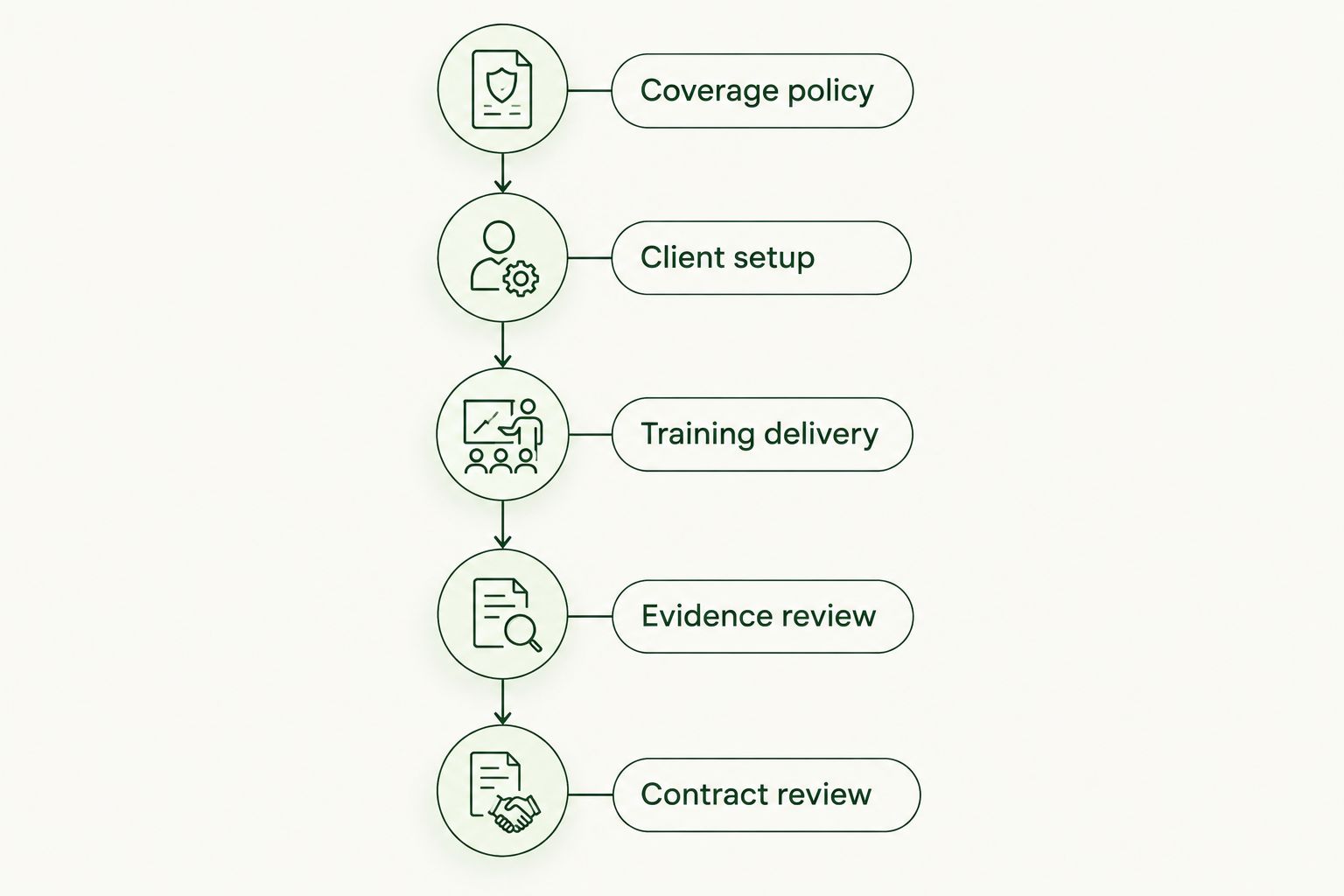
Evaluate the complete service before selecting the platform.
Give both vendors the same acceptance criteria. Record a pass, an unresolved question, or a failure for each requirement. Do not turn an unanswered question into a presumed capability.
Final verdict: choose the service model first
Choose Defend Wise if you run an MSP training service
Defend Wise wins for the MSP buyer whose priorities are white-label delivery, a flat platform fee, and unlimited seats. Its stated offer directly matches that profile.
Select it after confirming that the employee workflow, client administration, and evidence output meet your requirements. The commercial model is the reason to shortlist it—not a substitute for product acceptance.
Choose CanIPhish if phishing simulation leads your brief
CanIPhish is the better starting shortlist choice for a buyer organizing the evaluation around phishing simulation. Test the campaign and training follow-up first, then confirm the broader service and contract fit.
Do not select it solely because you want simulated phishing. Select it when the demonstrated workflow satisfies your written requirements and the agreement supports your intended deployment.
| Dimension | Winner or decision rule |
|---|---|
| MSP training bundle | Defend Wise |
| Phishing-first evaluation | CanIPhish |
| Explicit white-label offer | Defend Wise |
| Unlimited-seat platform model | Defend Wise |
| Training category coverage | Tie; inspect the training |
| Compliance outcome | Neither guarantees it |
| Pricing fit | Compare the contract with your service scope |
| Operational fit | Decide through the acceptance test |
FAQ
Is Defend Wise or CanIPhish better for an MSP?
Defend Wise is the clearer fit for an MSP seeking flat-fee, white-label security awareness training with unlimited seats. Confirm the administration, training, and evidence workflows before selecting it.
Which should I evaluate for phishing simulation?
CanIPhish belongs on a phishing-first shortlist. Ask it to demonstrate your intended campaign, employee follow-up, and reporting requirements.
Does unlimited-seat training remove all MSP delivery costs?
No. Unlimited seats remove seat-based friction from the stated platform fee, but onboarding, reporting, and exception handling still require a defined service scope.
Does white-label training guarantee that every screen is customizable?
No. A white-label offer does not establish the customization controls on every screen, message, or report. Inspect the surfaces your clients will actually use.
Will either platform make my clients compliant?
Neither platform purchase establishes compliance by itself. Match the training records and service responsibilities to each client's actual obligations.
How should I compare the pricing models without focusing on a headline fee?
Compare the billing basis, included scope, and contract treatment of coverage changes. Then account separately for your MSP's onboarding, administration, reporting, and exception work.
What should I test before choosing a training platform in 2026?
Test coverage policy, client setup, training delivery, evidence review, and contract fit. Apply the same acceptance criteria to both candidates so a strong demonstration does not hide an unresolved requirement.
One last thing
Ask the vendor to show you what happens after the training is complete. Review the client-facing record, an incomplete assignment, and a routine user change.
That is where your managed service continues after the lesson ends. Choose the platform that passes those ordinary workflows—not just the one that presents the strongest opening demonstration.