Security awareness training evidence for cyber insurance renewals
Prepare the SAT slice of a cyber insurance evidence pack: completion records, phishing simulation results, overdue users, exceptions, and follow-up notes.
DefendWise
DefendWise
TL;DR
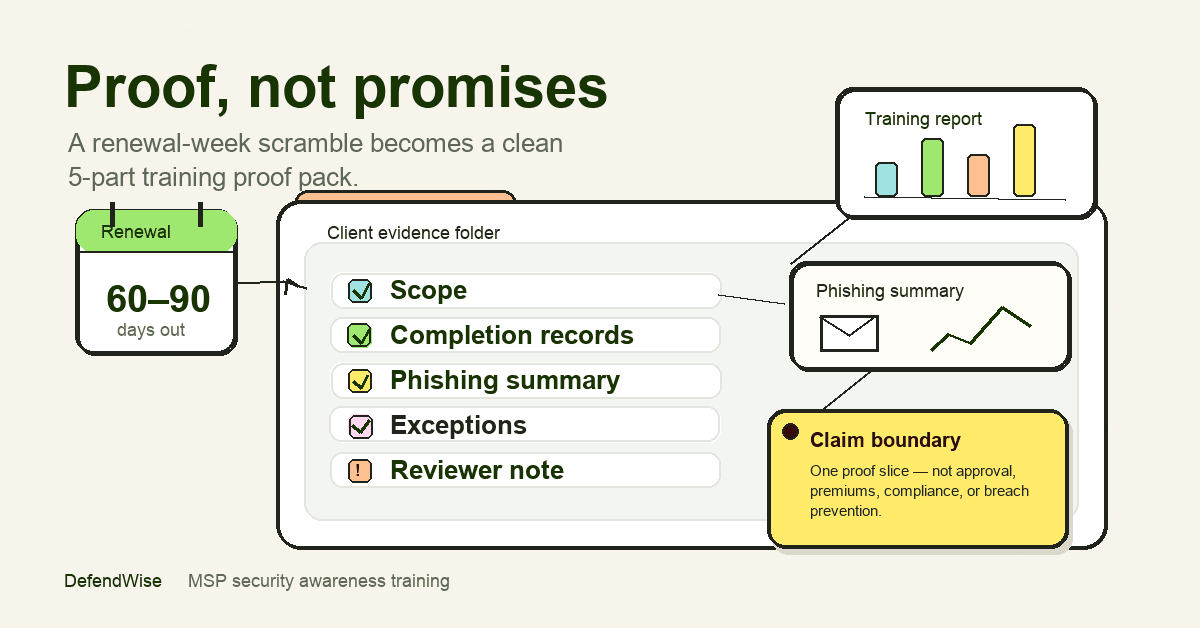
Security awareness training evidence is one slice of a cyber insurance renewal pack. It does not prove full insurance readiness, but it can show whether users were in scope, training was assigned, completion was tracked, phishing simulations were recorded where available, and exceptions were handled honestly.
For the full MSP evidence pack across MFA, backups, endpoint coverage, patching, logging, access, and incident response, use the broader cyber insurance evidence checklist. This article is only the SAT proof folder.
DefendWise can support the security awareness training and phishing-training proof slice of that wider pack. It should never be positioned as a guarantee of cyber insurance approval, lower premiums, compliance satisfaction, or breach prevention.
What is cyber insurance training evidence?
Cyber insurance training evidence is the set of records an MSP can use to show that a client’s workforce security awareness program is real, scoped, tracked, and repeatable.
That usually means more than saying, “Yes, we do annual training.” A useful evidence pack can show who was in scope, what training was assigned, when it was completed, what exceptions remain, and whether related phishing or reporting exercises were run.
This matters because insurance renewal conversations are moving from broad attestations toward verification. Help Net Security’s June 2026 renewal coverage described the shift as insurers asking for more questionnaires, more evidence, and more attestations because the market is moving from trusting answers to verifying them. Huntress makes the same practical point in its cyber insurance guide: carriers increasingly want receipts for controls such as MFA, EDR, backups, monitoring, incident response, and security awareness training.
Training evidence does not sit alone. It is one slice of a broader renewal pack that may also include MFA enforcement, endpoint coverage, backup testing, incident response plans, logging, patching, and vendor access controls. For the MSP, the right framing is simple: this is the awareness-training proof folder, not the whole insurance file.
Authoritative security frameworks also support the idea that awareness programs should be structured and maintained. NIST SP 800-50 Rev. 1 describes a lifecycle approach to building a cybersecurity and privacy learning program, including planning, delivery, measurement, and regular updates. CIS Critical Security Control 14 similarly focuses on establishing and maintaining a security awareness and skills training program to influence workforce behavior.
None of that means every insurer asks the same question or accepts the same proof. The carrier and broker decide what is required. The MSP’s job is to make sure the client is not scrambling for basic SAT records when renewal pressure lands.
Why this matters for MSPs
MSPs are often the first call when a client receives a renewal questionnaire. The client does not always know which controls the MSP owns, which controls a broker needs, and which controls require internal business decisions.
That creates 3 problems.
First, the MSP can get pulled into evidence assembly at the worst possible time. A renewal deadline turns into screenshots, CSV exports, calendar archaeology, and a hunt through every security portal. The technical work may be small; the admin drag is not.
Second, weak evidence makes a strong program look weaker than it is. A client may have training in place, but if the MSP cannot show dates, coverage, and exceptions cleanly, the story becomes vague. CyberDuo’s 2026 renewal checklist makes the same general point about renewals: organizations can run into trouble not because they have no security, but because they cannot prove quickly and clearly that expected controls are in place.
Third, evidence requests affect MSP packaging. If training proof is easy to pull for 1 client but painful for 30, the service does not scale. Multi-client SAT should leave behind reviewer-ready records by default, not become a manual project for every renewal.
Coalition has also argued that MSPs and cyber insurance providers are increasingly connected in the client’s risk picture. MSPs help clients implement controls, maintain evidence, and support underwriting conversations. That does not make the MSP the insurer, the broker, or the compliance authority. It does make the MSP responsible for being clear about what it can prove.
What MSPs actually need in the training evidence pack
A good evidence pack is not a folder dump. It is a short, client-specific set of records that answers the obvious reviewer questions.
| Evidence item | What it should show | Why it matters |
|---|---|---|
| Client scope | Legal entity, tenant/client name, period covered, user groups in scope | Prevents confusion about which client and workforce the records cover |
| Learner roster | Users assigned training, role/group where available, active/inactive status | Shows who was expected to complete training |
| Completion records | Assignment date, completion date, status, course/module name | Shows training happened and can be traced to users |
| Phishing simulation summary | Campaign date, audience, delivery count, click/report metrics if tracked | Shows testing or practice activity where the client runs simulations |
| Follow-up actions | Remedial training, manager follow-up, repeat assignments, exceptions | Shows the MSP did more than run a one-off campaign |
| Exceptions log | Users not trained, business reason, owner, target date | Keeps gaps visible instead of hiding them |
| Program cadence | Monthly, quarterly, annual, or event-driven schedule | Shows training is recurring, not a renewal-week scramble |
| Reviewer note | 1-page explanation of what the evidence proves and does not prove | Reduces misinterpretation and claim drift |
The reviewer note is underrated. It can say, in plain English: “This pack shows security awareness training assignment and completion records for Client A for the period January-June 2026, plus phishing simulation summary records where available. It does not prove MFA, EDR, backup testing, incident response testing, or insurance eligibility.”
That note protects the MSP from overclaiming and helps the client understand the limits of the artifact.
Step-by-step: build the renewal-ready SAT proof pack
1. Confirm the renewal window and broker ask
Start by asking the client when renewal is due and whether the broker or carrier has already provided a questionnaire. If there is a specific wording around training, keep it with the evidence pack.
Do not translate a generic blog post into a carrier requirement. If the carrier asks for a particular artifact, source the answer from the questionnaire or broker guidance.
2. Define the client and user scope
Write down which entity, location, tenant, or client environment the pack covers. Then define the workforce in scope: all employees, specific departments, privileged users, remote staff, contractors, or another group.
This is where MSPs get into trouble with multi-tenant delivery. One mixed export across clients is not evidence; it is a data-handling problem. Keep each client’s records separated.
3. Pull training completion records
Export the simplest usable record set: assigned users, module names, assignment dates, completion dates, and status. Include the date range covered.
The point is not to impress the reviewer with every possible field. The point is to make completion easy to verify. If there are gaps, keep them in the pack with owner and next action rather than pretending the record is perfect.
4. Add phishing simulation evidence where available
If the client runs phishing simulations, include a campaign summary. Useful fields include date, audience size, emails delivered, clicks, reports, training assigned after the simulation, and any excluded groups.
Be careful with metrics. A click rate is a signal, not a complete measure of security culture. NIST’s work around phishing measurement, including the Phish Scale, is a reminder that phishing results need context. Do not turn a single campaign into a broad breach-prevention claim.
5. Add follow-up and remediation notes
Training evidence is stronger when it shows what happened after the first assignment. Did incomplete users receive reminders? Did clicked users receive extra training? Did managers get a summary? Were new starters added later?
This does not need to be a novel. A short action log with dates and owners is usually more useful than a long narrative.
6. Add exceptions instead of hiding them
Every MSP knows the real world has exceptions: leave, turnover, contractors, shared mailboxes, dormant accounts, and clients who never provide a clean roster.
List those exceptions. Include why they exist, who owns them, and when they will be addressed. A transparent exceptions log is better than a perfect-looking export that falls apart under one question.
7. Package the evidence with a short cover note
End with a 1-page cover note. It should include the client, period, records included, records not included, source systems, and contact owner.
Use plain language. The broker, underwriter, finance lead, and client owner may all read it. Do not bury the point in platform jargon.
What good looks like
A renewal-ready training evidence pack has 5 traits.
It is client-specific. Every record maps to one client, tenant, or legal entity. No mixed-client exports.
It is dated. Training and simulation records show when activity happened, not just that a program exists somewhere.
It is scoped. The pack explains who was included and who was not.
It is honest about gaps. Exceptions and incomplete users are visible, with owner and next action.
It is easy to hand off. A broker or client stakeholder can understand it without a 30-minute screenshare.
The best MSPs will make this part of routine client reporting, not a one-off renewal scramble. Monthly or quarterly client reports, QBR notes, and standard evidence packs all reduce last-minute pressure.
Internal DefendWise reading that supports this operating style:
- The Coverage Gap: Why MSPs Struggle to Train Every Client
- Bulk import users to a multi-tenant training platform: an MSP guide
- How to Prepare Compliance Evidence Packs for ISO 27001 Audits
- DefendWise flat-fee MSP security awareness training
Mistakes to avoid
Mistake 1: Saying training proves insurance readiness
Training is one control area. It does not prove MFA, EDR, backup resilience, incident response, vulnerability management, or vendor risk.
Keep the claim narrow: training evidence supports the awareness-training portion of a broader renewal pack.
Mistake 2: Waiting until the questionnaire arrives
If the client asks for evidence 4 days before renewal, the MSP is already in scramble mode. A better process keeps training records and exceptions updated throughout the year.
A 60-90 day pre-renewal check is a practical fallback if the MSP does not yet have year-round reporting discipline.
Mistake 3: Mixing clients in one export
MSPs live in multi-tenant systems. Evidence must respect that. A spreadsheet with multiple clients in the same file creates confusion and may create confidentiality risk.
Export one client at a time. Name files clearly. Remove unrelated tenant data.
Mistake 4: Hiding incomplete users
Incomplete training is not ideal, but hiding it is worse. Exceptions happen. Make them visible, explain the reason, and attach a next action.
The reviewer is not helped by a clean-looking pack that leaves obvious questions unanswered.
Mistake 5: Treating phishing clicks as the only metric
Phishing simulation results are useful, but they need context. Campaign difficulty, timing, user role, reporting behavior, and follow-up all matter.
If you include phishing data, explain it carefully. Do not say a low click rate proves breach prevention or that a high report rate guarantees resilience.
Framework and evidence mapping
Use frameworks lightly. The goal is to make the evidence easier to understand, not to turn a cyber insurance renewal into an audit cosplay exercise.
NIST SP 800-50 Rev. 1 is useful because it describes a lifecycle approach to cybersecurity and privacy learning. For an MSP, that maps naturally to: define the client training program, deliver the content, track participation, measure outcomes carefully, then maintain and improve it.
CIS Critical Security Control 14 is useful because it frames awareness as an ongoing program that influences workforce behavior and skills. That supports the idea that training should be maintained and recorded, not run once and forgotten.
NIST SP 800-53 includes the Awareness and Training control family. Training records are part of that family’s evidence conversation in many audit contexts, but do not cite control numbers in a client pack unless you have verified the exact framework and requirement that applies to that client.
The FTC Safeguards Rule may also matter for some clients in financial-services-adjacent categories, because covered businesses must maintain an information security program and train staff. But an MSP should not assume a client is covered or give legal advice. If a client asks whether a rule applies, route them to counsel, their broker, or the appropriate compliance advisor.
For cyber insurance renewals, keep the pack practical:
- What did we train?
- Who was included?
- Who completed it?
- What phishing or reporting practice ran, if any?
- What gaps remain?
- What does this prove, and what does it not prove?
That is the level of clarity most MSPs need before the renewal conversation gets stressful.
How a flat-rate MSP SAT platform helps
Per-seat pricing can make full-client coverage harder to justify, especially across small accounts and lower-margin clients. That becomes a problem when evidence requests arrive and the MSP has trained only some clients or some users.
A flat-rate, multi-tenant SAT platform helps MSPs standardize training coverage and reporting across the client base. DefendWise supports the SAT/phishing-training evidence slice with white-label, MSP-focused training delivery and client-level reporting, without turning every added user into another seat-cost decision.
That is not an insurance promise. It is an operations promise: make it easier for the MSP to run training broadly and produce cleaner proof when the client asks.
Frequently asked questions
What cyber insurance training evidence should an MSP prepare for a client renewal?
Prepare client-level records that show scope, training assignments, completion status, dates, phishing simulation activity where available, remediation notes, and exceptions. Add a short cover note explaining what the records prove and what they do not prove.
Can security awareness training guarantee cyber insurance approval?
No. Security awareness training is only one part of a broader cyber insurance evidence pack. It cannot guarantee approval, coverage, premium changes, renewal outcomes, compliance satisfaction, or breach prevention.
When should MSPs start preparing training evidence before renewal?
Ideally, the MSP keeps records current all year through routine reporting. If that process is not mature yet, start a focused pre-renewal evidence check 60-90 days before the client’s renewal date.
Should MSPs include phishing simulation results in cyber insurance evidence?
Yes, if the client runs phishing simulations and the results are cleanly available. Include campaign dates, audience size, delivery counts, click/report metrics where tracked, and follow-up training. Explain the limits of the data so the result is not overread.
What if a client has incomplete training records?
Do not hide the gap. Include an exceptions log with the users or groups affected, the reason, the owner, and the target resolution date. Transparent exceptions are more credible than a pack that pretends every record is perfect.
How should MSPs package evidence for multiple clients?
Package one client at a time. Keep tenant-separated exports, clear file names, date ranges, and reviewer notes. Never mix multiple client records into one shared spreadsheet or PDF.
Does a framework mapping help with cyber insurance renewals?
Sometimes. NIST and CIS references can help explain why awareness training records matter, but the carrier’s questionnaire and broker guidance should drive the actual evidence request. Do not cite control numbers unless they are verified for the client context.
How can DefendWise help MSPs prepare training evidence?
DefendWise helps MSPs run security awareness training across client tenants and produce client-level reporting under a flat-rate, white-label model. It supports the SAT proof slice of the evidence pack, while the MSP still owns the broader renewal conversation with the client, broker, and other control owners.