Can employees be fired for failing a phishing test?
Can employees be fired for failing phishing test? Yes, but legal limits apply. Learn what employers must review and how MSPs should handle simulation results.
DefendWise
DefendWise
Yes, employees can be fired for failing a phishing test in the United States, but a failed simulation does not automatically make a dismissal lawful. In 2026, the answer depends on the employment relationship, applicable state law, workplace policies, and whether the decision violates a contract or legal protection. A click is evidence of an action—not proof of intent, misconduct, or the employer’s right to terminate.
TL;DR
- Can employees be fired for failing phishing test? Yes, but contracts, state law, and protected rights limit termination.
- A failed phishing simulation calls for fact-checking and targeted security awareness training before disciplinary decisions.
- Separate an accidental click from deliberate policy violations, repeated noncompliance, and actual exposure of sensitive information.
- Defend Wise fits MSPs seeking flat-fee, white-label security awareness training—not an employment-law decision system.
Can employees be fired for failing a phishing test?
An employer operating under an at-will employment relationship generally can dismiss an employee for a lawful reason without proving serious misconduct. That does not eliminate restrictions imposed by employment contracts, collective bargaining agreements, anti-discrimination laws, retaliation protections, or state-specific rules.
A phishing-test result is not a legal exemption from those restrictions. An employer must assess the actual employment circumstances rather than assume that a security label makes every disciplinary decision defensible.
For MSPs, Defend Wise provides white-label security awareness training for end-client organizations. Keep training administration separate from employment decisions: the client’s authorized management, HR team, and legal advisers should handle disciplinary review.
| Response | Best for | Benefit | Limitation |
|---|---|---|---|
| Targeted coaching | An accidental mistake with an identifiable learning gap | Addresses the behavior the employee needs to change | Does not resolve deliberate refusal to follow policy |
| Formal discipline | Documented policy violations requiring a management response | Makes expectations and consequences explicit | Requires review of policy, consistency, and legal protections |
| Termination review | Conduct serious enough to justify considering dismissal | Allows authorized decision-makers to assess employment consequences | A failed simulation alone does not establish that dismissal is lawful |
These are response categories, not an automatic escalation ladder. The facts determine which response belongs in the discussion.
Why this matters
A phishing simulation measures how an employee responds to a particular message. It does not, by itself, establish whether the employee understood a policy, received suitable training, intentionally disregarded instructions, or caused a real security incident.
For a 2026 MSP training program, define the purpose before deployment. A learning exercise needs a learning response; a disciplinary process needs evidence, authorized decision-makers, and employment-law review.
The distinction also matters when you sell training alongside compliance support. Completion records and simulation results describe activity. They do not establish legal compliance, prove that someone deserves dismissal, or replace an investigation.
What counts as failing a phishing test?
Start with the event, not the label. Opening a message, following a link, entering information, opening an attachment, and reporting a suspicious email are different actions. A useful review identifies exactly what happened.
Do not assume that every recorded interaction came from the employee. Email-security systems can inspect links automatically. Confirm how the simulation records interactions and whether the available evidence supports attributing the event to a person.
Opening or clicking
A message opening or link click establishes less than a completed interaction with a simulated credential page. Ask what the employee saw, what action the record shows, and whether the employee subsequently recognized and reported the message.
Do not describe a click as credential disclosure unless the evidence shows credential disclosure. Precision matters when a training record becomes part of an employment discussion.
Entering information or opening an attachment
Submitting information or interacting with an attachment calls for a different review from opening an email. Identify the action without overstating what a simulation proves about real-world damage.
If an actual incident occurred alongside the exercise, handle incident response separately. A simulated event and a confirmed exposure are not interchangeable, even when they involve similar behavior.
Reporting after a mistake
An employee can make a mistake and then take the correct next action by reporting it. Record both events rather than treating the initial interaction as the entire outcome.
Reporting does not erase a policy violation. It gives the employer additional evidence about the employee’s response and provides a behavior the training program can reinforce.
Why the employment outcome varies
There is no universal firing rule for a failed phishing simulation. In a 2026 review, assess these factors before treating a result as grounds for dismissal:
- Employment status and applicable law: At-will employment, public-sector employment, contracts, and collective bargaining agreements carry different constraints.
- Written expectations: Review what the security policy required, how it was communicated, and what consequences it actually described.
- Training and instructions: Establish whether the employee received relevant guidance and had a workable way to report suspicious messages.
- Verified conduct: Distinguish an accidental interaction from intentional disclosure, refusal to follow instructions, or another documented violation.
- Consistency and protected rights: Compare treatment of similar conduct and check for discrimination, retaliation, or other unlawful grounds.
- Prior documented events: Examine what earlier records actually establish; do not turn an unsupported allegation into a repeated offense.
No single factor supplies blanket permission to fire. A policy acknowledgment, for example, does not override a contract or statutory protection.
How should an employer review a failed phishing test?
Use a documented process that separates security facts from employment judgments. For a 2026 program, decide who owns each step before employees receive the simulation.
Establish the event
Confirm the message, the recorded action, and the evidence connecting that action to the employee. Check whether automated link inspection or another technical explanation affects the record.
Preserve the relevant facts without collecting unnecessary sensitive information. The review should explain what happened, not expand into unrelated surveillance.
Check the policy
Identify the rule the employer believes was violated. A general instruction to remain alert is different from a specific requirement not to submit credentials through an unsolicited email link.
Review the version of the policy that applied at the time. Do not retroactively apply a new disciplinary standard to an earlier exercise.
Hear the employee
Give the employee an opportunity to explain the interaction. Their account can clarify what appeared on screen, whether they reported the message, and whether instructions or reporting access were unclear.
Compare that account with the available records. Neither the employee’s explanation nor a dashboard label should replace a factual review.
Review protections
Before considering discipline, check the employment agreement, applicable policies, and relevant legal protections. Public-sector procedures and collectively bargained processes require particular attention where they apply.
A security rationale does not authorize discriminatory treatment or unlawful retaliation. Route those concerns to qualified employment counsel rather than asking the training administrator to decide them.
Choose the response
Match the response to the verified conduct and the purpose of the exercise. Targeted instruction fits a learning gap; a documented policy violation requires the client’s established management process.
Write down the reason for the decision. Keep the security finding distinct from the employment judgment so the record does not imply that a simulation automatically required punishment.
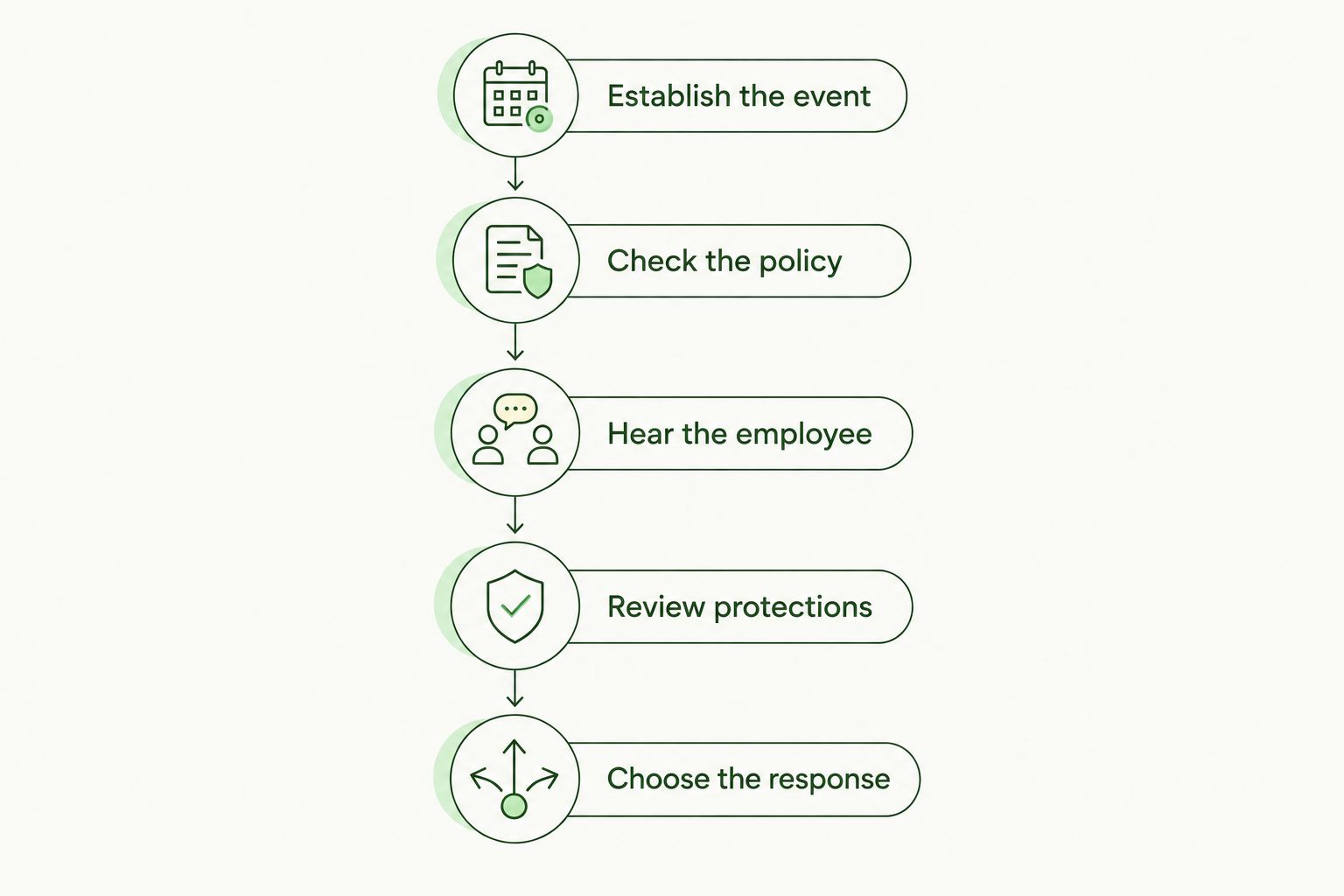
Verify the security event before deciding its employment consequences.
What should your phishing-test policy say in 2026?
Write the response rules before the test, not after someone fails. Your policy should explain the purpose of simulations, expected employee behavior, the reporting route, and how results enter a review process.
Separate training participation from simulation outcomes. Refusing assigned training is different from making a mistake during a test; combining the two hides the conduct management actually needs to evaluate.
A usable policy should address:
- Purpose: Explain whether simulations support education, risk assessment, or both.
- Reporting: State how employees should report suspicious messages and mistakes.
- Result handling: Identify who can access individual records and who reviews disputed results.
- Response process: Describe how coaching, retraining, and disciplinary review are considered.
- Employment safeguards: Keep the process subject to applicable law, contracts, and collective bargaining obligations.
Do not promise automatic dismissal unless the employer has deliberately adopted and legally reviewed that approach. Likewise, do not promise that simulation conduct can never have consequences if other workplace rules remain applicable.
A template is a starting point, not an employment-law assessment. Have the employer’s authorized reviewers approve the policy for the actual workforce and jurisdiction.
What should MSPs do instead of becoming the disciplinary referee?
An MSP’s role is to administer the agreed service, explain the security evidence, and support the client’s training process. The client owns employment decisions. Put that boundary in the service workflow so a technician is not asked to recommend dismissal from a report.
Defend Wise security awareness training is best for MSPs seeking a flat-fee, white-label platform for end-client organizations. Its stated unlimited-seat model addresses seat-count friction; it does not determine whether an employee’s termination is lawful.
The benefit is a training model aligned with MSP delivery. The boundary is equally important: software cannot replace the client’s policy, employee interview, or legal assessment. Do not present training records as a certification of employment-law compliance.
For each subclient, agree on:
- Who receives individual results and aggregate reports.
- Who confirms disputed interactions before escalation.
- Who assigns follow-up training and records completion.
- Who refers disciplinary questions to HR or employment counsel.
- What the client expects as compliance evidence, without promising that one report satisfies every requirement.
Keep the handoff factual. Describe the verified interaction, the applicable training assignment, and any reporting action. Leave labels such as negligent, insubordinate, or terminable to the authorized employment review.
Can my employer fire me after one failed phishing test?
Yes, a single failed test can lead to dismissal in an at-will employment relationship, but the decision must still be lawful. Review your employment agreement, any applicable collective bargaining agreement, and the employer’s stated policy.
Preserve the relevant communications and explain what happened accurately. If discrimination, retaliation, or a contractual violation is involved, consult qualified employment counsel about your circumstances.
Is failing a phishing test the same as misconduct?
No, failing a phishing test does not automatically establish misconduct. The employer must distinguish the recorded interaction from the rule allegedly violated and assess the surrounding facts.
An accidental click, deliberate disclosure, and refusal to complete required training are different events. A fair factual review keeps those distinctions visible.
Does passing training guarantee that I cannot be fired?
No, completing security awareness training does not guarantee protection from dismissal. Completion establishes participation in the assigned activity, not immunity from workplace rules or future employment decisions.
The reverse is also true: an incomplete assignment or failed simulation does not remove legal protections. Training status and employment rights remain separate questions.
FAQ
Can employees be fired for failing phishing test in 2026?
Yes, employees can be fired for failing a phishing test in the United States, but a dismissal must comply with applicable law and employment obligations. A simulation result does not override contracts, collective bargaining agreements, or protections against discrimination and unlawful retaliation.
Can I be fired just for clicking a simulated phishing link?
Yes, a simulated-link click can be part of an employer’s reason for dismissal under an at-will relationship, subject to legal limits. The employer should verify the interaction rather than treat a click as proof of credential disclosure or deliberate misconduct.
Does my employer have to warn me before firing me for a phishing test?
There is no universal U.S. requirement for a warning before dismissal for a failed phishing test. Applicable law, contracts, collective bargaining agreements, and the employer’s own obligations determine the required process.
Should I report a phishing email after I have already clicked it?
Yes, report the message and your interaction promptly through your employer’s designated channel. Accurate reporting supports the security response and records what you did after recognizing the problem.
Can a phishing-test result be wrong?
Yes, a recorded interaction can require technical verification before it is attributed to an employee. Automated link inspection is one reason to examine how the simulation records activity.
Is repeated failure enough to justify termination?
Repeated failure does not automatically establish that termination is lawful. Review the verified conduct, training history, written expectations, employment obligations, and consistency of the proposed response.
Can Defend Wise decide whether a client should fire an employee?
Defend Wise provides security awareness training for MSPs, not an employment-law determination. The client’s authorized management, HR team, and legal advisers should evaluate disciplinary decisions.
One last thing
Track the recovery action, not just the initial mistake. An employee who reports a suspicious message after interacting with it has given the security team information that a failure-only label leaves out.
Make that distinction explicit in your 2026 review process. Document the interaction, the report, and the follow-up separately, then let authorized reviewers assess the employment consequences.
This article provides general U.S. information, not legal advice. Consult qualified employment counsel before making or challenging a disciplinary decision.