Can a business run security training on zero budget?
Free security awareness training for small business works with an owner and clear reporting. Build a practical plan using CISA and FTC resources.
DefendWise
DefendWise
Yes. A business can run security awareness training without buying a course by using free public resources, assigning an owner, and recording participation. The work does not disappear: someone still has to choose relevant lessons, explain your reporting process, and follow up with employees.
TL;DR
- Free security awareness training for small business works when someone owns delivery, reporting instructions, and attendance records.
- CISA and the FTC provide public cybersecurity education; choose lessons that match your employees’ work.
- Free learning materials do not automatically provide training administration or compliance evidence.
- Start with phishing, account protection, and a clear way to report suspicious activity.
Can a business run security training on zero budget?
Yes, if zero budget means no spending on training materials rather than no staff time. You can build a basic program from public guidance and deliver it through meetings or communication tools you already use.
For MSPs comparing this approach with Defend Wise, separate the lesson content from the work of managing training across client organizations. Those are different requirements.
For your 2026 plan, choose an approach based on who will run it and what records you need:
| Approach | Best for | Main advantage | Main limitation |
|---|---|---|---|
| CISA public resources | Businesses starting with everyday security habits | Guidance on phishing, passwords, multifactor authentication, and software updates | You must organize delivery and keep your own participation records |
| FTC small-business resources | Owners connecting cybersecurity to business operations | Business-focused explanations of common cybersecurity issues | Reading the guidance does not establish that employees completed training |
| Internally led lessons using public resources | Teams with an available training owner | You can connect advice to your actual reporting process | Preparation, reminders, and recordkeeping remain internal work |
These approaches can work together. Use public guidance for the lesson, then add your business’s instructions for handling the situation. A generic phishing explanation becomes useful when employees also know exactly where to send a suspicious message.
Why this matters
Free content is not the same as a managed training program. A folder of links gives employees information; a program gives them an action, a deadline, a reporting route, and follow-up.
That distinction matters when a customer, insurer, or internal stakeholder asks what training occurred. A resource link shows what you shared, not who reviewed it or what they understood. Keep those claims separate.
For a small business, the practical goal is straightforward: make expected behavior clear without creating an administrative task nobody owns. Start with the risks employees encounter in their work, not a long syllabus assembled because the materials were available.
Public resources: best for getting started
CISA’s Secure Our World guidance covers recognizable actions: recognize and report phishing, use strong passwords, enable multifactor authentication, and keep software updated. These topics give you a starting point without requiring you to write security advice from scratch.
The FTC’s Cybersecurity for Small Business materials address business-facing cybersecurity issues. Use them when you need to connect employee behavior with business processes, such as checking requests involving sensitive information.
For your 2026 resource list, select a specific topic rather than sending employees to a large library. Tell them what to read, what behavior to practice, and where to ask questions. Check that the resource remains accessible before assigning it.
Best for: a business that needs trustworthy educational material and has someone available to manage delivery.
Trade-off: public resources provide guidance, not a record of your employees’ participation. You still need a way to document the assignment and explain your own procedures.
Avoid treating an agency name as proof that your training program meets a particular contract or insurance requirement. The material’s source and your organization’s evidence are separate questions.
Internally led training: best for explaining your procedures
Use an internally led session to connect general advice to the way your business works. Employees need to know whom to contact, how to verify an unusual request, and what to do after a mistake.
Keep examples generic and remove confidential details. You do not need to circulate an actual customer invoice or expose an employee’s error to explain how an impersonation attempt works.
A useful lesson ends with an action employees can repeat. For example, ask them to explain how they would verify an unexpected request to change payment details. Assess the verification process, not whether they remember a technical term.
Best for: a business whose immediate need is clear instructions tied to its own workflows.
Trade-off: accuracy and consistency depend on the person preparing the lesson. Use authoritative guidance for security recommendations, and have the relevant business owner confirm instructions about payments, access, or sensitive information.
Build a small training routine you can maintain
Use this sequence as a suggested starting plan, not a regulatory standard or a promise of sufficient coverage. The time boxes below are planning choices you can adjust to your team.
1. Assign ownership
Name the person responsible for selecting material, sending assignments, recording participation, and answering questions. Give employees a backup contact when that person is unavailable.
Ownership must include follow-up. If everyone is responsible for training in general, nobody is responsible for checking whether a specific assignment was completed.
2. Choose one behavior
Start with a behavior employees can demonstrate, such as reporting a suspicious email. Avoid combining phishing, device security, payment fraud, and data handling into one crowded lesson.
For a suggested 10-minute lesson, select a short resource and explain the action you expect afterward. The time box keeps the assignment focused; it is not evidence that the topic has been fully covered.
3. Explain reporting
Write down the reporting route in language employees already use. Identify the person or established channel that receives concerns, and explain what information to include.
Do not invent a new reporting address unless your business has created and assigned it. If employees report through a manager, make that instruction explicit and explain the alternative when that manager is absent.
4. Practice a decision
Schedule a suggested 15-minute discussion around a fictional request. Ask employees what they would do before opening an unexpected attachment, sharing sensitive information, or acting on changed payment instructions.
Use the answers to find unclear procedures. If employees disagree about who can approve a request, fix that process rather than assigning another generic article.
5. Record and review
Keep the assignment date, topic, resource, intended audience, and completion status together. Record any questions that require a change to your instructions.
Set a suggested 30-day review to check whether assignments were completed and reporting instructions remain accurate. This is an operating choice for your 2026 plan, not a compliance deadline.
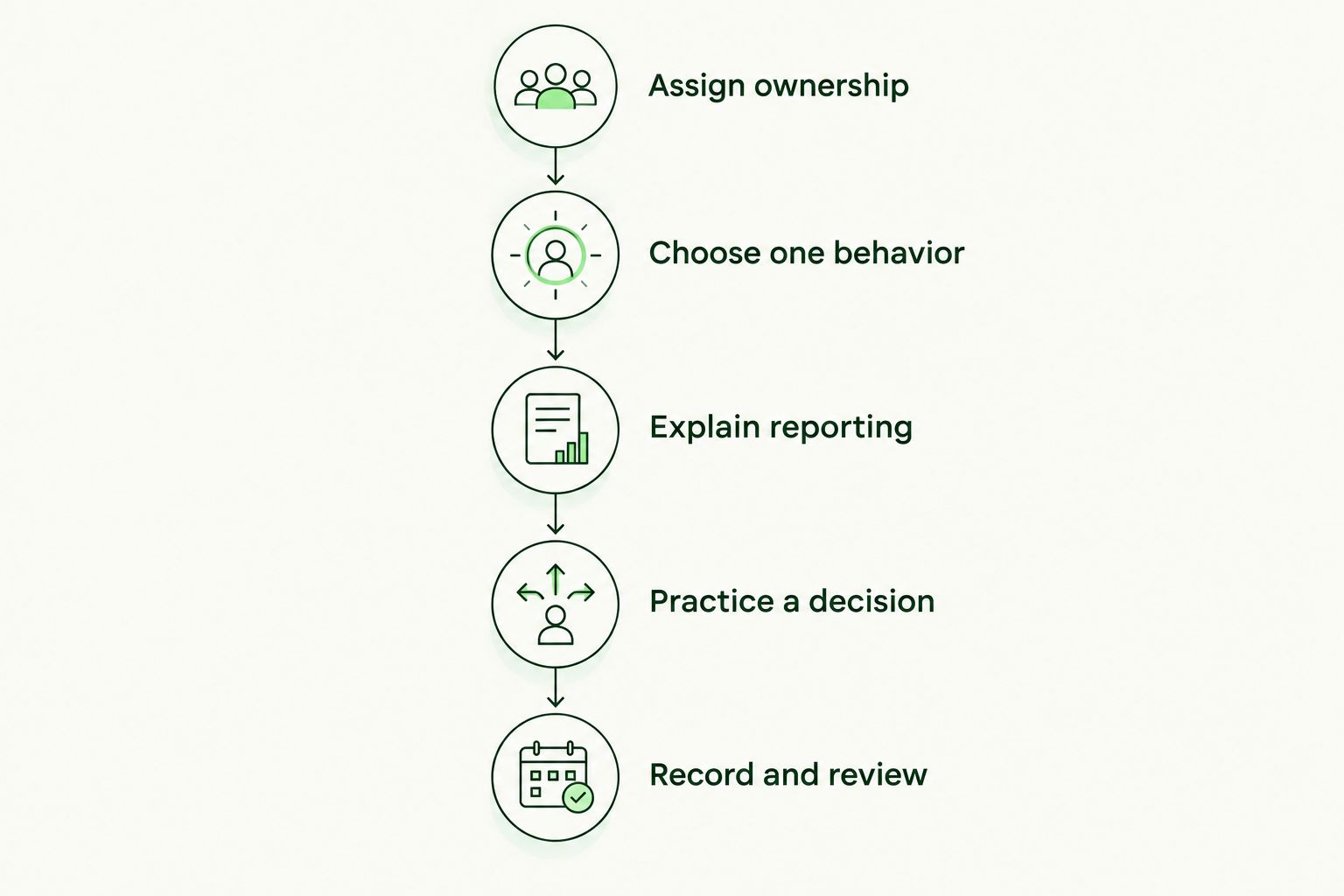
Choose the behavior and reporting route before you ask employees to complete training.
Why zero-budget training still takes work
A no-purchase approach leaves several responsibilities with your business. Scope these tasks before you commit to running the program internally:
- Material selection: choose guidance that matches employees’ responsibilities rather than sending the same collection of links to everyone.
- Local instructions: add the reporting, approval, and verification steps that public materials cannot specify for your organization.
- Participation tracking: distinguish an assignment sent from an assignment completed. Keep the record accurate rather than assuming attendance.
- Follow-up: answer questions, address missed assignments, and correct instructions that employees find confusing.
- Evidence preparation: retain records in a form you can retrieve when someone asks about training.
You do not need to estimate a financial return to make this decision. Identify who will perform each task and whether that responsibility fits their role. If no one can own the work, collecting more free resources does not solve the problem.
For an MSP, repeat this exercise across end-client organizations. Separate client-specific reporting instructions and records rather than treating every subclient as one undifferentiated audience.
What should you keep as training evidence?
Keep records that describe what actually happened. A useful starting record includes the topic, source material, assignment date, intended participants, and the completion information you collected.
Distinguish the type of evidence. A meeting attendance list records attendance; an acknowledgment records acknowledgment; an answered exercise records the response to that exercise. None should be relabeled as proof of something broader.
For your 2026 evidence folder, retain the instructions employees received alongside the participation record. This lets you explain both the content and the process without reconstructing an old assignment from memory.
Training records do not automatically establish compliance. If an insurer, customer, or contract specifies training requirements, compare those requirements with your actual program. Do not substitute a generic certificate or a public resource list for the requested evidence.
Keep incident reporting separate from completion tracking, too. Finishing a lesson does not tell you whether an employee knows where to report a real concern. Ask that question directly during the exercise.
When should you consider a managed platform?
Consider a platform when the management requirement exceeds what your internal routine can reliably deliver. Write down the missing capability first: client separation, assignment handling, reporting, branding, or evidence retrieval. Then check that requirement against the platform’s documented capabilities.
Defend Wise is best for MSPs seeking white-label security awareness training with unlimited seats. Its stated model centers on a flat fee rather than per-seat billing. That distinction is relevant to an MSP packaging training across end-client organizations, not a reason to purchase software before defining the service.
The fit and limitation are different sides of the same decision. Defend Wise addresses an MSP-oriented software requirement; a business seeking only public educational materials can start with CISA or FTC guidance instead. Do not confuse the need for content with the need for a platform.
Before selecting any platform, ask for a demonstration of the workflows you require. Confirm how assignments, client records, reporting, and evidence retrieval work rather than assuming those capabilities from a category label.
Can free training satisfy an insurance questionnaire?
Free training can be part of the activity you describe, but your answer must match the questionnaire’s wording and your records. State what you actually deliver, how often you deliver it, and how you document participation.
If a question asks about a practice you do not perform, do not treat related educational content as an equivalent. Clarify the requirement with the requesting party.
Should you run phishing simulations immediately?
Start by establishing the reporting process and teaching employees how to use it. A simulation should not be the first time an employee learns whom to contact about a suspicious message.
If you later consider simulations, define the objective, authorization, handling of employee information, and follow-up before choosing a delivery method.
How do you know whether the lessons are useful?
Ask employees to demonstrate the expected action using a fictional scenario. A correct explanation of how to verify a request or report a message is more informative than asking whether the lesson was interesting.
Keep completion and understanding separate. You need an accurate record of each, not a single checkbox that claims to represent both.
FAQ
What's the best free security awareness training for a small business?
CISA and FTC public resources are useful starting points for a small business that can manage delivery internally. Choose material that matches employee responsibilities and add your own reporting instructions.
Can I run security awareness training without buying software?
Yes, you can deliver public learning materials through meetings or communication tools you already use. You still need an owner, clear assignments, and accurate participation records.
How long should a small-business security lesson take?
A suggested 10-minute lesson is a practical starting time box for a narrowly defined behavior. Adjust the session to the material and questions; the duration is not a compliance standard.
Does sending a cybersecurity article count as completed training?
Sending an article records distribution, not completion. Define what employees must do and record whether they did it.
Is free training enough for cyber insurance?
Free training is not automatically sufficient for cyber insurance requirements. Compare your actual activities and records with the insurer’s specific questions and conditions.
Do employees need phishing simulations before basic training?
Employees should first know how to recognize and report suspicious messages. Establish the reporting route and expected response before considering a simulation.
When is Defend Wise relevant instead of free resources?
Defend Wise is relevant when an MSP needs white-label security awareness training software with unlimited seats. Public resources serve a different need: educational material that the business organizes and administers itself.
One last thing
Before assigning another lesson in 2026, ask an employee a simple question: where would you report a suspicious request right now?
If the answer is unclear, fix the reporting instructions first. The next useful improvement is not always more content. Sometimes it is a clear action that everyone can follow.