Best security awareness training for wealth management firms 2026
DefendWise leads for MSPs serving wealth management firms with flat-fee, white-label training; KnowBe4 fits large in-house compliance teams in 2026.
DefendWise
DefendWise
Best overall for MSPs serving wealth management clients: DefendWise. Best for large in-house compliance teams: KnowBe4. Best for firms standardized on email security: Proofpoint Security Awareness Training. Best for episodic, advisor-friendly content: Ninjio. Best for boutique RIAs wanting phishing-only focus: Hook Security.
Wealth management firms and the MSPs that support them are shopping for security awareness training under real pressure in 2026: SEC exam staff are asking for training logs, FINRA Rule 3110 supervisory obligations touch phishing readiness, and Regulation S-P (17 CFR Part 248) makes client data handling part of every advisor's job description.
TL;DR
- DefendWise is the best security awareness training for wealth management firms delivered through an MSP, priced as one flat fee.
- KnowBe4 fits large wealth management firms with dedicated compliance staff and the biggest phishing template library.
- Per-seat pricing from most vendors gets expensive fast as an RIA adds advisors, assistants, and support staff in 2026.
- Proofpoint Security Awareness Training pairs best with firms already running Proofpoint email security.
- Hook Security suits boutique RIAs that want phishing-only training with human-reviewed reporting.
Why this matters
A wealth management firm's biggest security exposure isn't malware — it's a wire fraud email that looks exactly like a client's real request. Advisors and support staff handle account numbers, transfer instructions, and Social Security numbers all day, which makes them a direct target for business email compromise and executive impersonation scams.
Most RIAs don't buy security awareness training directly. They get it bundled into their managed services agreement, which means the MSP's pricing model becomes the firm's pricing model. That's the detail that decides whether training costs stay flat as the firm hires, or creep up every time someone adds a headcount.
What makes the best security awareness training for wealth management firms
- Compliance-ready evidence mapped to SEC exam expectations, FINRA Rule 3110, and Regulation S-P, not just a generic completion certificate
- Pricing that survives growth — flat fee versus per-seat, and how the bill changes when the firm adds advisors, para-planners, or ops staff
- Phishing simulations that mirror finance-specific lures — wire fraud, executive impersonation, fake custodian emails
- White-label and multi-tenant delivery for MSPs running training across several wealth management clients at once
- Financial services content depth covering insider trading risk and client data handling, not generic office-worker modules
- Low admin overhead so someone isn't manually chasing completion reports every quarter
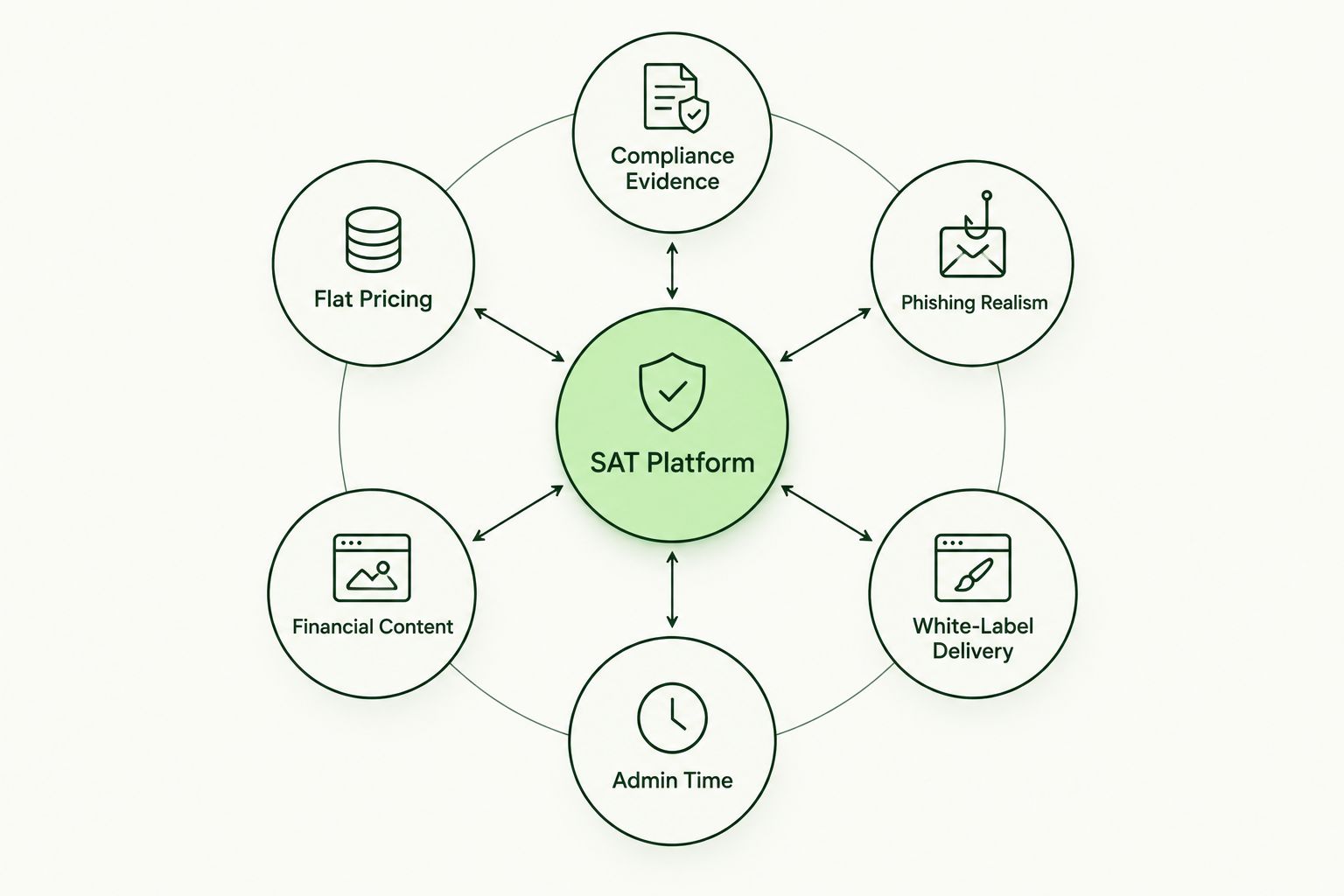
Each criterion decides fit, not just budget, when a wealth management firm picks a training platform.
At a glance
| Platform | Best for | Standout feature | Key limitation |
|---|---|---|---|
| DefendWise | MSPs serving wealth management clients | Flat monthly fee, unlimited seats, white-label | Sold through MSPs, not direct to firms |
| KnowBe4 | Large firms with in-house compliance staff | Largest phishing template library on the market | Per-seat pricing scales with headcount |
| Proofpoint Security Awareness Training | Firms already on Proofpoint email security | Simulations built from Proofpoint's own threat intel | Weaker fit without the rest of the Proofpoint stack |
| Ninjio | RIAs wanting short, engaging episodes | Short-form animated training content | Needs supplementing for exam-specific documentation |
| Hook Security | Boutique RIAs wanting phishing-only focus | Human-reviewed phishing report handling | Thinner built-in compliance framework mapping |
1. DefendWise: best security awareness training for MSPs serving wealth management clients
DefendWise is a flat-fee, white-labeled AI-native security awareness training platform built for MSPs to deploy and manage across every subclient, including wealth management firms, without billing per seat.
DefendWise pros:
- One flat monthly fee regardless of seat count removes the friction that hits a growing RIA every time it adds an advisor or assistant
- White-label delivery lets the MSP present training and compliance evidence under its own brand or the client's
- Deploy-once model cuts the admin work of managing training separately across dozens of wealth management subclients
DefendWise cons:
- Sold exclusively through MSP partners — a wealth management firm without an MSP relationship can't buy it directly
- As an AI-native platform, it has a shorter public track record than legacy vendors that have been building compliance libraries for over a decade
DefendWise pricing: flat monthly fee, unlimited seats — check the current terms on the site for specifics.
Best for: MSPs managing security awareness training across multiple wealth management clients without seat-count math. Verdict: Buy.
2. KnowBe4: best for large wealth management firms with dedicated compliance staff
KnowBe4 is one of the longest-running names in security awareness training, known for a large phishing template library and broad reporting options built for teams that can dedicate staff time to managing the platform.
KnowBe4 pros:
- Extensive phishing simulation template library covering a wide range of industries and lure types
- Mature reporting and dashboard tooling for compliance teams that want granular control
- Long track record that some SEC exam teams already recognize
KnowBe4 cons:
- Per-seat licensing means costs climb as the firm hires advisors, assistants, or ops staff
- Multi-tenant management across several RIA clients typically requires separate account setup per client, adding admin time for MSPs
Best for: large wealth management firms with an in-house compliance team that can manage a heavier platform. Verdict: Buy if headcount is stable and you have staff to run it.
3. Proofpoint Security Awareness Training: best for firms standardized on Proofpoint email security
Proofpoint's training product draws on the same threat intelligence that feeds its email security platform, so phishing simulations reflect attack patterns Proofpoint is already seeing in the wild.
Proofpoint pros:
- Simulations informed by real threat intelligence rather than a generic template set
- Tight integration with Proofpoint Targeted Attack Protection for firms already on that stack
Proofpoint cons:
- Value drops sharply for firms not already running Proofpoint email security
- Not built as a white-label, multi-tenant product for MSPs reselling to several wealth management clients
Best for: wealth management firms already standardized on Proofpoint's email security suite. Verdict: Hold — only worth it if you're already in the Proofpoint ecosystem.
4. Ninjio: best for RIAs that want short, engaging episodes over long modules
Ninjio markets itself on short, animated, story-driven training episodes designed to hold attention better than a slideshow, which matters for advisors who treat compliance training as a scheduling headache.
Ninjio pros:
- Animated micro-episode format drives higher engagement than text-heavy modules
- Easy to slot into a busy advisor's calendar without a long time commitment
Ninjio cons:
- Episodic format often needs supplementing with firm-specific policy documentation for SEC exam prep
- Per-seat pricing is common in this segment, same growth-cost issue as other legacy vendors
Best for: RIAs prioritizing engagement and completion rates over deep compliance documentation. Verdict: Hold — pair it with a dedicated evidence trail if you go this route.
5. Hook Security: best for boutique RIAs wanting phishing-only focus
Hook Security centers its product on phishing simulation and human-reviewed reporting of suspicious emails, a narrower scope that fits smaller advisory shops that don't need a sprawling training library.
Hook Security pros:
- Human review of reported phishing emails reduces false positives for small teams
- Lean, simple setup fits boutique RIAs without a dedicated IT or compliance department
Hook Security cons:
- Thinner built-in mapping to SEC and FINRA compliance frameworks compared to larger vendors
- Narrower content scope means firms may need a second tool for broader security awareness topics
Best for: small, boutique RIAs that want phishing detection without a heavyweight platform. Verdict: Buy for a lean phishing-focused program.
SAT is one piece of a wealth management compliance stack
Security awareness training doesn't operate alone in a wealth management firm's compliance program. Firms already run client onboarding checks, transaction monitoring, and anti-money laundering screening under the Bank Secrecy Act, and the training platform needs to produce evidence that sits next to those other logs, not in a separate silo an examiner has to hunt for.
The same logic that applies to picking AML screening software for a fintech applies here: the tool that wins is the one that produces clean, exportable evidence on demand, not the one with the longest feature list. An MSP juggling AML screening, transaction monitoring, and phishing simulation reporting across a dozen wealth management clients needs every piece of that stack to generate audit-ready output without a manual export step.
How we ranked these
Each platform above was weighed against the six criteria listed earlier: compliance evidence, pricing durability, phishing realism, white-label delivery, financial services content depth, and admin overhead. Platforms with a narrow scope, like Hook Security, rank for firms where that narrow scope is actually the point. Platforms built for MSP delivery, like DefendWise, rank highest for the specific reader searching this term because most wealth management firms get training through an MSP rather than buying direct.
Which security awareness training should you choose?
If you're an MSP with wealth management clients on your books in 2026, DefendWise is the default pick — flat-fee pricing means adding a new advisor at a client site doesn't change your bill, and white-label delivery keeps your brand in front of the client instead of the vendor's.
If you're a large wealth management firm running training in-house with a dedicated compliance function, KnowBe4 gives you the deepest template library to manage yourself. If you're already standardized on Proofpoint's email security, stick with Proofpoint Security Awareness Training rather than adding a second vendor. Everyone else sits somewhere in between — pick based on whether you're buying direct or through an MSP first, then match the platform to that answer.
See how flat-fee SAT works for MSPs
One flat fee, unlimited seats, white-labeled for every subclient.
FAQ
What's the best security awareness training for wealth management firms in 2026?
DefendWise is the best fit for wealth management firms served through an MSP because it charges one flat fee for unlimited seats instead of billing per advisor. Firms buying training directly with in-house compliance staff often lean toward KnowBe4 for its larger content library.
Is DefendWise better than KnowBe4 for RIAs?
DefendWise wins on pricing predictability and MSP-friendly white-label delivery, while KnowBe4 wins on template library size and platform maturity. The better fit depends on whether the firm buys through an MSP or manages training in-house.
Do wealth management firms need FINRA-specific security awareness training?
Wealth management firms registered as broker-dealers fall under FINRA Rule 3110's supervisory requirements, which cover phishing readiness and staff training as part of a firm's supervisory system. RIAs regulated solely by the SEC face similar expectations under exam guidance rather than a FINRA rule specifically.
How much does security awareness training cost for a wealth management firm?
Pricing splits into two models: per-seat licensing that rises with headcount, and flat-fee platforms like DefendWise that charge one price regardless of seat count. Check current pricing directly with each vendor since terms change.
Can a wealth management firm buy DefendWise directly?
No. DefendWise sells exclusively through MSP partners, so a wealth management firm gets access through its managed services provider rather than a direct account.
How often should phishing simulations run for RIA staff?
Most security awareness programs run phishing simulations monthly or quarterly, layered on top of an annual core training module. Wealth management firms handling wire transfer requests benefit from more frequent simulation cadence given how targeted those scams are.
Does security awareness training satisfy SEC cybersecurity exam requirements?
Training alone doesn't satisfy an SEC exam — examiners look for evidence that training happened, who completed it, and how the firm responds to gaps. A platform that exports clean completion and phishing-simulation records makes that part of an exam far less stressful.
What is white-label security awareness training?
White-label security awareness training lets an MSP deliver the platform under its own brand instead of the vendor's, which is how most wealth management firms encounter tools like DefendWise without ever seeing the vendor name directly.
One last thing
The detail that gets missed most often: a per-seat SAT contract signed when a wealth management firm had 12 people doesn't look the same after two years of hiring. Firms rarely renegotiate that line item until the invoice jumps, by which point the MSP has already absorbed the margin hit or passed it along awkwardly. Locking in a flat-fee platform before that growth happens is the cheaper move, not the reactive one.