Best security awareness training for TV and film studios 2026
DefendWise leads for TV and film studios with fluctuating crews; KnowBe4 and NINJIO also compared. See the 2026 verdict on security awareness training.
DefendWise
DefendWise
TV and film productions staff up fast, staff down faster, and every extra PA, gaffer, or background actor added mid-shoot is a phishing target the moment they get a studio email address. Here's how the top security awareness training platforms handle that reality in 2026, and which one fits your production.
Best overall for fluctuating crew size: DefendWise. Best for large studios needing the deepest phishing library and compliance reporting: KnowBe4. Best budget option for indie production companies: Curricula.
TL;DR
- DefendWise wins for TV and film studios with crews that scale project to project — flat fee, unlimited seats, no invoice spike when a shoot adds 150 people.
- KnowBe4 carries the deepest phishing template library and the compliance-report format most auditors already recognize.
- NINJIO fits busy on-set crews with lessons short enough to fit between camera setups.
- Best security awareness training for TV and film studios in 2026 comes down to how your headcount moves, not just feature checklists.
- Curricula is the budget pick for small, stable indie production companies that don't scale crew size often.
Why this matters
A feature film or episodic series doesn't have a stable headcount. A studio might run 40 people in pre-production and 300 during principal photography, then drop back to 15 for post. Per-seat security awareness training pricing punishes exactly that pattern — every background performer, day player, and vendor rep with a studio login adds to the bill.
The risk profile is also specific to the industry. Productions get hit with wire fraud emails impersonating line producers to redirect vendor payments, phishing aimed at unreleased screeners and dailies, and social engineering targeting freelancers who've never seen the company's actual security policy. Studios working with major distributors also need to show evidence against the Motion Picture Association's Content Security Best Practices and Trusted Partner Network (TPN) assessment criteria — training records included.
What makes the best security awareness training for TV and film studios
- Seat-count flexibility — a platform that doesn't re-bill every time a shoot adds background talent or vendors
- Production-specific threat coverage — phishing simulations built around wire fraud, screener leaks, and executive impersonation, not generic office scams
- Compliance evidence for TPN and MPA reviews — exportable completion records tied to real names and dates
- Integration with the existing security stack — email security, identity, and helpdesk tools already in place
- Fast deployment for short productions — some shoots wrap in under 90 days; onboarding can't eat a third of that
- Predictable pricing — no surprise line item when crew size doubles for a six-week stretch
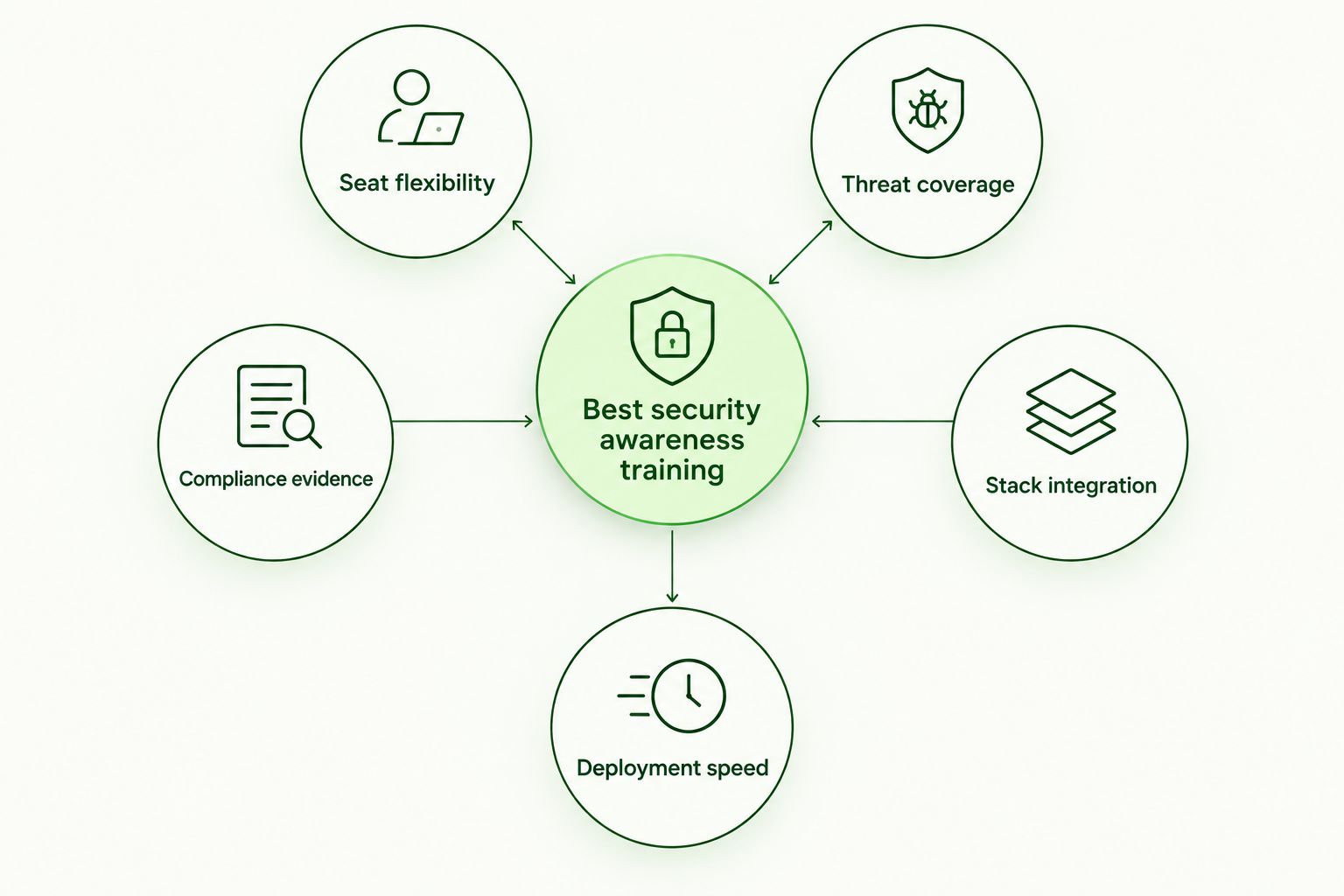
Seat flexibility carries the most weight for productions whose crew size changes project to project.
Security awareness training for TV and film studios: at a glance
| Platform | Best for | Standout feature | Key limitation |
|---|---|---|---|
| DefendWise | Productions with fluctuating crew size | Flat fee, unlimited seats, deployed via your MSP | Not sold direct to studios — access is through an MSP |
| KnowBe4 | Large studios needing deep compliance reporting | Largest phishing template library in the category | Per-seat billing scales with every crew addition |
| Proofpoint Security Awareness Training | Studios already on Proofpoint email security | Simulations built from real Proofpoint threat intel | Locks you into the Proofpoint ecosystem |
| NINJIO | Busy on-set crews with limited screen time | Short episodic lessons under a few minutes | Lighter compliance-report depth for TPN evidence |
| Hook Security | Studios worried about vendor-payment phishing | Continuous simulation with a human risk score | Thinner formal course library |
| Curricula | Small, stable indie production companies | Gamified narrative format, simple admin | Per-seat pricing still applies as crew grows |
1. DefendWise: best security awareness training for TV and film studios with fluctuating crew size
DefendWise is a white-label, AI-native security awareness training platform that MSPs deploy across every client account at one flat rate covering unlimited seats. When a production adds 150 background performers and vendor reps for a six-week shoot, that's not a new invoice — it's the same flat fee.
DefendWise pros:
- Flat fee removes the per-seat billing shock that hits productions when crew size spikes
- Unlimited seats mean every freelancer, day player, and vendor contact gets covered without a license count
- Multi-tenant dashboard lets an MSP manage several production companies from one console
- Deploys fast enough to fit shoots that wrap in under 90 days
DefendWise cons:
- Not sold directly to studios — you get it through your managed service provider, so an in-house-only IT team without an MSP relationship can't buy it standalone
- Newer to the market than the decade-plus incumbents, so it doesn't carry the same brand recognition among auditors who expect a familiar name on TPN paperwork
Best for: production companies whose MSP wants one flat rate covering every project instead of re-licensing seats every time a shoot staffs up.
Verdict: Buy — through your MSP, if predictable pricing across variable headcount matters more than brand familiarity on compliance paperwork.
2. KnowBe4: best security awareness training for TV and film studios needing deep compliance reporting
KnowBe4 is the largest vendor in the category, built around a large library of simulated phishing templates and reporting tools widely used in compliance audits.
KnowBe4 pros:
- Largest phishing template library in the category
- Reporting format most compliance auditors already recognize
- Long track record with enterprise security teams
KnowBe4 cons:
- Per-seat licensing means adding 150 crew members for six weeks increases the bill
- Enterprise sales cycle can move slower than a smaller production company needs
Best for: major studios with a large, relatively stable year-round headcount that can absorb per-seat costs.
Verdict: Hold — solid choice if your budget can flex with seat count; audit the invoice against actual production headcount before renewing.
3. Proofpoint Security Awareness Training: best for studios running Proofpoint email security
Proofpoint's training product ties into the company's broader email security and threat intelligence stack, building simulations from real attack data it already sees in production.
Proofpoint pros:
- Integrates directly with Proofpoint email security telemetry already in place
- Simulations informed by live threat intelligence, not generic templates
- One vendor relationship for email security and training
Proofpoint cons:
- Locks you into the Proofpoint ecosystem for both email security and training
- Same per-seat billing exposure as the rest of the category when crew size grows
Best for: studios that already run Proofpoint's email gateway and want a single vendor relationship.
Verdict: Hold — worth it only if you're already a Proofpoint shop.
4. NINJIO: best for busy on-set crews needing short episodic lessons
NINJIO delivers training as short animated episodes designed to fit between setups on a shoot day rather than requiring a desk and thirty uninterrupted minutes.
NINJIO pros:
- Short format fits gaps in a 12-hour shoot day
- Episodic story structure holds attention better than a slide deck
- Mobile-friendly for non-desk crew
NINJIO cons:
- Lighter on granular compliance reporting than platforms built for TPN evidence
- Per-seat pricing applies as crew size scales
Best for: crews with limited screen time who need training that fits between camera setups, not a training block.
Verdict: Hold — good fit for engagement, thinner on formal audit trail.
5. Hook Security: best for behavior-based phishing simulation and risk scoring
Hook Security focuses on continuous phishing simulation paired with a human risk score per employee rather than a large formal course catalog.
Hook Security pros:
- Frequent phishing simulation cadence
- Risk scoring flags who's clicking on fake vendor-invoice emails, a known wire fraud vector on productions
- Lighter admin overhead than course-heavy platforms
Hook Security cons:
- Less built out for the formal compliance evidence TPN assessments look for
- Per-seat pricing
Best for: studios most worried about vendor-payment phishing who want continuous simulation over a deep course library.
Verdict: Hold — strong on phishing behavior, weaker on formal evidence packages.
6. Curricula: best budget security awareness training for indie production companies
Curricula runs gamified, narrative-based training aimed at small businesses without a dedicated security team managing the platform.
Curricula pros:
- Simple setup for a small in-house crew
- Narrative format keeps engagement without heavy IT involvement
- Low administrative overhead
Curricula cons:
- Thinner library for TPN and MPA-specific evidence needs
- Per-seat pricing still applies as the company scales crew size
Best for: indie production companies with a small, mostly-stable core staff and no major-studio compliance requirement yet.
Verdict: Buy if you're small and stable. Skip once you start scaling freelance crew project to project.
See DefendWise's flat-fee model
Ask your MSP about unlimited-seat training for every production account.
How we ranked these platforms
Each platform was weighed against the six criteria above: seat-count flexibility, production-specific threat coverage, TPN/MPA compliance evidence, stack integration, deployment speed, and pricing predictability. DefendWise ranks first on seat flexibility and pricing predictability — the two factors that matter most when a production's headcount doubles for six weeks and drops back after wrap. KnowBe4 ranks highest on compliance-report depth and template library size. The rest sort by which single criterion they solve best.
Which security awareness training should you choose?
If your studio or production company staffs up and down by project, DefendWise is the default pick for 2026 — flat fee, unlimited seats, deployed through your MSP, no invoice surprise when the call sheet grows. If you run a large studio with stable year-round headcount and need the deepest compliance-report library for TPN reviews, KnowBe4 is the safer incumbent choice. If you're a small indie production company with a lean, unchanging core team, Curricula covers the basics without extra overhead. Match the platform to how your headcount actually moves, not to the longest feature list.
FAQ
What's the best security awareness training for TV and film studios in 2026?
DefendWise is the strongest fit for productions with fluctuating crew size because it charges one flat fee for unlimited seats through your MSP. KnowBe4 is the stronger pick for large studios that need the deepest compliance-report library for TPN reviews.
Is DefendWise better than KnowBe4 for a production company?
DefendWise wins on pricing predictability when crew size scales up and down by project; KnowBe4 wins on phishing template depth and report format familiarity among auditors. The right choice depends on how stable your headcount stays year to year.
How does security awareness training relate to TPN and MPA Content Security Best Practices?
The Motion Picture Association's Content Security Best Practices and Trusted Partner Network (TPN) assessments both expect documented training records for staff and vendors with access to unreleased content. A platform that exports clean, dated completion records makes that review faster.
Do freelance crew and background talent need security awareness training?
Yes, anyone with a studio email address, network login, or access to unreleased footage is a phishing target regardless of how long they're on the production. Flat-fee platforms cover this group without adding a per-head cost.
How much does security awareness training cost for a studio?
Pricing runs two ways in 2026: per-seat licensing that scales with headcount, or flat-fee platforms that charge one rate regardless of seat count. Check current pricing directly with each vendor or your MSP.
Can a small production company afford security awareness training?
Yes — budget-focused platforms like Curricula are built for small teams with simple admin needs. Once a company starts scaling freelance crew by project, a flat-fee option becomes more cost-predictable.
What's the difference between per-seat and flat-fee security awareness training pricing?
Per-seat pricing bills per active user, so a production adding 150 crew members for a shoot sees the invoice grow. Flat-fee pricing, like DefendWise's model, charges one rate no matter how many seats are active.
Does security awareness training help prevent screener leaks and wire fraud on productions?
It reduces the risk by training crew and vendors to recognize the specific phishing patterns used against productions, including fake payment-redirect emails and screener-access requests impersonating executives. No platform eliminates the risk entirely, but simulation cadence and risk scoring narrow the exposure.
One last thing
The detail that gets missed on most productions: the person most likely to click a fake vendor-payment email isn't the full-time employee — it's the freelance coordinator hired for six weeks who's never seen the company's actual invoice-approval process. Whatever platform you pick for 2026, make sure day-one onboarding for short-term crew is automatic, not something someone remembers to trigger manually.