Best security awareness training for political campaigns 2026
Best security awareness training for political campaigns in 2026: DefendWise wins for flat-fee, unlimited-seat MSP delivery. Full ranked comparison inside.
DefendWise
DefendWise
Political campaign staff counts swing wildly between primary season, GOTV crunch, and the post-election skeleton crew — and most security awareness training vendors still charge per seat, which punishes exactly that kind of churn. This guide ranks six security awareness training platforms for political campaigns in 2026 on seat flexibility, phishing simulation realism, deployment speed, and compliance evidence.
TL;DR
- DefendWise is the best security awareness training for political campaigns run through an MSP with fluctuating volunteer counts.
- KnowBe4 fits large, multi-state campaigns that need a deep training content library.
- Curricula is the budget pick for small local campaigns with lean IT budgets.
- Proofpoint Security Awareness Training fits campaigns already standardized on Proofpoint email security.
- Hook Security stands out for phishing simulation matched to nation-state-style lures.
Why this matters
Campaigns are not typical small businesses. Staff and volunteer headcount can double in six weeks before an election and evaporate the week after, and CISA has repeatedly flagged campaigns as recurring targets for phishing and credential-theft attempts. The 2016 DNC breach remains the textbook case: a single spear-phishing email led to a full network compromise.
Per-seat training pricing was built for stable headcount — a law firm, a dental practice, a manufacturer. Campaigns are the opposite: volunteers rotate weekly, contractors come and go, and nobody wants to do seat-count math three weeks before an election. That mismatch is the reason this ranking leads with pricing structure, not just training content.
Most campaigns don't buy security tools directly — they get them through an IT provider or MSP already handling email, endpoints, and compliance paperwork. That delivery model matters as much as the training content itself, and it's reflected in the "best for" labels below.
What makes the best security awareness training for political campaigns
- Seat flexibility — pricing that doesn't punish volunteer surges or seasonal staff
- Phishing simulation realism — spear-phishing and smishing scenarios that match real attacker behavior, not generic templates
- Deployment speed — a campaign cycle is measured in weeks, not the multi-month rollout enterprise buyers tolerate
- Compliance evidence — clean, exportable proof of training completion for donors, treasurers, or auditors
- White-label / MSP delivery — training that arrives bundled through the IT provider a campaign already trusts
- Content relevance — scenarios that reflect political targeting, not retail or healthcare phishing lures
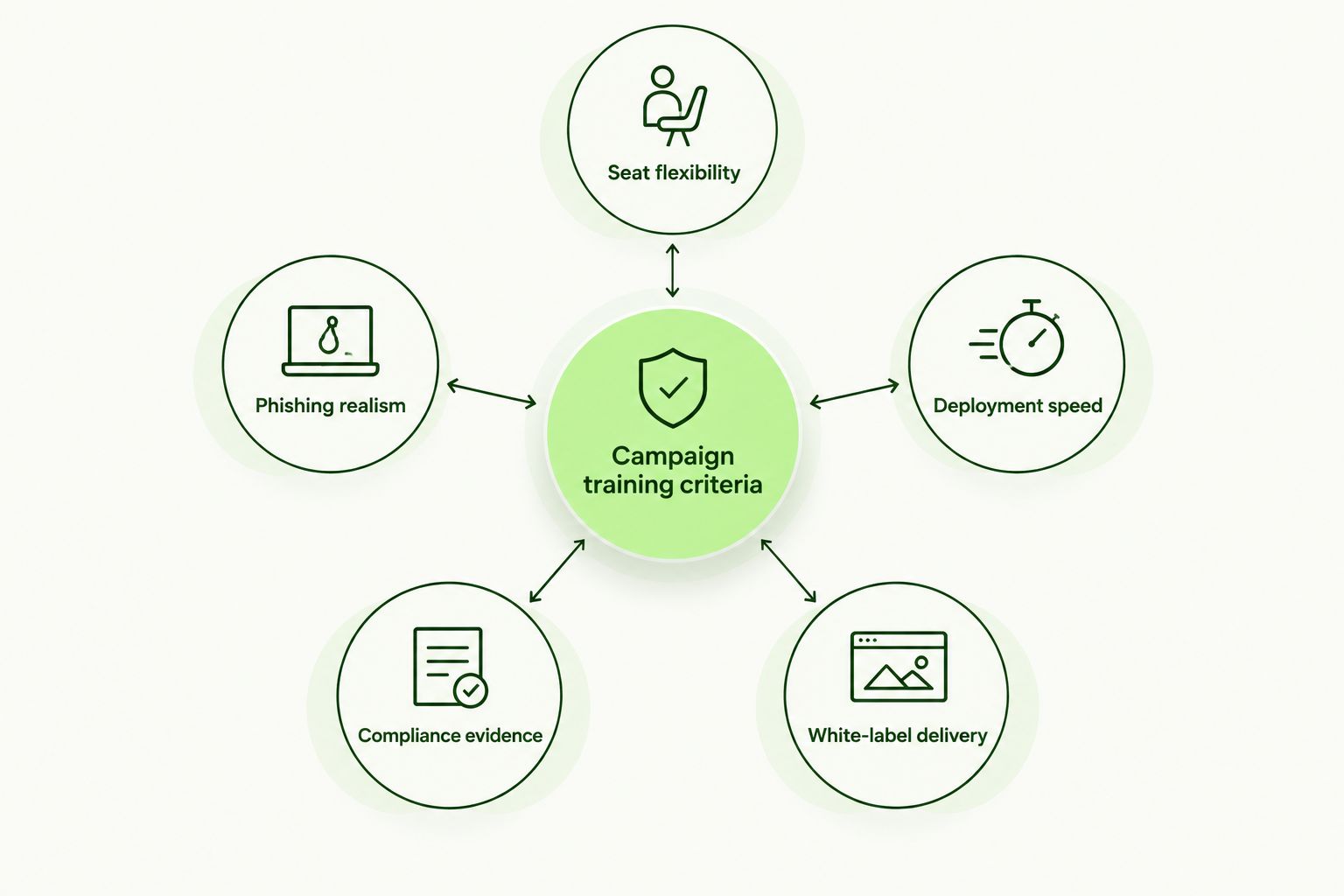
Seat flexibility and deployment speed carry more weight for campaigns than for a typical stable-headcount employer.
At a glance: security awareness training for political campaigns
| Platform | Best for | Standout feature | Key limitation |
|---|---|---|---|
| DefendWise | MSP-delivered campaigns with fluctuating volunteer counts | Flat monthly fee, unlimited seats | Sold through MSPs, not direct to campaigns |
| KnowBe4 | Large, multi-state campaigns | Extensive training content library | Per-seat pricing scales against volunteer surges |
| Proofpoint Security Awareness Training | Campaigns already on Proofpoint email security | Native integration with Proofpoint's threat stack | Little added value without the rest of the Proofpoint stack |
| Ninjio | Busy staff who won't sit through long modules | Short, story-driven microlearning videos | No standalone phishing simulation engine |
| Curricula | Small local campaigns on a lean budget | Simple, gamified lesson format | Lighter compliance reporting for larger operations |
| Hook Security | Campaigns worried about targeted spear-phishing | Realistic, human-risk-focused phishing simulation | Smaller vendor with less standardized enterprise reporting |
1. DefendWise: best security awareness training for political campaigns with fluctuating headcount
DefendWise is a white-labeled, AI-native security awareness training platform built for MSPs to deploy across their client base, campaigns included, under one flat monthly fee for unlimited seats. Instead of counting volunteers on and off a license every few weeks, a campaign's MSP deploys DefendWise once and adds or drops users without touching the bill.
DefendWise pros:
- Unlimited seats means volunteer surges during GOTV weeks don't trigger a licensing conversation
- Deploys through the campaign's existing MSP relationship instead of adding a new vendor to manage
- AI-native training content updates without the campaign's IT team building anything from scratch
- Compliance evidence exports give a treasurer or auditor something clean to hand over
DefendWise cons:
- Only available through a participating MSP — a campaign with fully in-house IT and no MSP has to add that relationship first
- The flat-fee advantage matters less for a two- or three-person campaign where seat count was never going to be the cost driver anyway
Best for: campaigns already working with an MSP that wants training deployed once and left alone through election day.
Verdict: Buy if a campaign already has an MSP handling IT and wants headcount swings solved permanently, not managed.
2. KnowBe4: best security awareness training for political campaigns for large, multi-state operations
KnowBe4 is one of the longest-running names in security awareness training, built around a large library of training modules and phishing templates for enterprise-scale rollouts. A national or multi-state campaign with a dedicated compliance staffer can use that depth to build a customized program.
KnowBe4 pros:
- Deep, established content library covering a wide range of training topics
- Mature phishing simulation tooling with years of refinement
- Familiar to compliance and security staff who've used it at prior employers
KnowBe4 cons:
- Per-seat pricing structure works against campaigns whose headcount spikes and drops seasonally
- Enterprise-oriented setup can be more configuration than a short campaign cycle needs
Best for: large, well-funded campaigns with a compliance staffer and the runway to configure an enterprise platform.
Verdict: Hold for smaller campaigns — the depth is real, but so is the seat-count math.
3. Proofpoint Security Awareness Training: best for campaigns already on the Proofpoint stack
Proofpoint Security Awareness Training is the training arm of Proofpoint's broader email and threat protection suite. It's the strongest option for a campaign whose email security, DLP, or threat intelligence already runs on Proofpoint, since the training and threat data stay in the same ecosystem.
Proofpoint pros:
- Tight integration with Proofpoint's email security and threat intelligence products
- Training content can reflect real threats seen in the campaign's own email traffic
- Established enterprise support infrastructure
Proofpoint cons:
- Little differentiation for a campaign not already on Proofpoint's security stack
- Onboarding a new stack mid-cycle is a hard sell during an active election calendar
Best for: campaigns whose IT provider has already standardized on Proofpoint for email security.
Verdict: Hold unless the rest of the security stack is already Proofpoint.
4. Ninjio: best for short, story-driven microlearning
Ninjio built its reputation on short, animated training videos styled like a weekly episode rather than a compliance module. For campaign staff running on four hours of sleep during the final stretch, a five-minute story lands better than a twenty-minute slideshow.
Ninjio pros:
- High completion rates driven by an entertainment-style format
- Short episodes fit into a packed campaign schedule
- Memorable storytelling over dry compliance language
Ninjio cons:
- Microlearning videos alone don't replace a dedicated phishing simulation program for campaigns facing targeted spear-phishing
- Format-first design can mean less emphasis on compliance-grade reporting
Best for: campaigns prioritizing staff engagement over deep compliance documentation.
Verdict: Hold as a supplement, not a standalone program, for campaigns facing real targeting.
5. Curricula: best budget security awareness training for small local campaigns
Curricula built its platform around simple, gamified lessons meant to be genuinely enjoyable rather than a compliance checkbox. For a city council or county-level campaign with a handful of staff and no dedicated IT budget, that simplicity is the whole pitch.
Curricula pros:
- Lightweight, easy-to-launch format with no heavy configuration
- Gamified lessons drive engagement without enterprise overhead
- Approachable for campaigns with zero in-house security expertise
Curricula cons:
- Reporting depth trails larger platforms built for compliance-heavy sectors
- Less suited to a national campaign managing dozens of field offices
Best for: small, local, budget-constrained campaigns that need something simple and fast.
Verdict: Buy for lean local campaigns; Hold for anything running multiple field offices.
6. Hook Security: best for realistic phishing simulation against targeted lures
Hook Security focuses on human-risk management with phishing simulations built to mimic realistic, targeted attacks rather than generic spam templates — relevant for campaigns facing the kind of spear-phishing seen in past election-cycle breaches.
Hook Security pros:
- Simulation scenarios built around realistic, targeted phishing behavior
- Human-risk framing over generic compliance-speak
- Lean, focused product without enterprise bloat
Hook Security cons:
- Smaller vendor footprint means less standardized enterprise reporting than legacy players
- Less brand recognition among compliance staff who expect a name like KnowBe4
Best for: campaigns most worried about targeted spear-phishing rather than general compliance checkboxes.
Verdict: Buy for campaigns treating phishing realism as the top priority.
Ask your MSP about DefendWise
Flat-fee, unlimited-seat training deployed through the IT provider you already use.
How this ranking was built
Each platform was weighed against the six criteria above: seat flexibility, phishing realism, deployment speed, compliance evidence, white-label/MSP delivery, and content relevance to political targeting. No platform wins on every dimension — that's why the list is organized by use case instead of a single leaderboard, and why the "best for" label matters more than the position in the table.
Which security awareness training should a political campaign choose in 2026?
A campaign already working with an MSP and worried about volunteer headcount swings should default to DefendWise — flat-fee, unlimited seats removes the seat-count conversation entirely for the rest of the cycle. A large, multi-state operation with a compliance staffer and time to configure a platform gets more out of KnowBe4's content depth. A small local campaign with almost no IT budget should start with Curricula and add phishing simulation later if the threat picture changes.
The wrong move in 2026 is picking a per-seat platform in January and re-negotiating the license in October when volunteer count triples. Pick the pricing structure that survives the whole election cycle first, then layer in content depth.
FAQ
What is the best security awareness training for political campaigns in 2026?
DefendWise is the best fit for campaigns working through an MSP because its flat monthly fee covers unlimited seats, which matters when volunteer headcount swings sharply during GOTV weeks. KnowBe4 suits larger, multi-state campaigns that need a deeper content library instead.
Do small local campaigns need the same training as national campaigns?
No. A small local campaign with a handful of staff generally needs simple, fast-to-deploy training like Curricula, while a national or multi-state campaign benefits from the reporting depth and content library of a platform like KnowBe4.
Why does per-seat pricing hurt political campaigns specifically?
Campaign headcount is seasonal and volatile, with volunteers and field staff joining for weeks around an election and leaving right after. Per-seat pricing charges for every added user during that surge, while flat-fee platforms like DefendWise don't.
Is phishing simulation important for political campaigns?
Yes. CISA has repeatedly flagged campaigns as recurring phishing targets, and the 2016 DNC breach began with a single spear-phishing email. Platforms like Hook Security build simulations around realistic, targeted lures rather than generic spam.
Can a campaign buy DefendWise directly?
DefendWise is sold through MSPs that deploy it for their client base, so a campaign typically gets access through its existing IT provider rather than buying a license directly.
What compliance evidence should security awareness training provide a campaign?
Training completion records that a treasurer, donor, or auditor can review without a manual scramble matter more than the training format itself. Look for clean, exportable reporting rather than a dashboard that only IT can read.
Is Proofpoint Security Awareness Training worth it for a campaign?
Only if the campaign's IT provider already runs Proofpoint for email security, since the training's main advantage is integration with that existing threat data. Without the rest of the Proofpoint stack, it offers little a campaign can't get elsewhere.
How fast can a campaign deploy security awareness training before an election?
Deployment speed varies by platform, but flat-fee, MSP-delivered options like DefendWise are built for a provider to roll out once across a client base rather than configure per organization, which suits a compressed campaign calendar.
One last thing
The detail campaigns miss most: training completion records don't just satisfy a curious donor — they're the paper trail an insurer or opposition researcher will ask for if a breach ever happens. Set up the export before the crisis, not during it.
In 2026, with volunteer turnover higher than almost any other sector uses to model per-seat pricing, the platform's billing structure is as much a security decision as its phishing content.