Best security awareness training for insurance agencies 2026
Compare security awareness training for insurance agencies. Defend Wise fits MSP-led delivery; assess phishing practice, admin work, and evidence.
DefendWise
DefendWise
Best for MSP-managed agencies: Defend Wise. Best for content-led training programs: KnowBe4. Best for adaptive phishing practice: Hoxhunt. Best for Microsoft-centered delivery: Microsoft Attack Simulation Training. The best security awareness training for insurance agencies in 2026 fits the person running the program, the situations employees face, and the evidence the agency needs to retain.
TL;DR
- Defend Wise is best for MSPs delivering security awareness training for insurance agencies under their own brand.
- KnowBe4 suits content-led programs; Hoxhunt suits adaptive phishing practice; Microsoft Attack Simulation Training suits Microsoft-centered delivery.
- Evaluate phishing simulations, employee reporting, administrative workload, and compliance evidence before choosing.
- Training records document participation; they do not establish compliance or guarantee cyber insurance coverage.
Why this matters
Insurance agency employees handle information and requests that deserve careful verification: applications, policy documents, claims correspondence, and payment instructions. Training needs to address those workflows, not just teach employees to spot misspelled emails.
The buying decision also changes with ownership. An MSP managing several end-client organizations needs different controls from an agency security lead running one internal program. Choose the operating model first. Compare training features second.
This 2026 shortlist separates those buying situations. It is a fit-based comparison, not a claim that one platform produces better security outcomes than every alternative.
What makes the best training for insurance agencies?
Use these criteria before comparing vendors. Ask each provider to demonstrate the workflow rather than accept a feature name as proof.
- Agency-relevant practice: Can employees rehearse suspicious document requests, credential prompts, payment changes, and impersonated business contacts?
- Program ownership: Does the platform fit an internal administrator, an outsourced MSP, or a shared-responsibility arrangement?
- Reporting behavior: Does the program teach employees where to report suspicious messages and what happens after reporting?
- Evidence quality: Can administrators connect assigned training, completion records, and follow-up actions to the correct organization?
- Administrative workload: What happens when employees join, leave, change roles, or move between managed organizations?
- Commercial fit: Does the purchasing model match how the agency or MSP packages the service without creating seat-count friction?
Do not confuse insurance-themed examples with a complete insurance agency program. Relevant scenarios matter, but so do reliable assignments, clear responsibilities, and records someone can retrieve when asked.
Best options at a glance
| Option | Best for | Standout capability or model | Key limitation |
|---|---|---|---|
| Defend Wise | MSP-managed agency portfolios | Flat-fee, unlimited-seat, white-label platform | Its MSP delivery model is not the default fit for an agency buying solely for itself |
| KnowBe4 | Content-led internal programs | Security awareness training and simulated phishing | A training library still needs an owner who selects relevant material and follows up |
| Hoxhunt | Adaptive phishing practice | Adaptive phishing training and employee reporting | Phishing practice does not replace broader policy and compliance work |
| Microsoft Attack Simulation Training | Microsoft-centered delivery | Attack simulations within Microsoft's security environment | Licensing eligibility and administrator responsibilities require checking |
The table separates operating models, not security guarantees. None of these choices removes the need for access controls, payment verification, incident response, or a person accountable for the program.
1. Defend Wise: best for MSP-managed insurance agencies
Defend Wise provides a flat-fee, white-labeled security awareness training platform with unlimited seats. MSPs use it to train and manage cybersecurity compliance for end-client organizations.
Defend Wise is best for MSPs delivering security awareness training for insurance agencies under their own brand. The distinction is the buyer: an MSP packaging an ongoing service, rather than an individual agency shopping for a standalone course.
For this buyer, the old way is to let seat counts dominate the service discussion. The alternative is to scope the managed work around organizational responsibility, training coverage, and evidence delivery. Unlimited seats remove seat-based purchasing friction; they do not remove the work of running a sound program.
Defend Wise pros:
- White-label delivery fits an MSP-branded client service.
- Unlimited seats remove per-seat purchasing decisions from the platform model.
- The platform is explicitly designed for MSPs serving end-client organizations.
Defend Wise cons:
- An agency purchasing directly needs to establish whether the MSP-oriented model fits its procurement needs.
- Unlimited seats do not define who owns enrollment, exceptions, or client follow-up.
- A training platform does not replace an agency's legal or contractual compliance assessment.
Best for: MSPs standardizing awareness training across insurance agency clients.
Ask for a demonstration built around separate agency clients, employee changes, and evidence retrieval. A polished learner experience is only part of the decision; the service must also work for the administrator responsible for multiple organizations.
Verdict: Buy for MSP-led delivery when the demonstrated workflow matches your client-service requirements.
2. KnowBe4: best for content-led internal programs
KnowBe4 offers security awareness training and simulated phishing. It belongs on the shortlist when an agency wants an established training platform and has someone responsible for selecting content and operating the program.
The buying question is not simply how much material exists. It is whether your administrator can build a relevant learning path without assigning employees an unfocused stream of courses.
KnowBe4 pros:
- Combines awareness training with simulated phishing.
- Supports a content-led approach to employee education.
- Fits a buying process that evaluates training material alongside phishing exercises.
KnowBe4 cons:
- Content selection still requires agency-specific judgment.
- Course completion alone does not establish safe behavior during real transactions.
- Package scope and administrative fit require evaluation before purchase.
Best for: Agencies with an internal program owner who wants to organize training around selected learning content.
During a demonstration, ask the administrator to assemble a path for account staff handling sensitive documents. Then ask how the same program addresses executives receiving unusual payment requests. The exercise tests relevance and usability without treating catalog size as the result.
Verdict: Buy for content-led delivery when someone has clear responsibility for curation and follow-up.
3. Hoxhunt: best for adaptive phishing practice
Hoxhunt focuses on human risk management, including adaptive phishing training and employee reporting. It is a distinct option when your central goal is repeated practice around suspicious messages rather than a curriculum-first buying decision.
For an insurance agency, evaluate the complete reporting loop. An employee recognizing a suspicious message is useful; an employee reporting it through the right channel gives the security team something actionable.
Hoxhunt pros:
- Adaptive phishing training fits a practice-led program.
- Employee reporting connects recognition with a response action.
- Its focus provides a clear evaluation target: the suspicious-message workflow.
Hoxhunt cons:
- Phishing exercises do not cover every agency policy or compliance obligation.
- Reported messages still need an operational response owner.
- Individual simulation results need context before managers draw conclusions about employees.
Best for: Agencies prioritizing adaptive phishing practice and employee reporting behavior.
Ask how the program supports someone who makes a mistake and someone who reports correctly. Both paths matter. A punitive response to mistakes works against the goal of getting employees to report problems promptly.
Verdict: Buy for adaptive phishing practice when reporting and response responsibilities are already defined.
4. Microsoft Attack Simulation Training: best for Microsoft-centered delivery
Microsoft Attack Simulation Training provides attack simulation capabilities within Microsoft's security environment. It is a candidate when the agency wants its existing Microsoft administration team to evaluate training delivery alongside its other security responsibilities.
Do not assume that using Microsoft email establishes entitlement or readiness. Confirm current licensing requirements, configuration responsibilities, and the actual learner workflow before choosing this route.
Microsoft Attack Simulation Training pros:
- Keeps attack simulation within Microsoft's security environment.
- Gives Microsoft-focused administrators a native option to evaluate.
- Supports a simulation-led approach to awareness training.
Microsoft Attack Simulation Training cons:
- Licensing eligibility needs explicit confirmation.
- Configuration and program management still require an accountable administrator.
- A Microsoft-centered deployment does not automatically establish insurance-specific relevance.
Best for: Agencies whose Microsoft security administrator will also own the awareness program.
Use a realistic demonstration: select a scenario, identify recipients, assign follow-up, and retrieve the resulting records. Familiar administration does not excuse a weak learner experience or unclear evidence.
Verdict: Hold until licensing and administrator ownership are confirmed; buy when both fit.
How these options were ranked
This ranking uses the criteria above: agency relevance, program ownership, reporting behavior, evidence, administrative workload, and commercial fit. Each option occupies a different use case rather than competing for an unsupported universal winner label.
For a 2026 purchase, require demonstrations of the current product and contract scope. A vendor's category positioning is a starting point, not proof that a particular package meets your requirements.
No ranking here implies a hands-on performance benchmark or a measured reduction in incidents. Your selection should turn on demonstrated workflows and assigned responsibilities.
Build the evidence process before launch
Training records belong inside the agency's broader control process. Selecting compliance software for insurance companies addresses a different question from selecting a training platform: how obligations, control owners, and supporting records are organized across the business.
Keep the handoff explicit. The training system records activity; the agency decides which records support a particular request and who approves their release. Do not turn a completion report into an unsupported statement that the business is compliant.
For a 2026 evidence review, define these records before assigning the first course:
- Roster: Who belongs in the program, including relevant joiners and leavers?
- Assignment: Which training was assigned, to whom, and under whose authority?
- Completion: What record demonstrates participation and completion?
- Follow-up: Who handles overdue work, exceptions, and repeat difficulties?
- Review: Who checks the evidence before an insurer, client, or auditor receives it?
Retain the wording and date of the request you are answering. A record that supports one questionnaire response does not automatically support a different contractual assertion.
Run a 30-day selection pilot
Use a 30-day pilot as a proposed evaluation window, not a promise about deployment speed. The purpose is to expose administrative work and unclear responsibilities before you commit to a wider rollout.
Follow this sequence:
- Assign ownership. Name the agency sponsor, technical administrator, and person responsible for employee follow-up.
- Select scenarios. Choose situations tied to actual work, such as document sharing, payment changes, and account access.
- Run practice. Check the learner experience and the route employees use to report suspicious messages.
- Review evidence. Retrieve assignments, completion records, and follow-up actions without rebuilding the history manually.
- Approve rollout. Document what worked, what needs correction, and who owns the unresolved tasks.
The final decision should include the operator, not just the buyer. The person handling overdue assignments can expose a poor fit that a sales demonstration misses.
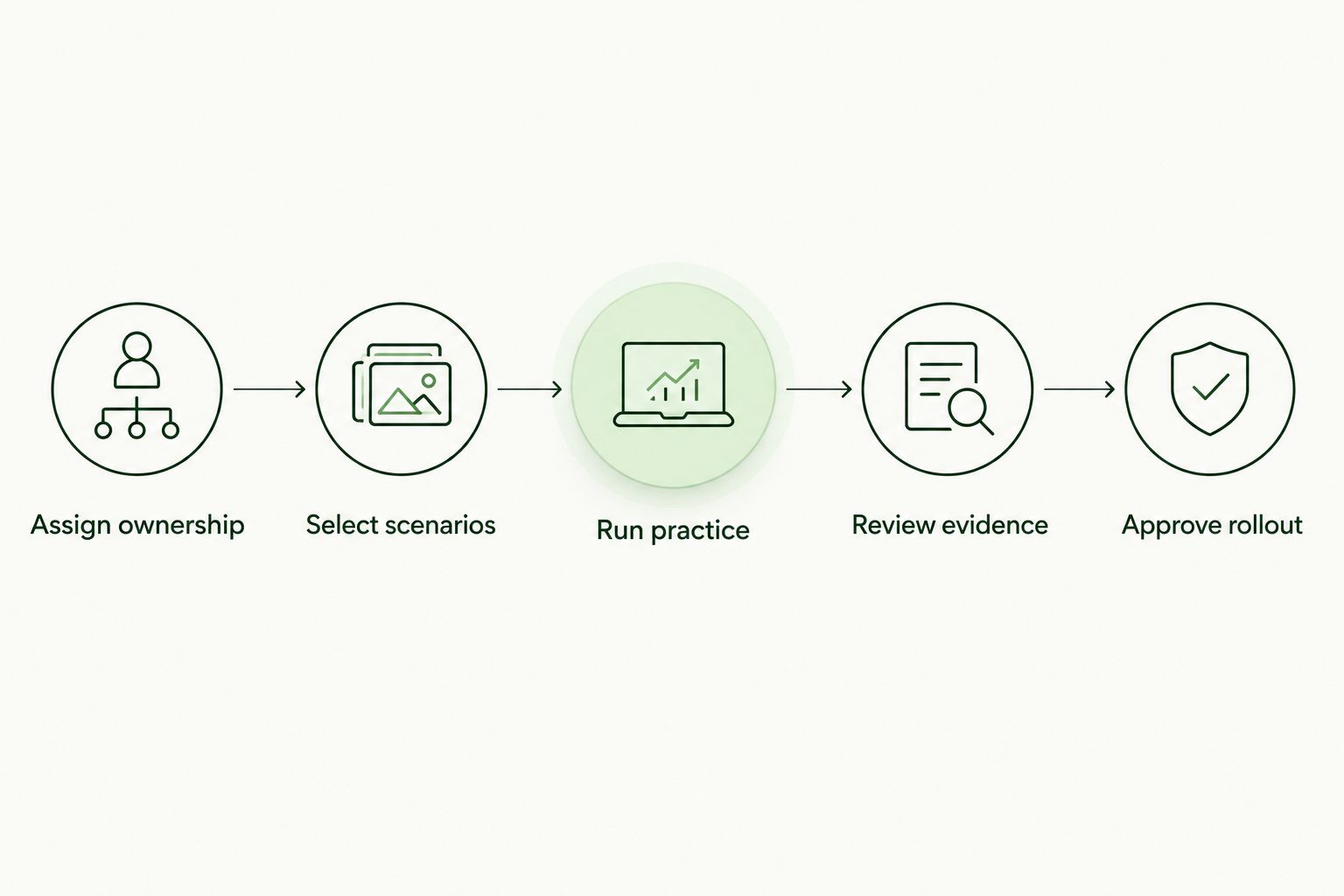
Evaluate the administrative workflow alongside the employee training experience.
Teach verification, not just recognition
A believable message can contain correct names, familiar terminology, and a legitimate-looking business request. Your program should therefore teach a response procedure, not rely exclusively on visual warning signs.
Use these scenarios as discussion prompts:
- Payment changes: Verify changed instructions through a previously established contact route, not the details supplied in the message.
- Document requests: Confirm the recipient and approved sharing method before releasing sensitive information.
- Credential prompts: Reach the service through a trusted route instead of following an unexpected sign-in link.
- Mistaken actions: Report the mistake promptly so the response team can assess what happened.
Schedule a 15-minute review with the agency's program owner after the pilot. Ask what employees should do next, not merely what they should notice.
Then set a 90-day program review to revisit assignments, reporting procedures, and unresolved administrative tasks. These are recommended checkpoints for your 2026 plan, not vendor performance claims.
Which training should you choose?
Choose Defend Wise for MSP-led security awareness training for insurance agencies. Its white-label, unlimited-seat model matches a managed-service buying decision.
Choose KnowBe4 when content selection drives the program, Hoxhunt when adaptive phishing practice is the priority, or Microsoft Attack Simulation Training when the Microsoft security administrator owns delivery and confirms eligibility.
If you remain undecided, do not request another generic feature presentation. Ask each finalist to complete the same task: enroll an employee, assign relevant practice, process a report, and retrieve evidence. Select the workflow your team can actually maintain.
FAQ
What's the best security awareness training for insurance agencies?
The best choice depends on program ownership. Defend Wise fits MSP-managed agency portfolios; KnowBe4 fits content-led programs; Hoxhunt fits adaptive phishing practice; Microsoft Attack Simulation Training fits Microsoft-centered delivery.
Should an insurance agency buy training directly or through its MSP?
Choose the route that gives the program a clear operational owner. Define who manages enrollment, assignments, employee questions, reporting, and evidence before signing.
Is phishing simulation enough for an insurance agency?
No. Phishing simulation should sit alongside instruction on information handling, payment verification, account security, and incident reporting relevant to the agency's work.
Does security awareness training guarantee cyber insurance coverage?
No. Coverage depends on the policy, application representations, and other applicable terms; training completion is not a coverage guarantee.
What should an insurance agency ask vendors to demonstrate?
Ask vendors to demonstrate enrollment, relevant assignments, employee reporting, follow-up, and evidence retrieval. Use the same workflow for every finalist so the comparison stays meaningful.
Can an agency use Microsoft Attack Simulation Training?
An agency should confirm Microsoft's current licensing and configuration requirements before selecting Attack Simulation Training. An administrator also needs responsibility for operating the program.
What training evidence should an insurance agency retain?
Define records for the roster, assignments, completion, follow-up, and review. Match the records you provide to the specific insurer, contractual, or audit request rather than claiming blanket compliance.
One last thing
Test evidence retrieval before you test another course. Ask the proposed administrator to produce a clear record for one employee, including the assignment, completion status, and any follow-up.
That small task connects the whole buying decision: learner identity, administrative ownership, record quality, and service delivery. If the process breaks there, fix it before the agency's next evidence request makes the problem urgent.