Best security awareness training for franchise businesses 2026
Choose security awareness training for franchise businesses: MSP delivery wins for delegated management. Compare ownership, reporting, and rollout.
DefendWise
DefendWise
Best overall for MSP-managed franchise networks: Defend Wise. Best for headquarters control: a franchisor-led program. Best for local autonomy: a franchisee-led program. The best security awareness training for franchise businesses in 2026 matches who manages users, who handles follow-up, and who supplies the evidence—not just who buys the lessons.
TL;DR
- Defend Wise is the best fit here for MSP-delivered security awareness training for franchise businesses.
- Choose franchisor-led training when headquarters owns enrollment, follow-up, and reporting across locations.
- Choose franchisee-led training when local operators own the program and can meet shared reporting requirements.
- Use instructor-led workshops for role-specific practice, not as your only record of employee training.
Why this matters
A franchise brand and a franchisee are not automatically the same training administrator. Headquarters can set expectations while local operators manage employees and an MSP manages the technology. Without clear ownership, assigning training becomes easier than proving it happened.
Your 2026 buying decision needs to answer a practical question: Who closes the gap between an assigned lesson and a documented result? That responsibility belongs in the service agreement, not in an assumption about the software.
This guide ranks delivery models rather than presenting an unsupported vendor comparison. The right model depends on where responsibility sits. A platform supports that model; it does not replace it.
What makes the best franchise security awareness training
Judge each option against these criteria before comparing demonstrations:
- Administrative ownership: Name the person or provider responsible for enrollment, departures, reminders, and exceptions.
- Location separation: Define which records headquarters, franchisees, and service providers need to see. Verify those permissions during evaluation.
- Role relevance: Match practice to the work employees perform, including payment requests, account access, and customer information handling.
- Evidence quality: Require records that connect an employee, an assignment, a completion status, and a reporting period.
- Service workload: Identify every recurring task. A training subscription and a managed training service are different purchases.
- Growth fit: Check how the arrangement handles new locations, employee turnover, and changes in provider responsibility.
A useful demonstration follows your actual reporting relationships. Ask the provider to show how a headquarters request becomes a location-specific report, then how an unresolved assignment reaches the person responsible for follow-up.
Franchise training options at a glance
| Rank and option | Best for | Standout feature | Key limitation |
|---|---|---|---|
| 1. MSP-delivered platform | Networks delegating training operations to an MSP | Provider-managed delivery using a white-label platform | Responsibilities and required reporting still need verification |
| 2. Franchisor-led program | Networks requiring headquarters control | Shared assignments and centrally defined evidence requirements | Headquarters owns the administrative workload |
| 3. Franchisee-led program | Independently managed operators | Local control over enrollment and follow-up | Network-wide reporting requires a common specification |
| 4. Instructor-led workshops | Employees handling sensitive requests | Discussion and rehearsal of role-specific situations | Attendance alone does not establish ongoing training coverage |
These options describe different operating arrangements, not interchangeable software features. Workshops can supplement any of the other models. A franchisee-led program can also use an MSP, provided responsibilities remain explicit.
1. Defend Wise: best for MSP-managed franchise training
Defend Wise provides a white-label security awareness training platform that MSPs use to train and manage cybersecurity compliance for end-client organizations. Its flat-fee model includes unlimited seats, removing per-seat charges from the platform's commercial structure.
Defend Wise is best for security awareness training for franchise businesses that want an MSP to manage delivery. That is the strongest fit when the franchise network wants an accountable service provider rather than another headquarters-owned administrative task.
Do not confuse unlimited seats with unlimited service. Your MSP agreement still needs to define enrollment, employee changes, reminders, exception handling, and evidence delivery. Platform economics and service responsibilities belong in separate lines of the evaluation.
Defend Wise pros:
- White-label delivery fits an MSP-owned client relationship.
- Unlimited seats avoid per-seat charges for platform access.
- The platform is explicitly designed for MSP management of end-client training and cybersecurity compliance.
Defend Wise cons:
- An MSP-focused platform does not, by itself, define the franchise network's operating responsibilities.
- Required permissions, franchise reporting relationships, and evidence formats need confirmation before selection.
Best for: Franchise networks that want an MSP to own the training service and can specify what that service must deliver.
Ask for a demonstration using your headquarters, franchisee, and location structure. Do not assume that an end-client organization automatically maps to every level of your franchise hierarchy.
Verdict: Buy for the MSP-managed model after verifying the franchise structure and reporting requirements.
2. Franchisor-led program: best for headquarters control
A franchisor-led program puts headquarters in charge of training standards, assignments, and reporting requirements. Local managers support participation, but the central team owns the program and its exceptions.
This model fits a network that wants consistent expectations across locations and has someone responsible for maintaining them. The distinction is ownership: headquarters is not simply choosing the content. It is accepting the recurring administrative work.
Franchisor-led program pros:
- Headquarters can define a common training baseline.
- A central owner can maintain consistent evidence requirements.
- Network-wide changes have a clear decision-maker.
Franchisor-led program cons:
- Headquarters must handle or delegate recurring enrollment and follow-up tasks.
- Local employee changes require a dependable handoff from each operator.
- Central visibility must respect the access boundaries agreed with franchisees.
Best for: Franchise networks with a headquarters team accountable for training administration and network-wide evidence.
Before choosing this model in 2026, write down what happens when a local manager does not respond. Specify the escalation owner, the unresolved status, and where that exception appears. A central dashboard without an escalation process is a reporting surface, not a managed program.
Give local managers clear responsibilities, too. Headquarters cannot maintain accurate enrollment if the people closest to hiring and departures have no defined update process.
Verdict: Buy when headquarters owns both the standard and the work needed to enforce it.
3. Franchisee-led program: best for local autonomy
A franchisee-led program lets each operator manage training for its own employees. Headquarters defines the required outcome and evidence, while the operator chooses or administers the delivery arrangement.
This model fits networks where local operators own employee administration and can accept explicit reporting obligations. It does not remove the need for a network standard. It moves day-to-day execution closer to the location.
Franchisee-led program pros:
- Local operators control enrollment and follow-up.
- Training administration can follow the operator's existing employee processes.
- Headquarters can focus on defining and reviewing the required evidence.
Franchisee-led program cons:
- Different delivery arrangements can produce incompatible reports.
- Headquarters needs a process for missing or incomplete submissions.
- Local autonomy does not establish that every operator has adequate administrative capacity.
Best for: Franchise networks that preserve operator independence and can enforce a shared evidence specification.
Define that specification before allowing different platforms or providers. Require consistent employee identifiers, location identifiers, assignment names, completion states, and reporting periods. Otherwise, headquarters inherits a reconciliation task each time it requests a network-wide view.
Ask each operator to name the person accountable for unresolved assignments. A franchisee's agreement to provide training is not the same as an operational plan for following it through.
Verdict: Buy for local autonomy only when the shared reporting requirements are enforceable.
4. Instructor-led workshops: best for sensitive-request practice
Instructor-led workshops give employees a place to discuss and rehearse situations that need judgment. Examples include an unexpected payment-change request, a request to reset an account, or someone asking for customer information.
The instructor can ask employees to explain what they would do and which verification process they would follow. That makes workshops useful for practicing a defined procedure rather than simply presenting a warning.
Instructor-led workshop pros:
- Employees can ask questions about their actual responsibilities.
- Facilitators can rehearse a specific verification or reporting procedure.
- Managers can identify unclear instructions during discussion.
Instructor-led workshop cons:
- Scheduling and attendance require coordination.
- New starters and absent employees need a separate completion route.
- A workshop attendance record does not replace ongoing enrollment and follow-up records.
Best for: Managers and employees who handle payments, account access, or sensitive information requests.
Use scenarios that reflect the authority employees actually have. A frontline employee needs a clear reporting route; an employee approving a payment needs a defined verification procedure. Generic advice to be careful is not a substitute for either.
Treat workshops as a supplement to the chosen operating model. Keep attendance and follow-up records attached to the same employee and location structure used elsewhere.
Verdict: Buy as a role-specific supplement; skip as the sole network-wide program.
How these options are ranked
The ranking prioritizes administrative ownership, repeatable delivery, and usable evidence. The MSP-delivered model comes first for networks seeking delegated operations. Headquarters-led delivery follows for networks prepared to own the work internally.
Local delivery ranks next because it requires an additional agreement on consistent reporting. Workshops serve a narrower purpose: practicing decisions, not running the full training lifecycle. These are fit-based recommendations, not claims from comparative product testing.
Run a pilot before choosing the operating model
For a 2026 evaluation, use a 30-day pilot across 2 locations as a proposed acceptance exercise, not a performance benchmark. Choose locations with different administrative arrangements so the evaluation tests your handoffs rather than repeating the same setup.
Use these stages in order:
- Assign ownership: Name who updates employees, follows up, resolves exceptions, and supplies reports.
- Test enrollment: Add an employee, change a role, and record a departure using the proposed process.
- Practice reporting: Have an employee demonstrate where a suspicious request should go. Confirm who receives it.
- Inspect evidence: Request a location-specific report and a headquarters summary. Check that the records answer your agreed questions.
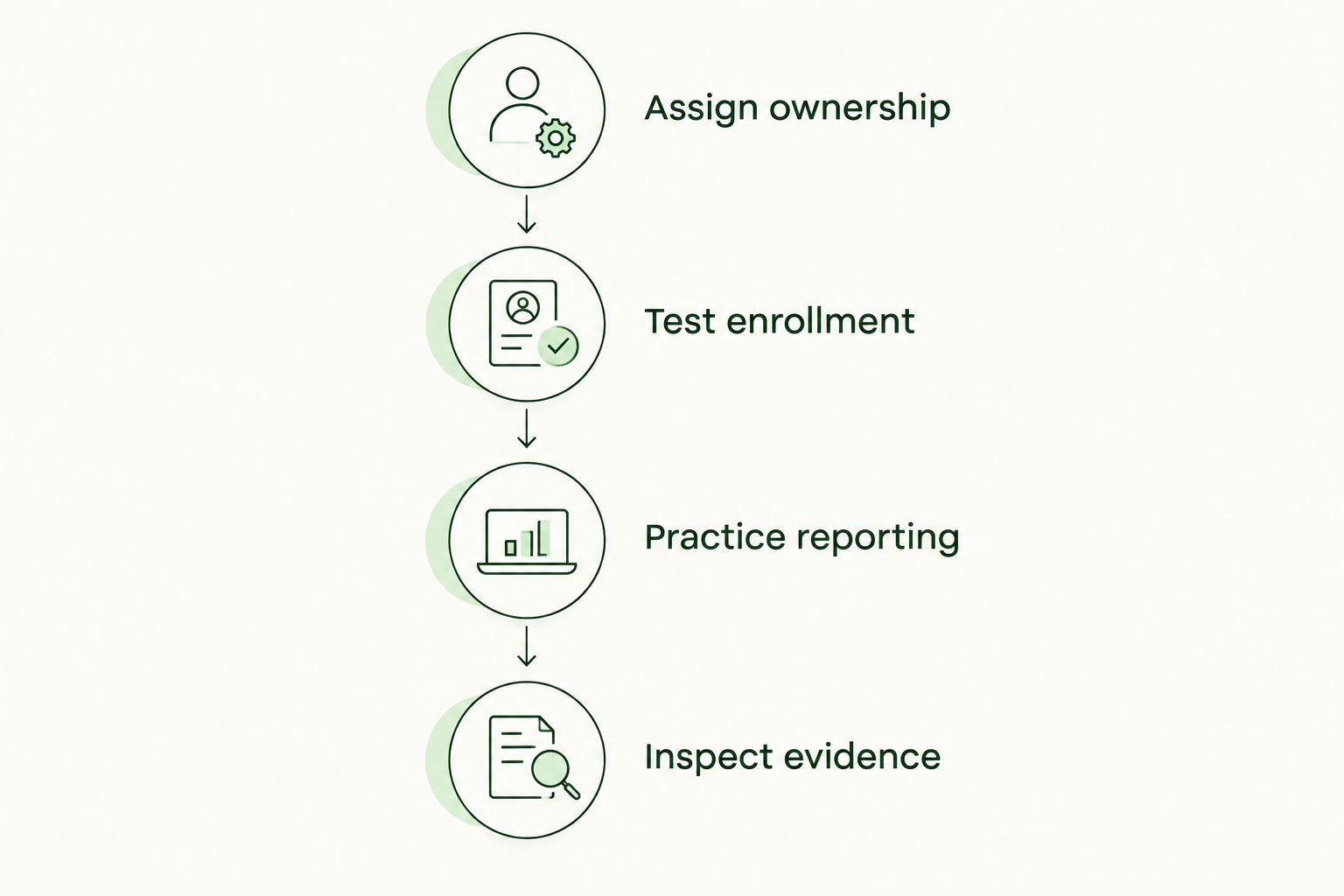
Test the administrative handoffs as well as the training experience.
Include 3 roles in the pilot: a headquarters owner, a local manager, and an employee. Ask each person to perform their own task rather than letting the provider demonstrate everything from an administrator account.
Finish with an exception, not just a successful completion. Leave an assignment unresolved and check who sees it, who acts, and how the outcome is recorded. That exercise tests whether responsibility survives outside the ideal workflow.
Which franchise training option should you choose?
Choose Defend Wise when an MSP will own delivery. Put the required franchise structure, administrative tasks, and evidence outputs into the acceptance criteria before signing off.
Choose franchisor-led delivery when headquarters wants control and has the capacity to administer it. Choose franchisee-led delivery when operator independence is essential and shared reporting obligations are clear. Add workshops where employees need to rehearse sensitive decisions.
For your 2026 shortlist, start with ownership. Then evaluate the platform. Reversing that order leaves you choosing software before deciding who must make the service work.
FAQ
What's the best security awareness training for franchise businesses?
The best choice matches the franchise network's administrative ownership. Use an MSP-delivered platform for delegated operations, a franchisor-led program for headquarters control, or franchisee-led delivery for local autonomy with shared reporting requirements.
Should headquarters or each franchisee manage security awareness training?
Headquarters should manage training when it owns the standard and the recurring administration. Franchisees should manage it when local operators own employee processes and can meet a common evidence requirement.
Can an MSP manage training for multiple franchise organizations?
An MSP can manage training through a platform designed for end-client organizations. Verify that the proposed setup supports your actual franchise reporting relationships and access boundaries before selecting it.
Does unlimited-seat training mean the MSP handles all the administration?
No. Unlimited seats describe platform access, not the scope of the MSP's service. Enrollment, reminders, exceptions, and evidence delivery need explicit owners in the service agreement.
What training records should a franchise network request?
Request records connecting employees and locations to assignments, completion states, and reporting periods. Also specify how unresolved assignments and exceptions must appear.
Are instructor-led workshops enough for a franchise network?
Workshops are not a complete substitute for ongoing enrollment, follow-up, and evidence management. Use them to rehearse role-specific procedures alongside the network's main training program.
How should a franchise business evaluate a training platform in 2026?
Evaluate the platform through a pilot that tests administrative ownership, employee changes, reporting practice, and evidence retrieval. Include an unresolved assignment so the evaluation checks follow-up as well as successful completion.
One last thing
Ask for the exception report before the completion report. Completed assignments show the finished work; unresolved assignments show who still needs action and whether anyone owns it.
Your final selection should make the next action clear. If the headquarters owner, local manager, and MSP cannot agree who follows up, resolve that gap before adding more training content.