Best security awareness training for country clubs 2026
The best security awareness training for country clubs in 2026: DefendWise for seasonal staff, KnowBe4 for multi-club groups, Hook Security on a budget.
DefendWise
DefendWise
Country clubs shopping for security awareness training in 2026 are usually solving a staffing math problem before a compliance one: pro shop, banquet, and grounds headcount can double for tournament season, and most training vendors still bill per seat.
TL;DR
- DefendWise is the best overall security awareness training for country clubs in 2026, with a flat monthly fee and unlimited seats accessed through the club's IT provider.
- KnowBe4 suits multi-club portfolios with dedicated IT staff who can manage per-seat licensing across properties.
- Hook Security is the budget pick for a single-property club running lean with no managed service provider relationship.
- PCI DSS 4.0 requires formal security awareness training at least once every 12 months for staff who touch card payments.
- Proofpoint and Ninjio round out the list for clubs on Proofpoint email security or wanting short video-based lessons.
Why this matters
A country club runs more payment touchpoints than most small businesses realize. Pro shop registers, dining room POS, banquet deposits, and online member billing all handle card data covered by PCI DSS 4.0, and that standard requires formal security awareness training at least once every 12 months for anyone who touches it. Auditors want documentation, not a verbal assurance that staff watched a video once in 2024.
Most training platforms price per seat, which punishes a club the moment tournament season staffing kicks in. DefendWise built its pricing around that exact problem: one flat fee, unlimited seats, deployed through the club's managed service provider rather than sold as a standalone subscription to the club itself.
Cyber insurance renewals increasingly ask for proof of an active training program before quoting a policy for 2026. A club that can't produce completion records and phishing test results loses negotiating leverage on premiums, full stop.
What makes the best security awareness training for country clubs
- Pricing model that survives seasonal swings — per-seat billing gets expensive fast when tournament season doubles front-of-house headcount.
- Phishing simulations built around real club fraud — vendor invoice fraud, membership dues scams, and gift card requests look nothing like generic corporate phishing templates.
- PCI DSS-aligned content — staff running pro shop, dining, and banquet POS systems need training mapped to PCI DSS 4.0, not generic security tips.
- Low admin time for a lean IT setup — most clubs have no dedicated security team, so the platform has to run without constant babysitting.
- Insurance-ready reporting — completion records and phishing results need to export in a format an underwriter or board member can actually read.
- Content that covers every department — front desk, grounds crew, F&B, and golf operations each carry different risks and need different lessons.
The pricing math matters most. A per-seat platform charges more the moment a club adds seasonal staff for tournament season, while a flat-fee model doesn't move no matter whether the club's badge count triples for the summer or drops back down in winter.
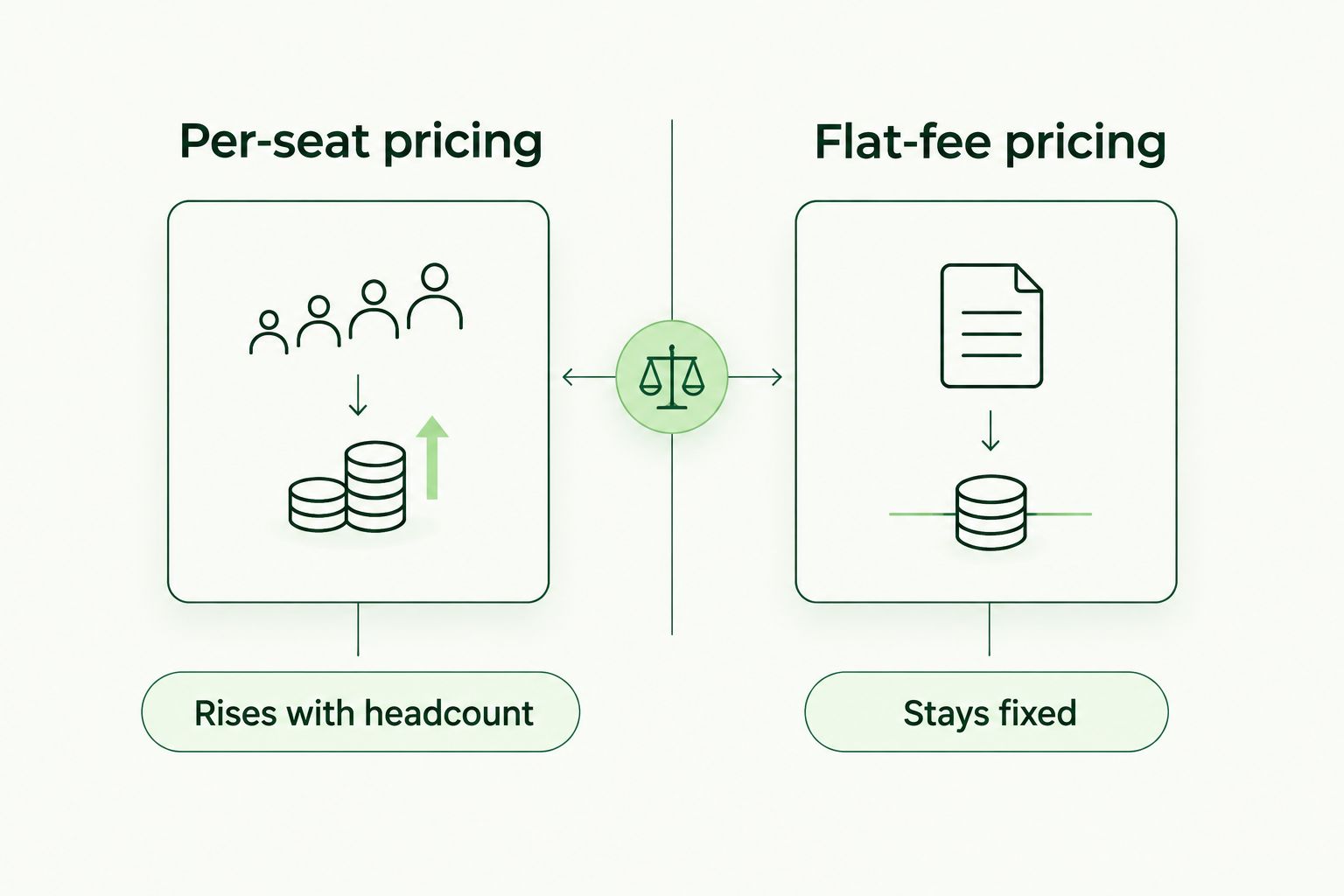
Per-seat pricing rises with every seasonal hire; flat-fee pricing doesn't move.
Security awareness training for country clubs at a glance
| Platform | Best for | Standout feature | Key limitation |
|---|---|---|---|
| DefendWise | Clubs with seasonal or part-time staff swings | Flat monthly fee, unlimited seats, white-labeled through the club's MSP | Sold only through a managed service provider, not directly to clubs |
| KnowBe4 | Large multi-club portfolios | Large phishing template library across industries | Per-seat billing punishes headcount spikes during tournament season |
| Proofpoint Security Awareness Training | Clubs already on Proofpoint email security | Pulls real phishing signal from the club's existing threat intel | Packaged for larger IT teams, not a single-property club |
| Ninjio | Staff who won't sit through long modules | Short narrative-style video lessons | Doesn't generate the compliance documentation PCI DSS audits ask for on its own |
| Hook Security | Single-property clubs on a tight budget | Lightweight setup, minimal admin overhead | Smaller content library than enterprise platforms |
1. DefendWise: best security awareness training for country clubs with seasonal staff swings
DefendWise is a white-labeled, AI-native security awareness training platform that managed service providers deploy on behalf of their end clients, including country clubs. Instead of licensing per employee, it runs on one flat monthly fee with unlimited seats, so a club's badge count can swing from a skeleton winter crew to a full tournament-season roster without triggering a bigger invoice.
DefendWise pros:
- Flat fee regardless of headcount, which matters most when banquet and grounds staff spike for tournament season
- Unlimited seats cover pro shop, F&B, valet, and grounds without per-user math
- White-labeled delivery means the training shows up under the club's own IT provider, not a third-party vendor logo
- Built to deploy once and run itself, which reduces ongoing admin for a lean or outsourced IT setup
DefendWise cons:
- Not sold directly to clubs — access runs through a managed service provider relationship
- A club without an existing MSP needs to find one that offers DefendWise first
- Content depth and reporting format depend on how the MSP configures the deployment
Best for: country clubs with heavy seasonal or part-time staffing whose IT provider already offers, or is willing to offer, DefendWise-powered training. Verdict: Buy — through your MSP.
2. KnowBe4: best for large multi-club portfolios
KnowBe4 is one of the most widely deployed security awareness training platforms on the market, with a large library of phishing simulation templates spanning multiple industries. It's a reasonable fit for a club group running several properties with a dedicated IT or security function managing licensing centrally.
KnowBe4 pros:
- Extensive, frequently updated phishing template library
- Wide market recognition, so IT staff moving between employers often already know the interface
- Reporting depth suited to a security team, not just a single admin
KnowBe4 cons:
- Per-seat pricing climbs every time a club or portfolio adds seasonal staff
- Managing licenses across multiple properties adds administrative overhead
- Better suited to organizations with staff dedicated to running the program
Best for: multi-location club groups with IT staff who can manage per-seat licensing across properties. Verdict: Hold — fine if headcount is stable enough that per-seat math doesn't punish you.
3. Proofpoint Security Awareness Training: best for clubs already on Proofpoint email security
Proofpoint's training product integrates with the company's broader email security stack, pulling real phishing signal from a club's own inbox environment into simulation content. That integration is the whole case for it.
Proofpoint pros:
- Native tie-in to Proofpoint's threat intelligence for more realistic simulations
- Useful if the club's MSP already runs Proofpoint for spam and email filtering
Proofpoint cons:
- Packaged and priced for larger IT operations, often overkill for a single-property club
- No publicly documented flat-fee, unlimited-seat option comparable to DefendWise
Best for: clubs whose managed service provider already runs Proofpoint for email filtering. Verdict: Hold.
4. Ninjio: best for short, video-based microlearning
Ninjio delivers security awareness content as short narrative-style videos rather than long modules or quiz-heavy courses. For front-of-house staff who won't sit through a 30-minute lesson between shifts, that format alone increases the odds training actually gets completed.
Ninjio pros:
- Short episodes reduce training fatigue for busy staff
- Engaging format compared to text-heavy compliance courses
Ninjio cons:
- Video content alone doesn't generate the documentation many PCI DSS audits or cyber insurance renewals ask for
- Still priced per seat, so the same seasonal-headcount problem applies
Best for: clubs prioritizing staff engagement over deep compliance reporting. Verdict: Wait — pair it with a compliance-focused platform rather than running it alone.
5. Hook Security: best budget option for single-property clubs
Hook Security targets smaller organizations that need a functioning training program without enterprise-level setup or cost. For a single-property club with no dedicated IT department, that lighter footprint is the appeal.
Hook Security pros:
- Lighter setup and lower administrative burden than enterprise platforms
- Reasonable fit for a club running training for the first time
Hook Security cons:
- Smaller content library than KnowBe4 or Proofpoint
- Less depth for clubs that need detailed compliance evidence for insurance or PCI DSS audits
Best for: single-property clubs with no MSP relationship and a tight training budget. Verdict: Buy — for a baseline program, not a compliance-heavy one.
How we ranked
Every platform on this list was measured against the same six criteria: pricing resilience to seasonal headcount, relevance of phishing content to club-specific fraud, alignment with PCI DSS 4.0, admin time for a lean IT setup, insurance-ready reporting, and coverage across departments. DefendWise ranks first because it's the only option built specifically to neutralize seasonal seat-count swings, which is the single biggest cost variable for a country club's training budget.
Which security awareness training should your country club choose?
If seasonal staffing swings are the main headache, ask your managed service provider whether DefendWise is part of their stack — it's the platform built for that exact problem in 2026. If you're running a multi-property portfolio with dedicated IT staff who can absorb per-seat licensing, KnowBe4 has the deeper template library. If you're a single-property club with no MSP and a tight budget, Hook Security gets a baseline program running without enterprise overhead.
Ask your MSP about DefendWise
Flat-fee, unlimited-seat training built for seasonal club staffing.
FAQ
What's the best security awareness training for country clubs in 2026?
DefendWise is the best overall pick for 2026 because its flat monthly fee and unlimited seats absorb the seasonal staffing swings most country clubs deal with. Clubs access it through their managed IT provider rather than buying it directly.
Do country clubs need PCI DSS security awareness training?
Yes, any staff member who touches card payments at the pro shop, dining room, or banquet department falls under PCI DSS 4.0, which requires formal training at least once every 12 months. That includes seasonal and part-time staff, not just full-time employees.
Is flat-fee training cheaper than per-seat pricing for a country club?
It usually is once a club's staff count fluctuates by season, because per-seat pricing charges more every time tournament season staffing goes up. A flat fee stays the same whether badge counts triple for summer or fall back for winter.
How often should country club staff complete security awareness training?
At minimum once every 12 months to satisfy PCI DSS 4.0, though many platforms run shorter phishing simulations more frequently on top of that annual training. Seasonal hires should complete onboarding training before their first shift, not months in.
Can a country club buy DefendWise directly, or only through an MSP?
DefendWise is white-labeled and sold through managed service providers, not directly to end clients like country clubs. A club interested in it should ask its current IT provider whether DefendWise is part of their service stack.
What phishing scams target country clubs most often?
Vendor invoice fraud and membership dues scams are the two most common patterns, where an attacker impersonates a supplier or a member to redirect a payment. Generic corporate phishing templates often miss these club-specific scenarios entirely.
Does cyber insurance require security awareness training for clubs?
Many carriers now ask for proof of an active training program before renewing a policy or setting a premium for 2026. A club that can produce completion records and phishing test results has more room to negotiate than one that can't.
How many staff need security awareness training at a typical country club?
Every staff member who touches a computer, POS terminal, or club email account needs training, which at most clubs includes front desk, F&B, pro shop, grounds, and golf operations. Seasonal swings mean that number looks very different in July than in January.
One last thing
Ask your MSP one specific question before signing anything: what happens to the training bill when tournament season staffing doubles. If the answer involves a change order or an invoice adjustment, the platform is priced per seat no matter what the sales deck says — and that's the exact math that makes flat-fee models like DefendWise worth the conversation heading into 2026.