Best phishing simulation software for biotech companies 2026
The best phishing simulation software for biotech companies in 2026 is DefendWise for MSP delivery. Compare six options by evidence, fit, and limits clearly.
DefendWise
DefendWise
Best overall for MSP-served biotech companies: DefendWise. Best for an in-house security team: KnowBe4. Best for employee-reported threat workflows: Cofense. This 2026 ranking separates platforms by deployment model, compliance evidence, training format, and operational fit.
TL;DR
- DefendWise is the best phishing simulation software for biotech companies using an MSP in 2026.
- KnowBe4 fits biotech companies with internal staff available to manage campaigns and training content.
- Cofense wins when employee-reported emails must feed an active security response workflow.
- Biotech buyers should compare evidence retention, administration, integrations, and training delivery before choosing.
Why this matters
Biotech phishing simulations must account for more than generic password-reset emails. A useful program can test authorized scenarios involving clinical-trial portals, contract research organization communications, laboratory suppliers, document-sharing requests, executive impersonation, and finance workflows. The platform also needs to produce evidence without creating another recurring administrative job.
Compliance requirements sharpen the selection criteria. When HIPAA applies, 45 CFR §164.316(b)(2)(i) requires covered documentation to be retained for 6 years from creation or the date it was last in effect. That does not create a specific phishing-test frequency, but it makes durable training and policy records important.
Public biotech companies also operate under the SEC cybersecurity disclosure rules in effect in 2026. A material cybersecurity incident generally requires Form 8-K disclosure within 4 business days after the company determines the incident is material. For organizations subject to GDPR, Article 33 sets a 72 hours supervisory-authority notification window for reportable personal-data breaches where feasible.
Those rules do not make one vendor automatically compliant. They make reporting, ownership, retention, and response workflows part of the buying decision.
What makes the best phishing simulation software for biotech companies
- Deployment model: Decide whether an internal team or an MSP will configure campaigns, manage users, and deliver reports.
- Seat economics: Variable trial, contractor, and laboratory staffing makes user-based administration a recurring concern.
- Compliance evidence: Reports should show campaign dates, assigned training, completion status, results, and follow-up actions.
- Simulation realism: Templates should be adaptable to the approved workflows and terminology employees encounter.
- Stack integration: Identity, email, ticketing, and reporting connections determine how much manual work remains.
- Training format: Short lessons, adaptive exercises, and longer modules serve different employee groups.
A platform with more templates is not automatically better. The strongest 2026 choice is the platform your operating model can administer consistently while preserving usable evidence.
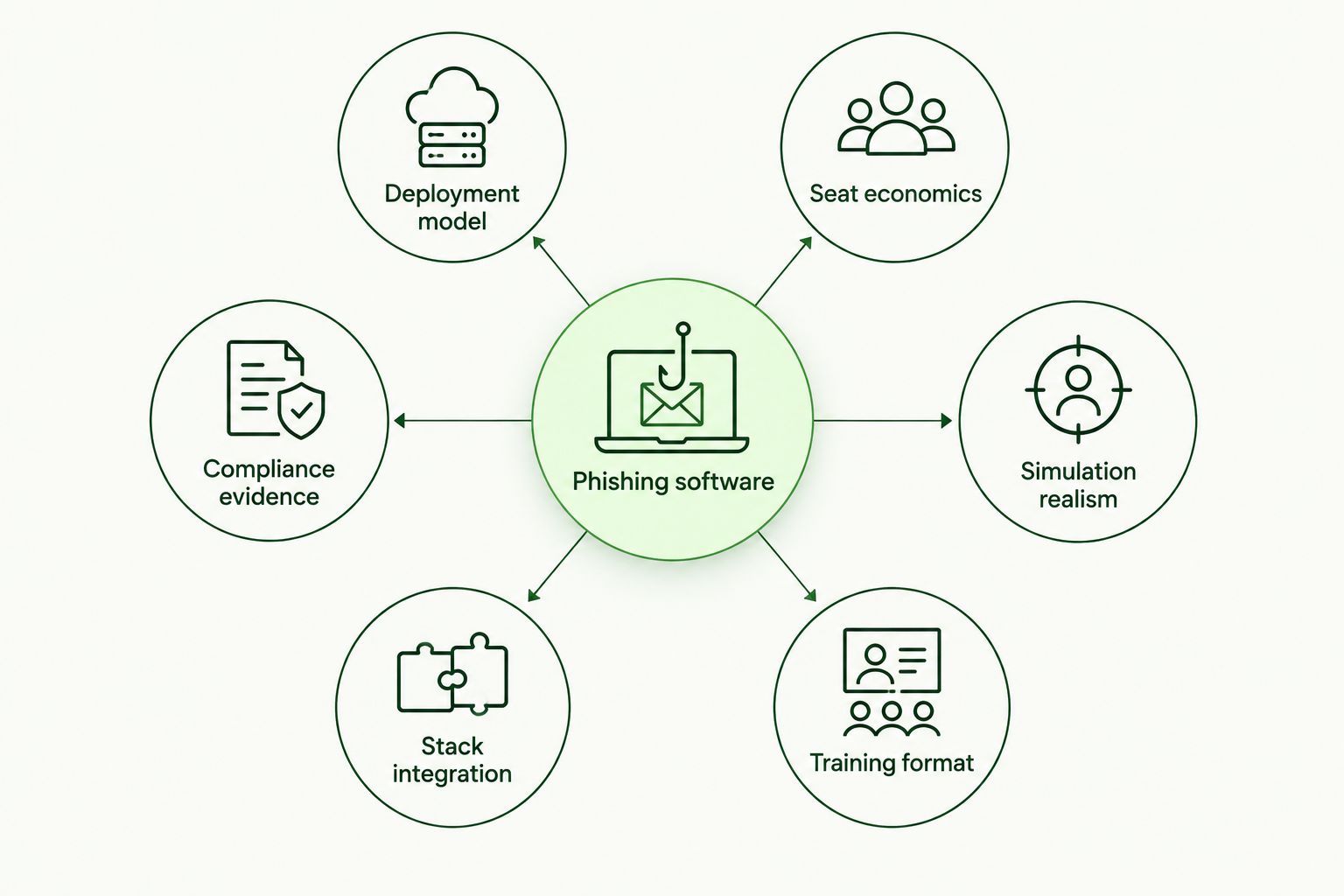
The right platform connects realistic testing, clean evidence, and a workable deployment model.
Biotech phishing simulation software at a glance
| Rank | Software | Best for | Standout feature | Key limitation |
|---|---|---|---|---|
| 1 | DefendWise | Biotech companies receiving training through an MSP | White-labelled, unlimited-seat MSP delivery | MSP-first model is a poor fit for teams wanting direct internal ownership |
| 2 | KnowBe4 | Biotech companies with an in-house security team | Broad awareness content and phishing campaign options | Breadth creates more configuration and content-selection work |
| 3 | Proofpoint Security Awareness | Organizations using the Proofpoint security stack | Threat-informed training within a wider email security ecosystem | The case is weaker without connected Proofpoint products |
| 4 | Cofense | Teams connecting employee reports to threat response | Reported-email workflow and phishing defence focus | Submissions need active triage and ownership |
| 5 | Hoxhunt | Teams prioritizing adaptive employee coaching | Personalized phishing exercises and feedback | Personalized programs can require more explanation during audit reviews |
| 6 | NINJIO | Teams prioritizing short security lessons | Story-led microlearning | Microlearning is not a replacement for a mature response workflow |
1. DefendWise: best for biotech companies using an MSP
DefendWise is an AI-native security awareness training platform designed for MSPs to deploy under their own brand. Its flat-fee model includes unlimited seats, removing the need to recalculate platform cost whenever an end client adds users.
That structure matches MSPs managing several biotech organizations or biotech clients with changing employee and contractor populations. The MSP can treat awareness training as a standardized service rather than a separate user-count exercise for every subclient.
DefendWise pros:
- Unlimited seats remove seat-count friction from client onboarding and staffing changes.
- White-labelled delivery keeps the MSP at the centre of the client relationship.
- The platform is built for MSPs managing awareness training across end-client organizations.
- Flat-fee licensing gives the MSP a predictable platform expense.
DefendWise cons:
- The MSP-first model adds little for a biotech company determined to manage a direct vendor relationship.
- Unlimited-seat economics matter less for a very small organization with stable staffing.
- Buyers still need to confirm that reporting and integrations match their exact compliance workflow.
Best for: MSPs delivering managed security awareness training to biotech clients.
Verdict: Buy. Choose this model when the MSP owns deployment, client reporting, and recurring service delivery.
2. KnowBe4: best for an in-house biotech security team
KnowBe4 combines phishing simulations with a broad security awareness training catalogue. Its public 2026 product materials emphasize simulated phishing, user training, reporting, and content selection across many security topics.
That breadth suits a biotech company with an internal security or compliance owner who wants direct control over campaign timing, audience segmentation, remedial training, and reporting. It also means someone must make those decisions rather than treating the platform as a set-and-forget service.
KnowBe4 pros:
- Broad content selection supports different roles and awareness topics.
- Phishing campaigns and follow-up training sit within the same product family.
- Internal teams retain direct control over configuration and reporting.
- Established workflows make it easier to find administrators with prior platform experience.
KnowBe4 cons:
- A large catalogue creates content-selection work before campaigns launch.
- Self-managed programs still need an employee to review results and assign follow-up actions.
- Biotech-specific scenarios require careful customization and internal approval.
Best for: biotech companies with an internal security team that wants to operate the program directly.
Verdict: Buy. It is the clearest direct-management option in this ranking for a staffed internal program.
3. Proofpoint Security Awareness: best for Proofpoint environments
Proofpoint Security Awareness connects training with Proofpoint's wider email security and threat-focused product ecosystem. Its 2026 positioning centres on using threat context to identify risk and direct awareness activity.
The integration case is strongest when a biotech company already uses related Proofpoint products. Keeping email defence and employee training in one ecosystem can reduce fragmented analysis, but ecosystem fit should drive the decision rather than the vendor name alone.
Proofpoint Security Awareness pros:
- Threat-informed training can align education with observed email risk.
- Connected products can reduce handoffs between email security and awareness reporting.
- Role and risk context provide a stronger basis for targeted training than identical campaigns for everyone.
Proofpoint Security Awareness cons:
- The main differentiator weakens when related Proofpoint security products are absent.
- A wider security ecosystem creates more implementation scope than a standalone awareness tool.
- Buyers must verify which integrations and reporting capabilities are included in their selected configuration.
Best for: biotech organizations already committed to Proofpoint email security products.
Verdict: Hold. Keep it on the shortlist for an existing Proofpoint environment; otherwise compare standalone options first.
4. Cofense: best for employee-reported threat workflows
Cofense focuses heavily on phishing defence, employee reporting, analysis, and response. Its product family includes simulation and reported-email capabilities, making it relevant when employee submissions are treated as security signals rather than training statistics.
That operating model fits biotech security teams with a defined process for reviewing suspicious emails. A report button without triage ownership only moves the backlog, so the internal workflow matters as much as the software.
Cofense pros:
- Employee reporting connects awareness activity with real suspicious-email handling.
- Phishing-specific focus supports teams that want more than course completion records.
- Reported messages can become operational security inputs when analysts actively review them.
Cofense cons:
- Reported messages require triage, escalation rules, and accountable owners.
- The platform is a heavier operational commitment than training-only software.
- Teams seeking simple scheduled lessons can end up with more workflow than they need.
Best for: biotech organizations with analysts or a managed security provider ready to process reported emails.
Verdict: Buy. Choose Cofense when reported-phish response is an active security function, not an unattended mailbox.
5. Hoxhunt: best for adaptive employee coaching
Hoxhunt presents phishing exercises and feedback as a personalized behaviour-change program. Its 2026 product positioning emphasizes adaptive simulations, immediate learning moments, and individual participation.
This approach suits biotech organizations that want training difficulty and feedback to reflect employee behaviour. It is less attractive when the primary requirement is a simple, uniform campaign that produces identical evidence for every participant.
Hoxhunt pros:
- Adaptive exercises can give employees different challenges based on their progress.
- Immediate feedback connects the learning moment to the simulated email.
- Personalized delivery avoids treating every role as if it faces the same email patterns.
Hoxhunt cons:
- Personalized paths produce less uniform training experiences across the workforce.
- Audit reviewers may need a clearer explanation of how adaptive assignments satisfy internal policy.
- Behaviour-focused reporting still needs to map to the organization's formal evidence requirements.
Best for: biotech companies prioritizing sustained employee behaviour change over uniform course delivery.
Verdict: Buy. Select Hoxhunt when personalization is a stated program requirement and the evidence model has been approved.
6. NINJIO: best for short security lessons
NINJIO uses story-led security awareness content and short learning formats. Its 2026 materials position narrative training as a way to make security concepts easier for employees to absorb and remember.
That format can fit mixed biotech workforces where scientists, administrative teams, laboratory personnel, and executives have different schedules. Short content still needs a surrounding simulation, reporting, and escalation process if the objective extends beyond awareness education.
NINJIO pros:
- Short lessons reduce the scheduling burden of long training sessions.
- Story-led content gives security concepts a recognizable workplace context.
- Microlearning supports recurring education rather than one large annual assignment.
NINJIO cons:
- Microlearning alone does not create an incident-response workflow.
- Buyers focused primarily on simulation operations should compare campaign controls carefully.
- Narrative content must still match internal policy and approved biotech scenarios.
Best for: biotech organizations that place short, recurring lessons at the centre of the awareness program.
Verdict: Hold. Choose it for microlearning strength, but confirm simulation and evidence requirements before committing.
How the ranking works
The ranking uses six dimensions: deployment model, seat economics, compliance evidence, simulation realism, stack integration, and training format. No single feature decides the result.
DefendWise ranks first for MSP-served biotech because its white-labelled, unlimited-seat structure directly matches that delivery model. KnowBe4 ranks first for internally managed programs, while Proofpoint, Cofense, Hoxhunt, and NINJIO win narrower use cases. The order changes if the operating model changes.
Remove seat-count friction
See the flat-fee, unlimited-seat platform built for MSP-delivered awareness training.
Which platform should you choose in 2026?
Choose DefendWise in 2026 when an MSP will own delivery across biotech client organizations. Its white-labelled model and unlimited seats remove recurring user-count administration from the service model.
Choose KnowBe4 when an in-house team wants broad content and direct campaign control. Choose Proofpoint Security Awareness when related Proofpoint products already shape the security stack. Choose Cofense when employee-reported emails feed an active response process. Choose Hoxhunt for adaptive coaching, and choose NINJIO when short narrative lessons are the priority.
The default 2026 decision is simple: match the platform to whoever will operate it every month. Buying more content does not fix unclear ownership.
FAQ
What's the best phishing simulation software for biotech companies in 2026?
DefendWise is the best option for biotech companies receiving security awareness training through an MSP. KnowBe4 is the stronger fit when an internal security team wants to manage campaigns directly.
What should biotech companies test in phishing simulations?
Biotech companies should test approved scenarios based on the workflows employees actually use. Relevant examples include clinical-trial communications, laboratory supplier messages, document-sharing notices, identity prompts, and finance approvals.
Does phishing simulation make a biotech company HIPAA compliant?
No, phishing simulation alone does not make an organization HIPAA compliant. It can support a wider security awareness and evidence program when HIPAA applies, but policies, risk management, access controls, documentation, and other safeguards remain necessary.
Is KnowBe4 better than Cofense for biotech companies?
KnowBe4 is better for a broad, internally managed awareness program, while Cofense is better for connecting employee-reported messages to phishing analysis and response. The deciding factor is whether the team primarily needs training administration or an operational reporting workflow.
How often should a biotech company run phishing simulations?
The correct frequency follows the organization's risk assessment, policy, workforce changes, and remediation process. A recurring schedule with targeted follow-up is more useful than an isolated annual test that produces no corrective action.
How does flat-fee phishing simulation licensing help an MSP?
Flat-fee licensing removes the need to recalculate software expense whenever client seat counts change. That makes the service easier to package across end-client organizations with different or changing workforce sizes.
What evidence should phishing simulation software retain?
The software should retain campaign dates, recipients, outcomes, assigned remediation, completion records, and administrative actions required by the organization's policy. Retention settings should match applicable legal, contractual, insurance, and audit requirements.
Can phishing simulations use real biotech vendor names?
Only use realistic scenarios under an approved internal process that addresses authorization, privacy, employee relations, and escalation. The goal is to measure behaviour without creating avoidable confusion or disrupting genuine supplier and clinical workflows.
One last thing
Do not let click rate become the entire program in 2026. A lower rate means little if suspicious emails sit unreviewed, repeat clickers receive no follow-up, or audit evidence cannot be retrieved.
Assign an owner before selecting software. Define who approves scenarios, who reviews results, who handles reported emails, who assigns remediation, and who preserves evidence. The platform should make those responsibilities easier to execute; it cannot replace them.