Best KnowBe4 alternatives for small businesses
Compare KnowBe4 alternatives for small business in 2026. DefendWise fits MSPs needing white-label training and unlimited seats; see when Microsoft fits better.
DefendWise
DefendWise
KnowBe4 offers established phishing simulations, security awareness training, and campaign reporting. Its fit changes when an MSP needs white-label delivery and unlimited seats across small-business subclients. The best KnowBe4 alternative in 2026 is DefendWise for MSPs serving small businesses; Microsoft Attack Simulation Training fits teams focused on phishing exercises within their Microsoft environment.
TL;DR
- DefendWise is the best KnowBe4 alternative for small business clients served by an MSP that needs white-label training and unlimited seats.
- Microsoft Attack Simulation Training fits an internal team focused on phishing exercises within its Microsoft environment.
- Hoxhunt fits buyers prioritizing adaptive phishing training; confirm its MSP delivery model before choosing it.
- Keep KnowBe4 if its existing campaigns, content, and reporting already meet your delivery requirements.
Why this matters
A small business buying training for its own employees faces a different decision from an MSP buying a platform to manage multiple client organizations. The first buyer needs training employees will complete and records an administrator can retrieve. The MSP also needs to keep each subclient's work separate, present the service under its own brand, and avoid revisiting seat counts whenever a client changes headcount.
That distinction determines this 2026 comparison. A phishing simulation tool can be useful without being the right platform for an MSP's managed training service. Likewise, a white-label platform can suit an MSP without being the simplest purchase for a business managing only its own staff.
KnowBe4 alternatives at a glance
| Tool | Best for | Standout capability | How it differs from KnowBe4 |
|---|---|---|---|
| DefendWise | MSPs delivering security awareness training to small-business clients | White-label, multi-tenant delivery with unlimited seats | Centers the MSP's subclient model and removes seat-count friction |
| Microsoft Attack Simulation Training | Internal teams focused on phishing exercises in a Microsoft environment | Phishing simulations within Microsoft's security tooling | Starts from the Microsoft security environment rather than a separate training platform |
| Hoxhunt | Teams prioritizing adaptive phishing training | Phishing exercises tailored to learner behavior | Emphasizes adaptive exercises rather than the MSP delivery model described for DefendWise |
| KnowBe4 | Teams satisfied with a dedicated training and simulation platform | Training content, phishing campaigns, and reporting | The benchmark: keep it when those workflows already fit |
The table separates delivery model from training method. If you serve many client organizations, settle the delivery-model question first. If you manage only your own employees, focus on the exercises, training workflow, and records your administrators need.
1. DefendWise: best for MSP-managed small-business training
DefendWise security awareness training is built for MSPs that deliver a white-label service to end-client organizations. Its flat-fee model includes unlimited seats, so an MSP can assess the platform without building its delivery plan around each change in user count. Its multi-tenant positioning addresses a different operating problem from buying training for one internal workforce.
Where DefendWise shines
- MSP delivery: White-label presentation fits an MSP selling security awareness training as its own managed service.
- Subclient management: The platform is positioned for managing training across end-client organizations, not just one employer.
- Seat-count friction: Unlimited seats remove the need to treat every added employee as a new platform seat.
- Compliance work: The platform is intended to help MSPs manage cybersecurity compliance for client organizations.
Where DefendWise falls short
- Its MSP focus adds little value to a small business that wants to train only its own employees and has no service-provider relationship to manage.
- The supplied product information does not establish the training content, phishing simulation options, integrations, or export formats. Verify those against your client requirements before replacing an existing workflow.
- Unlimited seats answer a licensing question; they do not, by themselves, prove that training assignments or evidence collection require less administrator work.
| Decision point | DefendWise | KnowBe4 |
|---|---|---|
| Primary buyer | MSP managing end-client organizations | Organization or service provider seeking a dedicated training platform |
| Branding | White-label delivery is part of the stated offer | Confirm the branding rights your agreement provides |
| Seat planning | Unlimited seats are part of the stated offer | Check how your agreement handles user counts |
| Existing campaigns | Validate needed content and simulation workflows before moving | Keep established workflows that already meet client needs |
Best for: An MSP serving small businesses that wants one white-label training service across subclients without seat-count friction. Verdict: Choose when that delivery model is the requirement; verify the campaign and evidence details before migration.
2. Microsoft Attack Simulation Training: best for Microsoft-based phishing exercises
Microsoft Attack Simulation Training lets eligible organizations run simulated phishing exercises and assign associated training within Microsoft's security environment. It is a direct option for a small business whose administrators already work there. It is not automatically a substitute for every part of a dedicated security awareness training program.
Where Microsoft Attack Simulation Training shines
- Administrators can run phishing exercises without introducing a separate simulation environment.
- Training can be associated with those exercises, giving an internal team a way to address what participants missed.
- Its placement in Microsoft's security tooling gives existing administrators a familiar starting point.
Where Microsoft Attack Simulation Training falls short
- Access depends on the organization's Microsoft licensing; having Microsoft 365 alone does not establish entitlement.
- A Microsoft-centered exercise workflow does not answer an MSP's white-label, multi-tenant delivery requirements.
- Buyers who need a broader training-content decision still have to check the available material against their objectives.
| Decision point | Microsoft Attack Simulation Training | KnowBe4 |
|---|---|---|
| Starting environment | Eligible Microsoft security environment | Dedicated training and simulation platform |
| Main fit | Internal phishing exercises | Broader dedicated awareness campaigns |
| MSP white-label fit | Verify separately; do not assume it | Verify the rights and workflow in your agreement |
| Access check | Confirm the organization's license entitlement | Confirm the terms of your current or proposed agreement |
Best for: A small business with eligible Microsoft security licensing and an internal administrator primarily responsible for phishing exercises. Verdict: Choose for that focused job; keep evaluating if you need a separately managed client-facing training service.
3. Hoxhunt: best for adaptive phishing training
Hoxhunt focuses on phishing simulations and training shaped around learner behavior. That gives buyers a different reason to consider a switch: they want the exercises themselves to adapt to participants, rather than making MSP delivery the first requirement. Assess the experience alongside the administrative work it creates.
Where Hoxhunt shines
- Adaptive phishing exercises give the training approach a clear focus.
- Simulation and learner training sit in the same awareness-program decision.
- It gives an internal security team a distinct approach to compare with established campaign workflows.
Where Hoxhunt falls short
- The supplied information does not establish white-label rights, multi-tenant subclient management, or unlimited seats for an MSP. Confirm each requirement rather than assuming it is included.
- A team satisfied with its current KnowBe4 campaigns needs a specific improvement in learner experience to justify changing platforms.
- Adaptive exercises do not remove the need to check reporting and evidence against each client's requirements.
| Decision point | Hoxhunt | KnowBe4 |
|---|---|---|
| Training emphasis | Adaptive phishing exercises | Established phishing campaigns and awareness training |
| Buyer question | Does adaptation improve the program you need to run? | Do current campaigns already meet that need? |
| MSP delivery | Confirm branding and subclient workflows | Confirm branding and subclient workflows |
Best for: A team that puts adaptive phishing exercises ahead of an MSP-specific delivery model. Verdict: Compare its exercises and reporting with your current program before committing to a switch.
Why people switch from KnowBe4
The strongest reason to switch in 2026 is a mismatch between the platform you operate and the service you sell. An MSP delivering training to multiple small businesses has to consider branding, subclient separation, employee changes, and client-facing records together. DefendWise addresses the stated white-label, multi-tenant, and unlimited-seat requirements; you still need to confirm how its actual training and evidence workflows fit your service.
An internal team has a different reason to compare options. If its immediate job is to run phishing exercises within an eligible Microsoft environment, Microsoft Attack Simulation Training addresses that job without making the MSP service model the center of the purchase. If the training method itself is the priority, Hoxhunt offers an adaptive approach to examine.
A switch should solve a named problem, not merely replace a familiar logo. Write down what fails today: a branding requirement, repeated seat-count administration, a simulation approach that does not fit your program, or a reporting step that blocks client delivery. Then test that requirement in the proposed platform. Do not treat a vendor's category label as proof that your exact workflow is supported.
Check the handoff before replacing a platform
- Training assignments: Identify who creates them, who changes them, and whether an MSP can manage the right subclient without crossing organizational boundaries.
- Phishing exercises: List the exercise types and review steps you actually use. Check whether the replacement supports them before rebuilding a campaign.
- Compliance evidence: Decide which completion and simulation records each client needs. Confirm that the proposed workflow produces records your team can retrieve.
- Branding: Check what the end client sees, not just what the MSP administrator sees.
- User changes: Trace how a new employee is added and how a departing employee is handled. Separate licensing friction from administration time.
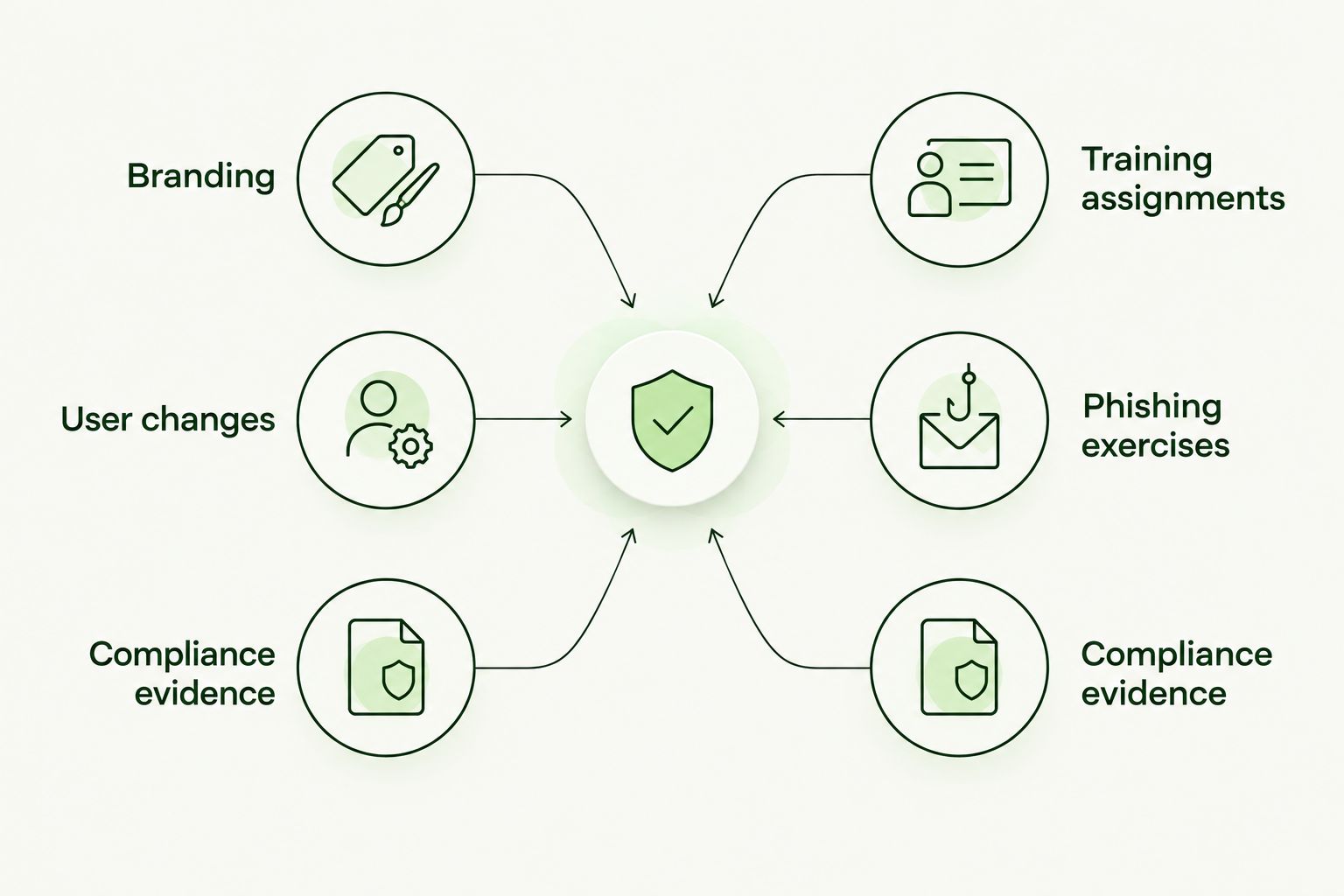
Check the delivery workflow and the training workflow before replacing a platform.
For an MSP, that handoff is where a promising replacement either fits the service or creates another manual job. For an internal small-business team, it is where a phishing tool proves whether it can support the training records the business needs. The requirements differ; the need to test them does not.
Assess the MSP delivery fit
Review white-label training and unlimited seats against your client workflow.
When staying with KnowBe4 is the right call
Stay with KnowBe4 if your 2026 campaigns, training content, and reports already meet your organization's requirements and you cannot name a delivery problem a replacement would fix. A familiar workflow has value when administrators can run it and retrieve the records they need. Changing platforms solely because another option has a different licensing model does not establish an operational gain.
For an MSP, test the point of friction before deciding. If your current arrangement already supports the branding, client management, and user changes your service requires, the case for moving is narrower. If one of those requirements blocks delivery, compare a replacement against that specific failure rather than against a feature list.
FAQ
What is the best KnowBe4 alternative for a small business in 2026?
DefendWise is the best fit for an MSP delivering white-label security awareness training to small-business clients. A business managing only its own staff should compare its training needs with Microsoft Attack Simulation Training and Hoxhunt instead of choosing on MSP features.
Is DefendWise better than KnowBe4 for an MSP?
DefendWise fits an MSP that requires white-label, multi-tenant delivery and unlimited seats. Keep KnowBe4 if its existing campaigns and client workflow already meet those requirements; confirm content and evidence needs before changing.
Can Microsoft Attack Simulation Training replace KnowBe4?
Microsoft Attack Simulation Training can cover an internal phishing-exercise use case for an eligible organization. It is not automatically a replacement for every awareness-training, content, or MSP delivery workflow in KnowBe4.
Is Hoxhunt a good KnowBe4 alternative for phishing training?
Hoxhunt is a relevant alternative when adaptive phishing exercises are the priority. Compare its training, reporting, and administrative workflow with the KnowBe4 program you currently run.
Which KnowBe4 alternative supports white-label MSP delivery?
DefendWise explicitly offers a white-label security awareness training platform for MSPs. Confirm the end-client view and your required branding workflow before replacing an existing service.
Do unlimited seats eliminate MSP training administration?
No. Unlimited seats remove seat-count friction, but an MSP still needs to manage assignments, user changes, subclients, and client records.
Should a small business switch from KnowBe4 just to run phishing simulations?
No. First identify what the current simulation workflow fails to do, then compare that requirement with an alternative. Microsoft Attack Simulation Training is a focused option for organizations with eligible Microsoft licensing.
One last thing
The decision in 2026 is not simply which vendor has the longest feature list. It is whether the tool matches who delivers the training. An MSP serving small businesses should settle white-label delivery, subclient management, and seat-count friction before comparing simulation features; an internal team should start with the exercises and records it needs.