Best KnowBe4 alternatives for healthcare organizations
Compare knowbe4 alternatives for healthcare in 2026. DefendWise wins for MSPs needing white-label training and unlimited seats; see where other options fit.
DefendWise
DefendWise
KnowBe4 gives healthcare organizations security awareness training and phishing simulations in one established platform. Its ceiling for an MSP is a different question: whether managing training across separate healthcare clients creates seat-count friction or extra evidence work. The best KnowBe4 alternative in 2026 is DefendWise for MSPs that need white-label training with unlimited seats; Hoxhunt is the stronger shortlist choice when adaptive phishing training is the priority.
TL;DR
- For knowbe4 alternatives for healthcare, choose DefendWise when your MSP needs white-label training and unlimited seats.
- Shortlist Hoxhunt when adaptive phishing training matters more than an MSP-led service model.
- Keep KnowBe4 if its current training and phishing workflows already produce usable client-level evidence.
- Check assignment, completion and follow-up records against each healthcare client's requirements before switching.
Why this matters for healthcare MSPs
A healthcare client does not just need employees to finish a course. It needs a way to show who was assigned training, who completed it and how exceptions were handled. Under the HIPAA Security Rule, 45 CFR §164.308(a)(5)(i) requires security awareness and training for all workforce members, including management. A platform can help deliver and document that work; buying the platform alone does not establish compliance.
For an MSP, the decision has 2 organizational levels: your team administers the service, while each healthcare client remains a distinct organization with its own workforce and evidence needs. Test both levels in 2026. A polished learner experience is not enough if your staff must manually separate client records before every review.
KnowBe4 alternatives for healthcare at a glance
| Tool | Best for | Standout capability | How it differs from KnowBe4 |
|---|---|---|---|
| KnowBe4 | Teams satisfied with their existing training and simulation workflow | Security awareness training alongside phishing simulations | The benchmark; staying avoids a migration |
| DefendWise | MSPs delivering white-label training to multiple healthcare clients | Unlimited seats under a flat-fee model | Centers the MSP's service model rather than a seat-count decision |
| Hoxhunt | Teams prioritizing adaptive phishing training | Adaptive phishing exercises | Leads with phishing practice as the selection criterion |
| Microsoft Attack Simulation Training | Eligible Microsoft 365 environments focused on email-attack exercises | Simulation within the Microsoft security environment | Fits an existing Microsoft security workflow rather than replacing an entire training decision by default |
| Proofpoint Security Awareness Training | Teams evaluating training alongside Proofpoint's security tools | Security awareness training and phishing simulations | Makes sense to assess within a Proofpoint-centered security stack |
Best for an MSP-led healthcare service: DefendWise. That verdict concerns packaging and administration, not a claim that any platform makes a healthcare organization HIPAA-compliant. The remaining choices solve different problems, so compare the records they produce for each client before choosing on training content alone.
1. DefendWise: best for MSP-led healthcare training
DefendWise is a white-label security awareness training platform built for MSPs to train and manage cybersecurity compliance for end-client organizations. Its flat-fee, unlimited-seat model removes the need to decide whether another client's workforce member justifies another training seat. That is the relevant distinction when your MSP packages training as an ongoing healthcare client service.
Where DefendWise shines
- White labeling supports delivery under the MSP's service identity.
- Unlimited seats remove seat-count friction from workforce coverage.
- Its MSP and end-client focus matches an organization that administers training for other organizations.
Where DefendWise falls short
- An MSP-focused product is not the automatic choice for a healthcare organization that wants to buy and administer training entirely on its own. Confirm the intended purchasing and operating model first.
- The supplied product details do not establish specific electronic health record integrations, identity-provider support or report exports. Verify any capability your client requires in a demonstration rather than assuming it exists.
Best for: MSPs that want to deliver security awareness training across healthcare clients without managing training seats individually.
| Decision point | DefendWise | KnowBe4 |
|---|---|---|
| Stated audience | MSPs managing end-client organizations | Organizations evaluating security awareness training |
| White-label priority | Explicit part of the MSP offering | Confirm the required branding workflow |
| Seat model | Unlimited seats | Confirm the terms that apply to your agreement |
| Healthcare evidence | Review client-level records against your requirements | Review client-level records against your requirements |
Do not turn the seat model into a compliance claim. In a 2026 evaluation, ask your team to walk through a new healthcare client, a new workforce member and a person who has not completed training. The useful result is a record your client can understand without your staff rebuilding it by hand. Verdict: Buy for an MSP-led service when those workflows meet your evidence requirements; hold if they do not.
2. Hoxhunt: best for adaptive phishing practice
Hoxhunt is an alternative when the quality and adaptation of phishing exercises drive the purchase. Its adaptive approach makes it a relevant comparison for healthcare teams that want repeated practice, not just assigned awareness content. An MSP should still assess whether the administrative view works across separate clients.
Where Hoxhunt shines
- Adaptive phishing training gives the evaluation a clear behavioral focus.
- Phishing exercises provide a practical way to assess how users respond to suspicious messages.
Where Hoxhunt falls short
- Adaptive exercises do not answer how an MSP will package, brand and administer the service for multiple healthcare clients.
- The healthcare client still needs assignment, completion and follow-up evidence; assess those records separately from phishing results.
Best for: Teams that put adaptive phishing practice ahead of an MSP-specific delivery model.
| Decision point | Hoxhunt | KnowBe4 |
|---|---|---|
| Main reason to shortlist | Adaptive phishing training | Established training and phishing-simulation workflow |
| MSP delivery | Test client separation and administration | Test client separation and administration |
| Compliance evidence | Inspect actual client-facing records | Inspect actual client-facing records |
In 2026, run the same healthcare scenario in both products. Review the learner experience, then ask an administrator to produce a record for one client without including another client's workforce. Verdict: Buy if adaptive practice is the deciding need and the evidence workflow passes; otherwise, hold.
3. Microsoft Attack Simulation Training: best for Microsoft security workflows
Microsoft Attack Simulation Training belongs on the list when a healthcare organization's email-security work already centers on Microsoft's environment. It gives the team a way to evaluate phishing exercises within that setting. Check the licensing and feature eligibility that apply to the client's environment before treating it as a complete substitute for its current awareness program.
Where Microsoft Attack Simulation Training shines
- It lets eligible Microsoft environments assess email-attack exercises without introducing a separate simulation workflow by default.
- Its position within the Microsoft security environment can simplify evaluation for teams already administering that environment.
Where Microsoft Attack Simulation Training falls short
- An attack-simulation decision is not, by itself, a decision about every training assignment and completion record a healthcare client needs.
- An MSP serving clients with different Microsoft arrangements must check eligibility and administration client by client.
Best for: Eligible Microsoft environments where phishing simulation is the immediate requirement.
| Decision point | Microsoft Attack Simulation Training | KnowBe4 |
|---|---|---|
| Evaluation focus | Exercises in the Microsoft security environment | A separate awareness-training platform with simulations |
| Eligibility | Check the client's Microsoft setup | Check the client's existing agreement |
| Training records | Verify the required assignment and completion trail | Verify the required assignment and completion trail |
The 2026 test is straightforward: determine whether simulation covers the actual gap, or whether the client also needs a different training-management workflow. Verdict: Buy for a qualifying simulation use case; skip it as a blanket replacement until the full evidence trail is confirmed.
4. Proofpoint Security Awareness Training: best for a Proofpoint-centered review
Proofpoint Security Awareness Training is a relevant alternative for a healthcare team reviewing awareness training and phishing exercises alongside other Proofpoint security tools. The reason to shortlist it is the client's existing security context, not an assumption that one vendor's products automatically solve every training-administration task.
Where Proofpoint shines
- It gives teams already evaluating Proofpoint a named awareness-training option to assess.
- Training and phishing exercises can be judged against the same client scenarios used for KnowBe4.
Where Proofpoint falls short
- A familiar vendor relationship does not establish that its training records fit an MSP's client-by-client reporting process.
- Do not assume a connection between security tools provides the assignment, completion and exception records a reviewer needs.
Best for: Healthcare teams already assessing Proofpoint's security tools and willing to test its training workflow directly.
| Decision point | Proofpoint Security Awareness Training | KnowBe4 |
|---|---|---|
| Reason to evaluate | Awareness training in a Proofpoint-centered review | Existing awareness training and phishing simulations |
| MSP administration | Demonstrate separate client workflows | Demonstrate separate client workflows |
| Evidence check | Inspect records produced for one healthcare client | Inspect records produced for one healthcare client |
Verdict: Hold until its client-level training records and administrative workflow beat the process you already have.
Why MSPs switch from KnowBe4
Switching is justified when the replacement solves a documented service problem, not when a comparison page declares a new winner. For a healthcare MSP, the strongest reason to assess an alternative is a mismatch between how you sell training and how you must administer it. A white-label, unlimited-seat model is specifically relevant when the MSP owns the client relationship and wants workforce coverage without seat-count decisions.
Use 3 evidence categories in every 2026 product review:
- Assignment: Can you identify which workforce members were assigned which training for a particular healthcare client?
- Completion: Can you show that client's completed training without mixing in another organization's records?
- Follow-up: Can you identify incomplete work and show how your team handled it?
These are evaluation questions, not a claim that a named vendor lacks a feature. Ask for a demonstration using your own client structure. If you cannot get a clear answer at the right organizational level, the training content does not fix the administrative problem.
A useful comparison follows the work your staff actually performs: add a client, assign training, review an incomplete assignment and prepare a client-facing record. Repeat the sequence for a second client. The second pass tests whether your team can keep organizations separate without relying on a manually maintained workaround.
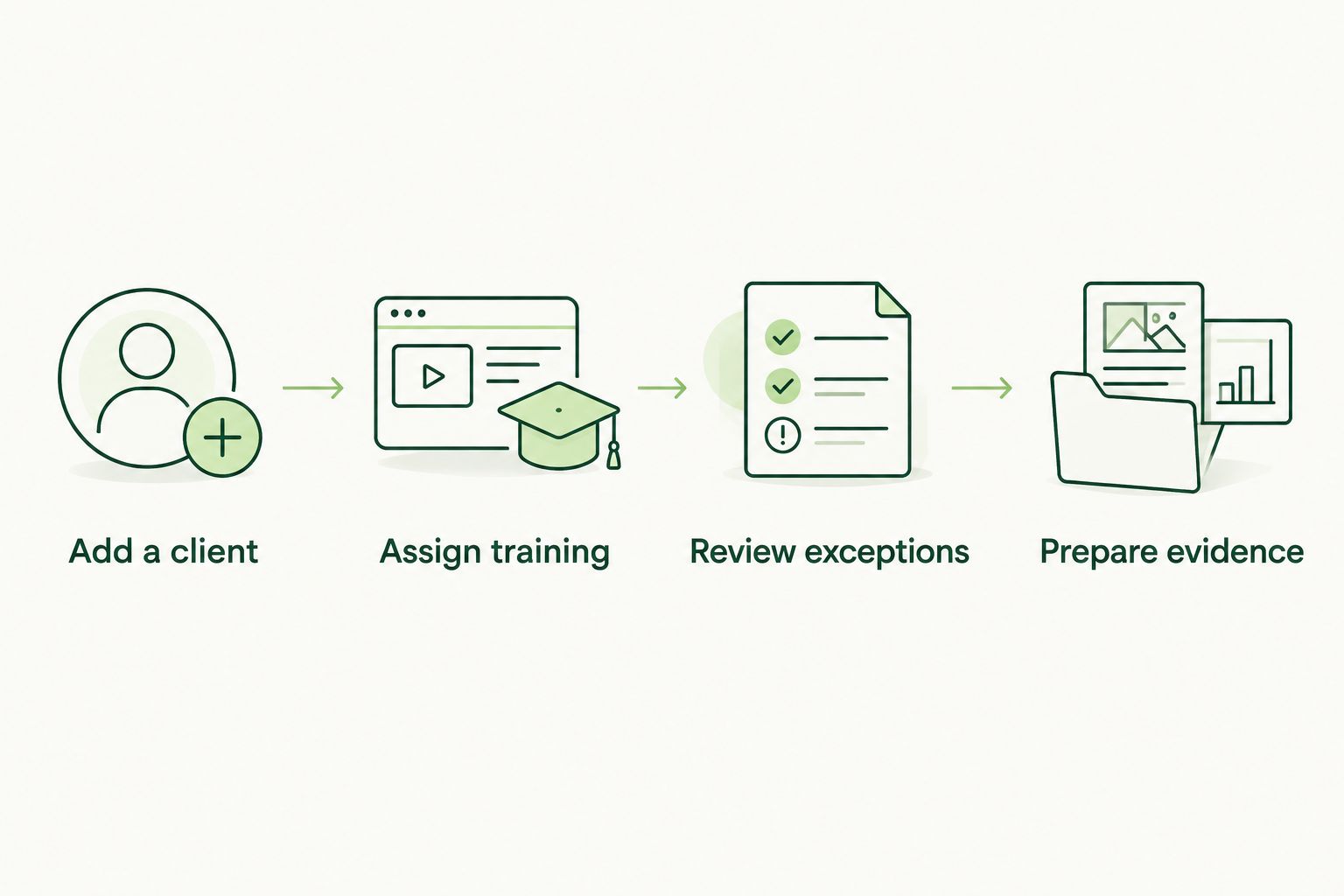
Judge each platform by the client-level record it produces at the end of the workflow.
When staying with KnowBe4 is the right call
Keep KnowBe4 if your 2026 setup already gives each healthcare client the training, phishing exercises and usable records it needs, without creating avoidable work for your MSP. A migration consumes attention and requires the team to preserve the evidence it has already collected. Switching merely to change vendors does not improve a working process.
Stay especially cautious if your clients rely on an established training routine and your proposed replacement has not passed a client-level demonstration. Compare the record a reviewer would receive, not the appearance of an administrative screen. Verdict: Hold KnowBe4 when it meets the requirement and the alternative has not shown a clear operational gain.
FAQ
What's the best KnowBe4 alternative for a healthcare MSP in 2026?
DefendWise is the best fit when the MSP needs white-label security awareness training with unlimited seats. Confirm its client-level evidence workflow against each healthcare customer's requirements before changing platforms.
Is DefendWise better than KnowBe4 for healthcare organizations?
DefendWise is the stronger choice for an MSP whose priority is white-label delivery without seat-count friction. A healthcare organization already satisfied with its KnowBe4 workflow has no reason to switch without a demonstrated gain.
Is Hoxhunt a KnowBe4 alternative for healthcare?
Yes. Hoxhunt is a relevant alternative when adaptive phishing training is the leading requirement; assess its training records and MSP administration separately.
Can Microsoft Attack Simulation Training replace KnowBe4?
Microsoft Attack Simulation Training can cover an eligible organization's phishing-simulation use case. Verify licensing eligibility and the complete training-evidence workflow before replacing an awareness program.
Does security awareness training make a healthcare organization HIPAA-compliant?
No. The HIPAA Security Rule requires security awareness and training for workforce members, but a training platform alone does not establish compliance with the rule's other requirements.
What records should an MSP request from a healthcare training platform?
Request client-specific assignment, completion and follow-up records. Check that the records identify the correct organization and remain usable when a workforce member has not finished training.
How long must HIPAA Security Rule documentation be retained?
The HIPAA Security Rule requires covered entities and business associates to retain required policies, procedures and related required documentation for 6 years under 45 CFR §164.316(b)(2)(i). Do not treat that provision as a blanket retention period for every training log; identify which records your organization must maintain.
One last thing
The most useful 2026 vendor demonstration starts with an incomplete assignment, not a completed course. Ask the vendor to show what the MSP sees, what one healthcare client receives and how that record stays separate from another client's. That exposes the work your team would otherwise inherit after the sale.