Best cyber security awareness training for manufacturers 2026
Choose cyber security awareness training for manufacturing companies by role: MSP management, finance workshops, shift briefings, and specialist OT training.
DefendWise
DefendWise
Best for MSP-managed delivery: Defend Wise. Best for purchasing and finance teams: instructor-led scenario workshops. Best for production-floor reinforcement: supervisor-led shift briefings. Best for engineers managing industrial systems: specialist operational technology training. The best cyber security awareness training for manufacturing companies in 2026 combines accountable program management with instruction matched to each employee’s work.
TL;DR
- Defend Wise suits MSPs managing cyber security awareness training for manufacturing companies through a white-label platform.
- Use scenario workshops for purchasing and finance staff who handle supplier changes and payment requests.
- Use shift briefings for production-floor reinforcement, not as a replacement for tracked training.
- Give engineers specialist operational technology training; general awareness does not establish industrial-system competence.
Why this matters
A manufacturer’s training program has to reach people doing different jobs. A purchasing employee changing supplier details faces a different decision from a technician receiving an unexpected remote-support request. Giving both the same material leaves the important decisions unexplained.
Choose the program around the action you need employees to take—not the size of its course library. For your 2026 plan, define who owns training, how employees access it, and what evidence you need afterward. Then choose the delivery methods that fit.
These recommendations distinguish program management from instruction. A platform organizes delivery; a workshop rehearses judgment; a briefing reinforces a rule; specialist training develops role-specific knowledge. They are complementary options, not interchangeable products.
What makes the best manufacturing security training?
Judge each option against these criteria before choosing a supplier or delivery method:
- Role relevance: Purchasing, finance, production, engineering, and supervisors need examples tied to their responsibilities.
- Workplace access: Confirm how employees without individual workstations will participate without sharing training identities.
- Clear reporting: Employees need a named reporting route and instructions for suspicious requests, unexpected access prompts, and possible mistakes.
- Completion evidence: Record who completed which material and when. Attendance alone does not show understanding.
- Administrative ownership: Assign responsibility for enrollment, reminders, exceptions, and client-facing reporting before launch.
- Technical boundaries: General awareness must not stand in for technical instruction about industrial systems or approved operating procedures.
For an MSP, seat-count friction belongs in this assessment too. Defend Wise provides flat-fee, white-label security awareness training with unlimited seats. That supports the commercial packaging of an MSP-managed service; you still need to evaluate the instruction, access arrangements, and reporting against the manufacturer’s requirements.
Manufacturing security training options at a glance
| Option | Best for | Standout capability | Key limitation |
|---|---|---|---|
| Defend Wise | MSP-managed client programs | Flat-fee, white-label security awareness platform with unlimited seats | A platform choice does not establish suitability for a particular plant’s training requirements |
| Instructor-led scenario workshops | Purchasing and finance decision-making | Discussion of supplier, invoice, and payment-change scenarios | Requires preparation, facilitation, and separate completion records |
| Supervisor-led shift briefings | Production-floor reinforcement | Instructions connected to immediate workplace decisions | Brief attendance does not demonstrate individual understanding |
| Specialist operational technology training | Engineers and industrial-system administrators | Instruction focused on industrial-system responsibilities | Does not replace workforce-wide awareness training |
The table ranks fit by responsibility, not by an unsupported claim that one method prevents more incidents. Choose a primary program, then fill the gaps with targeted instruction.
1. Defend Wise: best security awareness training for MSP management
Defend Wise provides a white-labeled security awareness training platform that MSPs use to train and manage cybersecurity compliance for end-client organizations. Its flat-fee model includes unlimited seats. It is best for MSPs that want to package security awareness training under their own brand without per-seat pricing.
For a manufacturing client, evaluate the operational fit before committing. Ask how the proposed deployment will handle distinct employee groups, evidence requests, and workers who do not routinely use an individual workstation. Treat these as acceptance requirements, not assumed features.
Defend Wise pros
- White-label delivery fits an MSP-branded client service.
- Unlimited seats remove per-seat pricing from the platform’s commercial model.
- The platform is explicitly designed for MSPs serving end-client organizations.
Defend Wise cons
- Platform selection does not replace manufacturing-specific scenario design.
- You still need an accountable owner for client enrollment and exceptions.
- Plant-specific access, content, and evidence requirements need validation before rollout.
Best for: MSPs managing security awareness as an ongoing client service.
For your 2026 evaluation, write down the evidence you expect to hand the client. Include employee identity, assigned material, completion status, and unresolved exceptions. Confirm each requirement during evaluation rather than treating a general compliance description as proof of a specific reporting function.
Verdict: Buy for MSP-managed delivery after validating the manufacturer’s workflow requirements.
2. Instructor-led workshops: best for purchasing and finance teams
Instructor-led scenario workshops put employees inside a decision instead of asking them to memorize a warning. A facilitator presents a supplier-change request, an urgent invoice, or an unusual executive instruction. Participants explain what they would verify and whom they would notify.
This format fits teams authorized to change payment details, approve purchases, or release sensitive commercial information. The session should use fictional examples modeled on approved internal procedures—not live credentials, real bank details, or confidential supplier correspondence.
Instructor-led workshop pros
- Discussion exposes conflicting assumptions about approval responsibilities.
- Scenarios connect security instruction to actual business decisions.
- Facilitators can correct misunderstandings before the session ends.
Instructor-led workshop cons
- Scheduling needs to accommodate the participating teams.
- Quality depends on the facilitator and scenario preparation.
- Attendance and learning outcomes require deliberate recording.
Best for: Purchasing and finance staff who approve supplier or payment changes.
Start with 3 scenarios: changed bank details, an urgent payment request, and an unexpected supplier attachment. This is a recommended workshop design, not a required training standard. For each scenario, ask employees to identify the suspicious element, name the verification route, and describe the reporting action.
Close with a written decision rule employees can use at work. If participants disagree about who can authorize a change, resolve that process problem before marking the workshop complete.
Verdict: Buy for decision-heavy roles; skip generic presentations without practice.
3. Shift briefings: best for production-floor reinforcement
Supervisor-led shift briefings reinforce a specific security action during an existing team discussion. The subject should be narrow: reporting an unexpected login prompt, handling an unfamiliar removable device, or escalating a suspicious support request.
The briefing is not a compressed technical course. Its purpose is to connect a recognizable situation with an approved response, using language employees can repeat without translating security jargon.
Supervisor-led shift briefing pros
- The format places instruction inside a familiar workplace routine.
- Supervisors can explain the reporting route in local terms.
- Short, focused topics make the expected action explicit.
Supervisor-led shift briefing cons
- Delivery can become inconsistent across supervisors and shifts.
- Group attendance does not prove individual understanding.
- Briefings cannot replace specialist instruction for technical responsibilities.
Best for: Production employees who need repeated, practical reminders alongside a tracked awareness program.
Use a 2-minute practice exercise as a design target, not a universal training requirement. Present a situation, ask for the first safe action, and confirm the reporting route. Avoid turning the exercise into a public test of the least-confident employee.
For a 2026 rollout, give every supervisor the same approved core instruction. Allow local examples, but do not allow different rules for the same event. Record absences and arrange a catch-up rather than counting the whole shift as trained.
Verdict: Buy as reinforcement; skip as your only awareness program.
4. Specialist OT training: best for industrial-system responsibilities
Specialist operational technology, or OT, training addresses the responsibilities of people who administer, maintain, or support industrial systems. Its scope should match their approved work: access authorization, remote-support arrangements, change procedures, and incident escalation.
This is distinct from workforce awareness. Recognizing a suspicious email does not demonstrate competence to change an industrial system, and completing a technical course does not remove the need for general reporting instruction.
Specialist OT training pros
- Instruction can focus on defined engineering and administration duties.
- Scenarios can distinguish security escalation from operational intervention.
- Role-specific assessment can examine decisions beyond basic awareness.
Specialist OT training cons
- Specialist content requires careful matching to responsibilities.
- Broad industrial examples still need local procedure context.
- Technical instruction is unsuitable as the sole program for nontechnical staff.
Best for: Engineers, industrial-system administrators, and personnel authorized to coordinate technical support.
When evaluating cybersecurity providers for manufacturing businesses, separate employee instruction from responsibility for technical controls. Your training scope should identify who teaches recognition and reporting; your service scope should identify who handles access reviews, system changes, and incident response. Do not leave either obligation implied.
Use discussion-based exercises unless practical work is explicitly authorized in an appropriate environment. A training exercise should never instruct an employee to improvise changes on production equipment.
Verdict: Buy for designated technical roles; skip as a workforce-wide substitute.
How these options are ranked
This 2026 ranking uses the criteria above: role relevance, workplace access, reporting clarity, evidence, ownership, and technical boundaries. It compares delivery models by their intended job. It does not assign invented performance scores or claim a hands-on product test.
The central trade-off is straightforward. A managed platform addresses program administration; facilitated instruction addresses decisions that need discussion. Briefings reinforce behavior, while specialist instruction addresses technical responsibilities.
Choose ownership first, role coverage second, and delivery format third. Reversing that order leaves you with content before anyone has accepted responsibility for using it.
Turn the shortlist into a manufacturing training program
Use this sequence to turn separate training options into an accountable service. Keep the handoffs explicit; a documented owner is more useful than an assumption that someone else handles reminders.
- Assign ownership. Name the person responsible for enrollment, exceptions, escalation, and client reporting. Separate the MSP’s duties from the manufacturer’s duties.
- Map roles. Group employees by the decisions they make, not only by department names. Include contractors where the manufacturer’s policy requires participation.
- Validate access. Walk through the proposed learning process with representative users. Confirm identity, accessibility, and the route for getting help.
- Rehearse decisions. Match scenarios to approved procedures. Employees should know both the safe action and the person or team receiving the report.
- Review evidence. Check completion records and unresolved exceptions. Record what needs correction before treating the program as finished.
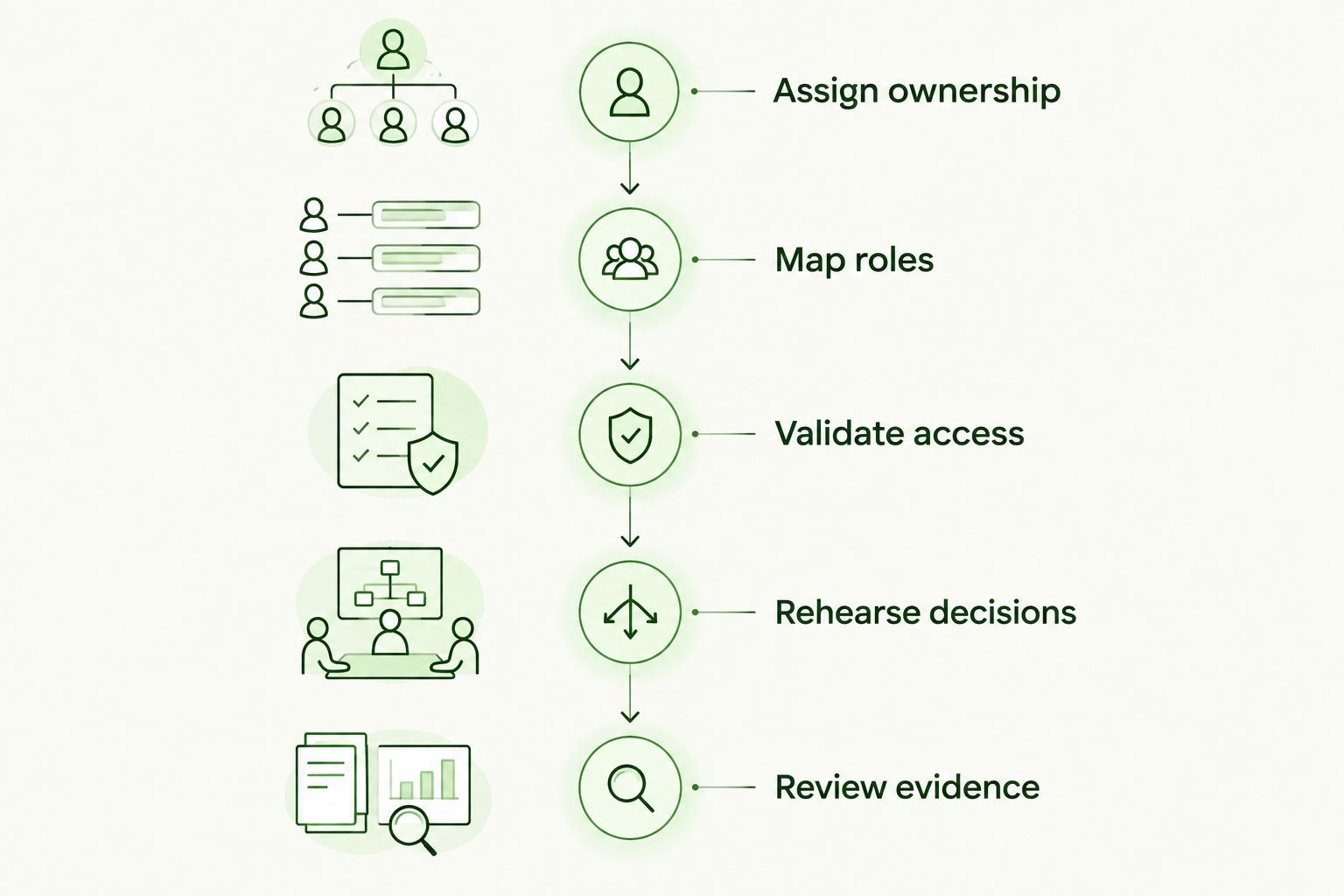
Set responsibility before choosing delivery, then verify what employees completed.
Apply 4 acceptance questions before expanding the program: Can the employee access the instruction? Can the employee explain the expected action? Can the administrator identify incomplete work? Can the client understand the resulting evidence? These are recommended evaluation questions, not claims about any platform’s capabilities.
Keep the 2026 acceptance record alongside the agreed service scope. When staffing, suppliers, or procedures change, use that record to identify which instruction needs revision rather than restarting the entire program.
Which manufacturing security training should you choose?
Choose Defend Wise for MSP-managed security awareness training when white-label delivery and unlimited-seat packaging match your service model. Validate the manufacturer’s access and evidence requirements before purchase, then add instruction where the general program needs role-specific depth.
Choose workshops for purchasing and finance decisions. Use shift briefings to reinforce approved actions on the production floor. Reserve specialist OT instruction for people with industrial-system responsibilities.
Do not buy four disconnected programs. Build one accountable service with different instruction for different responsibilities. Your 2026 selection is complete when each audience has a delivery route, each exception has an owner, and each claimed outcome has supporting evidence.
FAQ
What's the best cyber security awareness training for manufacturing companies?
The best cyber security awareness training for manufacturing companies combines accountable program management with role-specific instruction. Defend Wise fits MSP-managed, white-label delivery; workshops, shift briefings, and specialist OT instruction address different learning needs.
Should production workers receive the same training as office staff?
Production workers should share the same core reporting rules, but examples and delivery should match their work. Purchasing staff need supplier-change scenarios, while production employees need clear instructions for the situations they encounter.
Is a shift briefing enough for manufacturing security awareness?
A shift briefing is reinforcement, not proof of a complete awareness program. Track participation, address absences, and check whether employees understand the required action.
Does general awareness training replace OT security training?
General awareness training does not replace role-specific OT security instruction. Employees authorized to support industrial systems need instruction matched to their responsibilities and approved operating procedures.
What should an MSP check before choosing a training platform?
An MSP should check employee access, administrative ownership, content fit, and evidence requirements. Validate those workflows against the manufacturer's needs rather than assuming that a platform description establishes every required capability.
Does security awareness training guarantee manufacturing compliance?
Security awareness training does not guarantee compliance. Assess the applicable requirements and retain evidence of the relevant instruction, completion, and follow-up alongside other required controls.
How should a manufacturer measure whether training is working?
A manufacturer should check both completion and employees' ability to explain the expected response to relevant scenarios. Review reporting instructions and unresolved exceptions rather than treating attendance as the sole outcome.
One last thing
Ask an employee to explain how to report a suspicious request without opening the training material. If the answer is unclear, fix the reporting instruction before assigning another course. More completed content does not repair an ambiguous process.