AI Security Awareness Training Evaluation: 9 Tests for MSPs
AI security awareness training evaluation starts with 9 practical tests for content, data, governance, operations, and MSP fit.
DefendWise
DefendWise
TL;DR
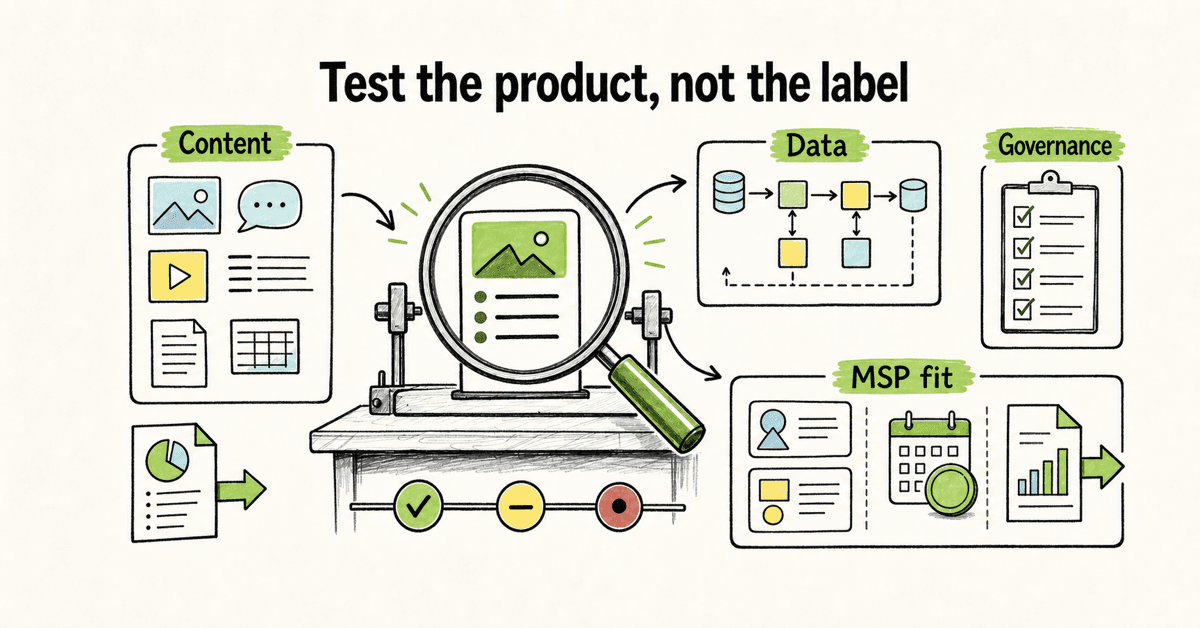
AI security awareness training evaluation should test the product, not the label. An MSP needs evidence that content is accurate, the data path is understood, model errors can be caught and corrected, and the service can run across client organizations without adding operational debt. Use the same scorecard for AI-native and traditional SAT products, then run a controlled pilot with representative client workflows. A strong AI story may improve content production or update speed, but it does not replace governance, security, reporting, or proof that the program works in your environment.
What is AI security awareness training evaluation?
AI security awareness training evaluation is the process of testing an AI-enabled SAT product against a defined use case, risk tolerance, and operating model.
That definition matters because “AI-powered” can describe very different things. One vendor may use AI to draft training modules. Another may personalize content, generate phishing scenarios, translate material, summarize learner data, or recommend follow-up actions. A third may use AI only in a back-office content workflow.
Those systems have different failure modes. An MSP cannot evaluate them with one question such as, “Do you use AI?”
Start with four questions:
- What does the AI do?
- What data does it receive?
- What decisions or content can it influence?
- What happens when it is wrong?
The NIST AI Risk Management Framework offers a useful structure: Govern, Map, Measure, and Manage. NIST says the framework is intended to bring trustworthiness considerations into the design, development, use, and evaluation of AI systems.
For an MSP, add a fifth question: can this product be operated safely and consistently across many client organizations?
A useful AI feature inside a single-company product may still be a poor MSP platform. The MSP needs tenant-aware administration, client separation, repeatable onboarding, usable reporting, and a commercial model that does not punish coverage growth. See the broader security awareness training for MSPs guide for the category requirements around the AI component.
Why this matters for MSPs
An MSP sits between the vendor and the client workforce. That creates 3 evaluation layers.
First, the product must produce training that is accurate, relevant, and usable. AI-generated material can be current and specific, but it can also contain invented details, poor advice, or inconsistent explanations. The buyer needs a review and correction path.
Second, the service may process client, learner, directory, campaign, or reporting data. The FTC has warned AI companies to honor privacy and confidentiality commitments, including promises about whether customer data will train or update models. An MSP should not accept a vague “we take privacy seriously” answer. The data flow needs to be documented.
Third, the MSP has to run the service repeatedly. A good demonstration can hide a bad operating model. If every client requires manual setup, content inspection, reminder management, and report cleanup, the AI may save the vendor time while creating work for the MSP.
The 9-part AI SAT evaluation scorecard
Use a weighted scorecard before watching demos. Require evidence for every score.
| Area | What to test | Evidence to request | Red flag |
|---|---|---|---|
| Use case | Exact AI functions and affected workflows | Feature map, architecture description, sample outputs | “AI does everything” with no boundary |
| Content | Accuracy, relevance, readability, corrections | Source policy, review workflow, samples, change log | No review or withdrawal process |
| Repeatability | Consistency across equivalent tests | Test results, limitations, release notes | One polished demo offered as proof |
| Data | Collection, purpose, retention, access, model use | Data-flow diagram, terms, subprocessors, deletion process | Customer-data use is unclear |
| Security | Access control, tenant separation, logging, AI-specific risks | Security documents, test summaries, incident process | AI layer excluded from review |
| Governance | Ownership, monitoring, approvals, change control | AI policy, accountable owner, risk register | No named owner for AI risk |
| MSP operations | Onboarding, multi-tenancy, reports, support, branding | Live workflow across 2 synthetic clients | Strong learner demo, weak MSP console |
| Measurement | Program and operating outcomes | Baseline, pilot plan, exportable results | Only completions or anecdotes |
| Commercial fit | Pricing behavior as coverage grows | Quote, fair-use terms, renewal basis, support scope | Limits become unclear at scale |
Do not average away a critical failure. Excellent content plus unclear data use is not “7 out of 10.” It is blocked until the data question is resolved.
1. Define the AI use case
Write one sentence for each AI-enabled function:
The system uses [type of AI] to [perform action] using [data] so that [user] can [intended outcome].
This exposes vague claims. If a vendor says the platform “personalizes learning,” ask what changes, which inputs drive the change, and whether the system can make an unsafe recommendation. If it “keeps content current,” ask which sources are monitored, who approves updates, and how bad content can be withdrawn.
NIST’s Generative AI Profile extends the AI RMF for risks specific to generative systems. Use it when a product generates text, images, audio, simulations, or recommendations rather than selecting from fixed rules.
The output should be a system boundary. Mark what is AI-generated, what is rule-based, what a human approves, and what reaches learners or clients.
2. Test content and corrections
Do not ask only for the best module. Build a representative content pack:
- a common threat such as credential phishing;
- a newer threat the vendor claims to cover;
- a role-specific scenario for finance, leadership, or service desk staff;
- a client with terminology or policy constraints;
- an ambiguous scenario that should trigger review rather than confident invention.
Score factual accuracy, clarity, learner action, tone, accessibility, and source traceability. Ask a subject-matter reviewer to mark errors before the pilot reaches real learners.
Then test the correction loop. Report a factual error. Record how the vendor acknowledges it, contains it, fixes it, checks related content, and communicates the change. A content engine that publishes quickly but corrects slowly is not current in any useful sense.
NIST SP 800-50 describes awareness and training as a lifecycle covering program design, material development, implementation, and post-implementation review. The publication is older, but that lifecycle remains a sound test. AI may change production, not the need to design, implement, and improve the program.
3. Measure consistency, not demo quality
Generative systems can return different answers to similar inputs. That does not make them unusable, but one successful output proves little.
Create a small regression set and run it more than once. Track factual errors, missing safety advice, invented references, tone drift, reading-level drift, client-brand leakage, inconsistent recommendations, and unsafe outputs.
NIST’s work on AI test, evaluation, validation, and verification reinforces the need for measurement methods. An MSP procurement exercise does not require a laboratory. It requires a repeatable test pack, recorded results, and thresholds set before the demo.
If the vendor cannot explain how it tests its own AI output, do not make your clients the test environment.
4. Map the complete data path
Draw the data path from source to deletion. Include integrations, support tools, model providers, analytics, logs, backups, and subprocessors.
| Data question | Required answer |
|---|---|
| What is collected? | Exact fields, files, prompts, metadata, and identifiers |
| Why is it needed? | Purpose tied to a feature |
| Where does it go? | Service, region, model provider, and subprocessors |
| Who can access it? | Roles, support access, and controls |
| How long is it kept? | Active storage, logs, backups, and deletion timing |
| Is it used to improve models? | Yes/no plus contractual terms and opt-out behavior |
| How is it deleted? | Customer process, verification, and exceptions |
| What crosses tenants? | Separation controls and shared-service boundaries |
The NIST Privacy Framework is a voluntary tool for identifying and managing privacy risk. It helps turn the review from a policy checkbox into questions about data processing, roles, and consequences.
Do not put real client data into an early trial. Use synthetic names, domains, learner records, and policies until the data path is accepted.
5. Review security around the AI layer
Traditional SaaS questions still apply: authentication, authorization, encryption, logging, vulnerability management, incident response, backups, and tenant separation.
AI adds more questions. If the product uses large language models or accepts untrusted content, ask how it addresses prompt injection, sensitive information disclosure, unsafe output handling, data poisoning, supply-chain risk, and overreliance. The OWASP GenAI Security Project provides a vendor-neutral starting list.
Keep the review proportional. A back-office drafting assistant with human approval has a different risk profile from an autonomous system that sends learner communications or changes campaigns.
For an MSP, test client boundaries directly. Create two synthetic client organizations. Use similar user names and content. Confirm that administrators, reports, exports, recommendations, and support activity remain correctly scoped. Multi-tenant control should be demonstrated, not inferred from a slide.
6. Check governance and change control
Ask for the accountable owner, approval path for new AI functions, model-change process, error monitoring, incident and customer-notification process, challenge path, retirement process, and known limitations.
The NIST AI RMF Core calls for policies, processes, procedures, and practices that support mapping, measuring, and managing AI risks.
ISO/IEC 42001 is another useful reference. It specifies requirements for establishing, implementing, maintaining, and improving an AI management system. Certification need not be a default buying requirement, but the management-system questions are useful: are policies, objectives, risk treatment, monitoring, and improvement connected to the service?
Governance should cover the product you are buying, not only the vendor’s corporate policy.
7. Test the MSP operating model
Leave the AI lab and run the service:
- Create two synthetic client organizations.
- Apply different branding and communication settings.
- Add users through the available onboarding path.
- Assign representative training.
- Review every learner-facing message.
- Test reminders, exceptions, and offboarding.
- Produce separate client reports and a fleet view.
- Export evidence and verify client scope.
- Repeat setup for a new client without rebuilding everything.
This separates an AI feature from an MSP platform. Evaluate multi-tenant management and automation alongside content quality.
Watch the work the vendor does not show. Who reviews generated content? Who fixes a bad translation? Who checks report exceptions? Who maintains directory groups? If the answer is always “the MSP,” put that work into the commercial score.
8. Measure the program, not the label
Choose a small measurement set before the pilot:
- onboarding time and manual steps;
- user and client setup errors;
- content-review defects;
- learner completion and support issues;
- reporting effort;
- exception backlog;
- suspicious-message reporting behavior where in scope;
- time to correct a bad module or communication;
- evidence export quality.
CISA advises businesses to train employees to recognize and report phishing and reinforce practices regularly rather than rely on one annual event. See CISA’s phishing training guidance. CISA’s joint phishing guidance also places training inside a broader set of defenses.
Do not turn an AI claim into a breach-prevention guarantee. Test whether the product supports the program you intend to run.
9. Test commercial fit as usage grows
Ask how price and service limits change when you add users, clients, administrators, campaigns, generated content, translations, reports, integration volume, and support requests.
Get renewal basis, fair-use terms, overage behavior, and support scope in writing. Compare total operating cost, not only subscription price.
For MSPs, flat pricing can remove seat-count friction, but “unlimited” still needs readable boundaries. Review the flat-fee pricing model and fair-use terms in the same exercise.
Step-by-step: run a 30-day pilot
1. Lock the use case
Write the client segment, learner group, AI functions, data boundary, and owner. Exclude anything that cannot be tested safely.
2. Set pass/fail gates
Define non-negotiable gates for data use, security, tenant separation, content accuracy, correction time, and reporting before access begins.
3. Build synthetic clients
Create at least two fictional client organizations with different branding, policies, roles, and reporting needs. Keep real customer data out until privacy and security review is complete.
4. Run the regression pack
Test common, current, role-specific, and ambiguous scenarios. Record outputs and reviewer decisions. Repeat selected tests for consistency.
5. Run the operating workflow
Complete onboarding, assignment, communication, reminder, reporting, export, and offboarding tasks. Count manual steps.
6. Trigger an error and a change
Submit a factual correction. Change a client setting. Ask how a model-provider update would be communicated. The response path often reveals more than the happy path.
7. Hold the decision review
Score the product against agreed weights. Separate confirmed evidence from assumptions and gaps. Do not convert unresolved critical questions into a middling score.
What good looks like
A good evaluation produces evidence an operator can use:
- Every AI function has a defined purpose and owner.
- Content sources, review, correction, and withdrawal are visible.
- Data collection, retention, model use, and deletion are documented.
- Security review includes the AI component and client boundaries.
- The vendor names limitations instead of claiming perfect output.
- Material changes follow change control.
- Two synthetic clients run without data or branding leakage.
- Reports are client-scoped, readable, and exportable.
- Pilot metrics compare against an agreed baseline.
- Pricing and fair-use behavior remain understandable as coverage grows.
The FTC’s Operation AI Comply announcement is a reminder that AI claims need evidence. A vendor assertion is a test hypothesis, not a procurement fact.
Mistakes to avoid
Buying the adjective
“AI-native” may describe a meaningful architecture choice. It does not prove content quality, security, privacy, or learner outcomes.
Letting the demo define the test
Vendor demos optimize for the happy path. Include ambiguity, correction, tenant boundaries, exports, and routine administration.
Using real client data too early
Synthetic data is enough for early workflow tests. Move to real data only after the data path, terms, and controls are accepted.
Treating training as the only control
Awareness supports a broader security program. It does not replace technical controls or incident response. NIST CSF 2.0 provides a broader structure across Govern, Identify, Protect, Detect, Respond, and Recover.
Ignoring the work after launch
Content approval, exceptions, support, reporting, and corrections continue after procurement. Put them into the pilot and cost model.
A practical framework map
| Framework | Use in the evaluation |
|---|---|
| NIST AI RMF | Organize AI risk into Govern, Map, Measure, and Manage |
| NIST Generative AI Profile | Add risks and actions specific to generative systems |
| NIST CSF 2.0 | Keep AI and training inside the broader security program |
| NIST Privacy Framework | Map data processing, roles, privacy risk, and consequences |
| NIST SP 800-50 | Test the training-program lifecycle, not only content production |
| ISO/IEC 42001 | Ask about the AI management system and improvement cycle |
| OWASP GenAI guidance | Add model- and application-specific security questions |
| FTC AI guidance | Require support for product, performance, and data-use claims |
Frameworks do not choose the product. They help the MSP ask consistent questions, record evidence, and explain the decision.
How an AI-native MSP SAT platform can help
An AI-native content model can help a training provider produce and update material without relying only on a fixed legacy library. The buying question remains whether that content is accurate, governed, and easy for the MSP to operate.
DefendWise is an AI-native SAT platform built for MSPs, with AI-generated training content, multi-tenant management, white-label delivery, automated onboarding and reporting, and a $399/month flat fee for unlimited users and client organizations. Those are confirmed public claims in the current DefendWise claim register. MSPs should still inspect the platform against the scorecard rather than accept any claim without a trial.
Start a Free 7-Day Trial to test the workflow with synthetic clients and your own gates.
Frequently asked questions
What is AI security awareness training evaluation?
It is a structured review of how an AI-enabled training product creates content, handles data, manages errors, supports security controls, and operates in the buyer’s environment. For an MSP, it also covers multi-tenant administration, reporting, branding, and commercial fit.
Does AI-native mean the training is more effective?
No. AI-native describes how a product may be built or operated. It is not proof of better learning or lower risk. Ask for evidence and compare against a defined baseline.
What should an MSP ask about AI-generated content?
Ask where sources come from, how facts are checked, who approves content, how corrections work, how changes are logged, and whether you can review content before launch.
What data questions belong in the review?
Document each data type, purpose, storage location, retention period, access control, subprocessor, deletion process, and whether data is used to train or improve a model. Get material promises in writing.
How long should a pilot run?
Use a time-boxed pilot long enough to test setup, delivery, reporting, correction handling, and one repeatable client workflow. A 30-day pilot is practical for many evaluations, but cadence and use case matter.
Which frameworks can help?
NIST AI RMF, NIST CSF 2.0, the NIST Privacy Framework, ISO/IEC 42001, NIST SP 800-50, and OWASP GenAI guidance provide useful governance, privacy, program, and security questions.
How should MSPs compare AI-native and traditional SAT?
Use the same outcome-based scorecard. Test content, updates, data, security, reporting, administration, tenant management, branding, support, and commercial fit. The label changes the questions, not the standard of evidence.
Sources
- NIST AI Risk Management Framework
- NIST Generative AI Profile
- NIST AI RMF Core
- NIST AI TEVV
- NIST Cybersecurity Framework
- NIST Privacy Framework
- NIST SP 800-50
- CISA phishing training guidance
- CISA joint phishing guidance
- FTC AI privacy and confidentiality guidance
- FTC Operation AI Comply
- ISO/IEC 42001:2023
- OWASP Top 10 for LLM Applications