MSP SAT solution: a practical buyer's checklist for 2026
MSP SAT solution buyers can use this checklist to test multi-tenant delivery, automation, reporting, pricing, and client fit before signing.
DefendWise
DefendWise
TL;DR
The right MSP SAT solution is not the platform with the longest course list. It is the platform your team can operate across a changing client fleet without rebuilding the same process for every tenant. Test multi-tenant control, onboarding, user lifecycle, training relevance, evidence, reporting, branding, integrations, support, and commercial fit as one delivery system. Run a scored pilot using real MSP workflows before you sign a long contract or standardize the service.
An MSP does not buy security awareness training for one company. It buys the operating layer for a managed service delivered to many companies.
That changes the buying criteria.
A polished learner demo can hide weak tenant separation. A large content library can hide manual user administration. A low entry price can hide minimums, per-seat growth, or reporting work that lands back on your service team.
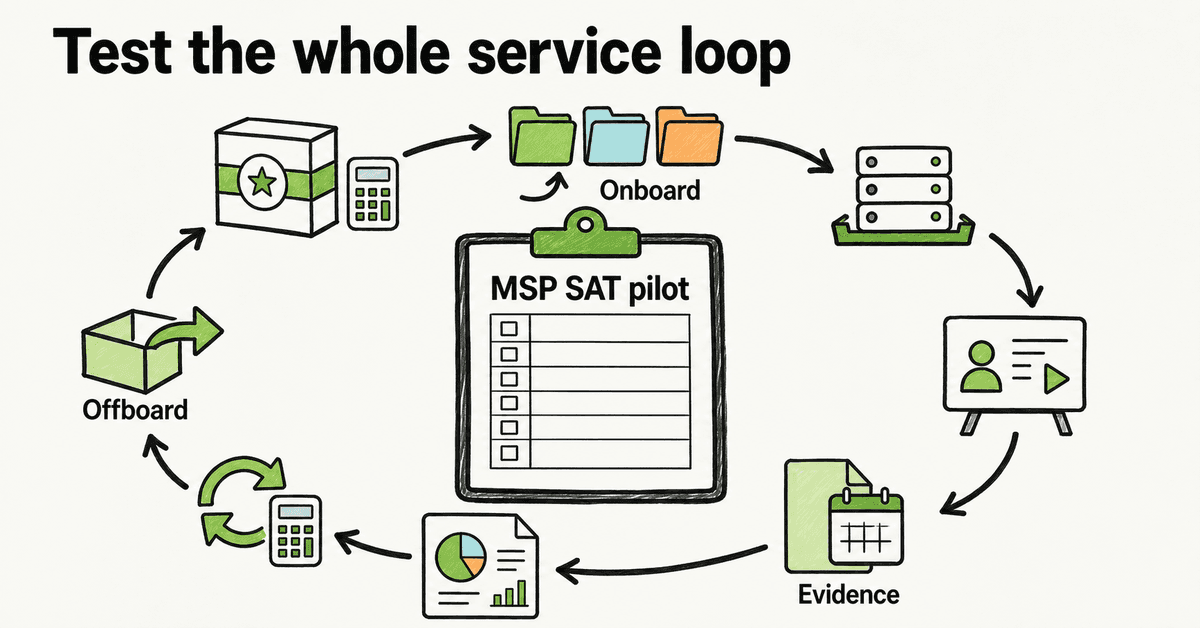
The buyer's job is to test the whole delivery loop: package, onboard, operate, evidence, review, renew, and offboard.
What is an MSP SAT solution?
An MSP SAT solution is a security awareness training platform used by a managed service provider to deliver, manage, and report training across multiple client organizations.
The platform still needs good training. But the MSP layer adds a second set of requirements:
- clear separation between client organizations;
- one manageable view across the client fleet;
- repeatable onboarding and user changes;
- automation that reduces recurring technician work;
- reports that account managers can use with clients;
- branding and communications that fit the MSP's service model;
- predictable economics as users and clients change; and
- evidence that can be retrieved when a client, auditor, or insurer asks.
This is why an enterprise SAT product with a partner discount is not automatically an MSP SAT product. The question is not whether the vendor will sell through the channel. The question is whether the product supports the way an MSP actually delivers the service.
NIST's SP 800-50 Rev. 1 treats cybersecurity and privacy learning as a life-cycle program that should encourage behavior change and improve through measurement and evaluation. You are choosing the system that must keep that program running after the kickoff call is over.
Why this matters for MSPs
The platform becomes part of your service promise
Once SAT sits inside a managed service agreement, the MSP owns the experience. Clients will not separate a vendor's weak reminder workflow from the MSP's delivery. They will not care which export failed before a QBR. They will see a late report, a confusing login, or an incomplete user list as your problem.
That makes platform fit an operating risk, not a feature preference.
Small manual steps compound across tenants
A task that takes 10 minutes for one internal security team may look harmless. Across 30 clients, every month, it becomes a recurring queue.
Do not accept “easy to do” in a demo. Ask whether the task can be set once, inherited, scheduled, delegated, audited, and changed in bulk without crossing client boundaries.
Security awareness is a program, not a content subscription
CIS Control 14 calls for an awareness program intended to influence workforce behavior and reduce cybersecurity risk. Its Control 14 overview is deliberately broader than course completion.
The CIS assessment specification makes the evidence requirement concrete. It checks whether a program exists, when it was reviewed, who completed training, whose training is current, and whether different risk areas are covered.
A buyer should therefore ask: can this platform help us run and prove a program, or does it mainly deliver videos?
Start with the service design
Before you compare vendors, define the service you intend to sell.
Write down:
- which client tiers receive SAT;
- whether it is bundled or sold separately;
- what every client receives by default;
- what can vary by client or industry;
- who owns onboarding, support, exceptions, and reporting;
- what the client sees each month or quarter; and
- what evidence must be available at renewal, audit, or insurance review.
If the service is undefined, the product demo will define it for you. That usually produces a service built around whatever the vendor happens to show well.
A better approach is to bring a service blueprint into every demo.
| Service stage | MSP question | Evidence to capture during evaluation |
|---|---|---|
| Package | Can this be included across the intended client tiers without pricing friction? | Cost model, minimums, terms, fair-use language |
| Onboard | Can a standard client be created from a repeatable baseline? | Setup steps, elapsed operator time, required permissions |
| Operate | Can users, assignments, reminders, and exceptions run without repeated manual work? | Task log, automation rules, failure handling |
| Support | Can the service desk troubleshoot without broad admin access? | Role model, audit trail, support path |
| Report | Can the MSP produce a clear client-ready report on schedule? | Sample report, export fields, scheduling options |
| Evidence | Can the team retrieve dated records when asked? | Assignment, completion, reminder, exception, and event records |
| Renew | Can an account manager explain progress and open risks? | Trend view, unresolved exceptions, next actions |
| Offboard | Can access and data handling be closed cleanly? | Export, retention, deletion, and permission steps |
This connects product behavior to delivery responsibility.
The 10 buyer tests that matter
1. Test tenant separation and fleet control
Ask the vendor to create 3 fictional clients with different administrators, brands, policies, and reporting contacts.
Then test whether your staff can:
- switch between clients without mixing data;
- view fleet status without exposing one client to another;
- delegate limited access to service desk, security, and account teams;
- apply a standard baseline to new clients; and
- override one client without changing the rest.
Do not settle for a parent-child diagram. Click through permissions and reports.
DefendWise describes its multi-tenant control as one MSP dashboard across client organizations. Whatever platform you evaluate, the pilot should prove separation and central operation with your scenarios.
2. Test the complete user lifecycle
A clean initial import is not enough. MSPs deal with joiners, movers, leavers, contractors, seasonal workers, aliases, disabled accounts, and clients with untidy directories.
During the pilot:
- add a new user;
- move a user to a different group or role;
- disable a user;
- restore the user;
- add a temporary worker;
- change the training assignment; and
- verify what appears in audit and completion records.
Ask what happens when directory sync fails. Ask who gets notified. Ask whether the platform retries, creates duplicates, or quietly leaves users out of scope.
CISA says organizations should keep employees informed and reinforce secure practices regularly, not rely on a one-off event. See Teach Employees to Avoid Phishing. That ongoing model only works if the user population stays accurate.
3. Test training relevance, not library size
A library count is easy to compare and hard to turn into an outcome.
Select 5 client roles: executive, finance or payroll, IT administrator, remote worker, and general employee.
Ask the vendor to show how the program changes by role and risk. Look for social engineering, authentication, data handling, incident reporting, and role-specific risk. These themes align with CIS Control 14.
Review the learner experience on a phone and desktop. Check reading level, accessibility, language support, captions, completion behavior, and whether examples feel current.
Do not assume “AI-generated” means accurate. Ask how content is reviewed, corrected, versioned, and retired.
4. Test simulations as a learning workflow
Phishing simulations should not be a monthly gotcha.
CISA's joint phishing guidance covers credential phishing, malware-based phishing, mitigations, and incident response. CISA also teaches users to recognize and report phishing, not merely avoid clicking.
Test whether the platform can:
- assign an appropriate simulation;
- capture relevant user actions;
- provide immediate, respectful coaching;
- record positive reporting behavior where supported;
- assign follow-up learning;
- show group trends; and
- give the MSP a clear next action.
Ask how it handles allowlisting, email security controls, false positives, and client communications. Repeated technical exceptions become service cost.
5. Test evidence before you need it
“Compliance-ready” can mean anything from a CSV to a mapped evidence pack. Do not buy the label. Test the records.
Give the vendor this request:
Show every user in scope for Client A on a past date, what each person was assigned, what they completed, what was overdue, which reminders were sent, which exceptions were approved, and who changed program settings.
Ask for that information in a format suitable for an account manager, client executive, auditor, and internal service review.
NIST CSF 2.0 places awareness and training in the Protect function. The NIST Cybersecurity Framework is outcomes-based, so a product badge does not prove your client's requirements are met.
Treat framework, control, and insurance mappings as a starting point. The client's assessor, policy, contract, and scope remain the authority.
6. Test reporting as a client conversation
A report is useful if an account manager can explain:
- who was covered;
- what changed;
- which exceptions remain;
- where behavior improved or regressed;
- what the client should do next; and
- what the MSP will do before the next review.
Give an account manager 15 minutes with the report, then ask them to present it to someone who did not attend the demo. If it needs spreadsheet cleanup or a security analyst to translate, record that as delivery cost.
DefendWise's automated reporting is designed around branded, scheduled client reports. In any pilot, verify fields, schedule, approval flow, branding, and export behavior.
7. Test white-label depth and trust
White-label can mean a logo on a portal. For a managed service, trust is shaped across every client-facing touchpoint.
Check the login URL, sender domain, enrollment and reminder emails, learner portal, reports, certificates, support links, privacy notices, and error messages.
A client should understand who is asking them to act. That matters in a program where unfamiliar senders and unexpected links are exactly what employees are taught to question.
DefendWise documents white-label security awareness training across portals, emails, reports, and client-facing materials. Use the same surface-by-surface test for every vendor.
8. Test integrations by running failure cases
An integration logo does not tell you which fields sync, how often data updates, or what happens when permissions change.
Ask:
- What objects and fields are read or written?
- What permission scope is required?
- How is each client authorized?
- What is logged?
- How are errors surfaced?
- Can a failed sync be replayed safely?
- What happens when access is revoked?
- Can actions cross tenant boundaries?
Break the connection during the pilot and watch recovery.
DefendWise lists Microsoft 365 sync and Zapier integration. Those are current public capabilities, but fit still depends on your exact workflow and should be tested.
9. Test commercial fit under change
Do not compare only month-one prices.
Model current usage, 25% client growth, one large client win, one large client churn, and seasonal usage.
Include per-user or per-client charges, minimums, term length, implementation, support, premium tiers, integrations, export restrictions, annual increases, and internal labor.
If the vendor offers unlimited use, read the fair-use policy. Ask what triggers review and how an outlier is handled.
DefendWise's current offer is $399/month flat for unlimited users and client organizations, with its fair-use policy defining the boundary. Apply the same discipline to every model: read the boundary, model change, and write down assumptions.
10. Test support and exit before purchase
Open realistic pilot tickets: a user cannot access training, a directory sync missed a user, a simulation was blocked, a report has incorrect client details, and an administrator needs a permission changed.
Record response time, ownership, clarity, and whether the fix is documented.
Also ask which data can be exported, in what format, how long data is retained, how admins are removed, what happens to custom content, and how deletion is confirmed.
A good vendor should explain the end of the relationship as clearly as the start.
Run a 30-day scored pilot
A pilot should be a test, not an extended demo.
Use 3 fictional or approved test clients: a small professional-services client, a growing client with joiners and movers, and a higher-risk client needing role-specific training and stronger reporting.
Synthetic data is enough to test most workflows. Do not use real client data unless your approvals, privacy review, and contract allow it.
Week 1: establish the baseline
Configure MSP settings, create tenants, set distinct brands and policies, add admins with different roles, import test users, and record every manual step.
Week 2: run the program
Assign baseline and role-specific training. Launch a safe test simulation if approved. Trigger reminders. Add, move, disable, and restore users. Change one client policy without affecting the others.
Week 3: report and troubleshoot
Produce client and fleet reports. Retrieve dated evidence. Break an integration. Open support tickets. Ask an account manager to present the report.
Week 4: model the service
Calculate cost under growth and churn. Add measured internal labor. Review security, privacy, support, and exit terms. Score the platform against pre-agreed criteria. Write the decision in one page.
Use a weighted scorecard
| Criterion | Suggested weight | What earns a high score |
|---|---|---|
| Multi-tenant control and permissions | 20% | Clear separation, central visibility, practical delegated roles |
| Automation and user lifecycle | 15% | Repeatable setup, reliable changes, visible failure handling |
| Reporting and evidence | 15% | Dated records, useful client reports, easy retrieval |
| Training and simulation quality | 15% | Relevant, accessible, role-aware learning with constructive feedback |
| Commercial fit | 15% | Predictable cost under growth and churn, clear terms |
| Integrations and security | 10% | Appropriate permissions, useful fields, logs, safe recovery |
| White-label and client experience | 5% | Trusted, consistent client-facing surfaces |
| Support and exit | 5% | Clear ownership, tested response, usable export and offboarding |
Set weights before final demonstrations. Otherwise, the most impressive demo tends to change what the team claims it valued.
Define hard failures too: tenant data leakage, silent user omissions, dated evidence that cannot be retrieved, hidden export tiers, a cost model that breaks outside a narrow band, or unexplained deletion practices.
A hard failure should not be averaged away by a beautiful learner interface.
Mistakes to avoid
Buying the biggest library
Course count is not relevance, behavior change, or delivery fit. Sample the content, test role assignment, and inspect how content changes.
Accepting “MSP-friendly” without workflow proof
Vendor and industry guides reach a similar conclusion: MSP fit depends on multi-tenant operation, automation, reporting, integrations, branding, and pricing. Examples include Drip7, CanIPhish, and MSP Success.
Those are not neutral standards. Use them to build tests, then verify claims in your pilot.
Treating completion as the only outcome
Completion tells you that a learner finished an item. It does not alone prove behavior change, reporting confidence, or reduced risk. NIST SP 800-50 Rev. 1 emphasizes life-cycle management, behavior change, metrics, and evaluation.
Comparing license price without delivery labor
Low software cost can still produce an expensive service if onboarding, reminders, support, reporting, and evidence remain manual.
Leaving evidence until renewal
If you wait until an auditor, insurer, or client asks, you are testing reporting under pressure. Retrieve dated evidence during the pilot.
How a flat-rate MSP SAT platform helps
A flat-rate model removes per-seat cost changes from the delivery equation, which can make it easier to model a standard service across client organizations. It does not remove the need to test workflow, content, evidence, support, security, or fair-use terms.
DefendWise is built for MSPs with white-label, multi-tenant delivery, automated onboarding and reporting, Microsoft 365 sync, and AI-native training content. The public offer is $399/month flat for unlimited users and client organizations, subject to fair use. MSPs can start a free 7-day trial and run these buyer tests before deciding whether it fits.
Frequently asked questions
What is an MSP SAT solution?
An MSP SAT solution helps a managed service provider operate training across multiple client organizations. It should support client separation, repeatable onboarding, user changes, training, reporting, evidence, and managed-service economics.
What should an MSP test first in a SAT platform?
Test the complete loop. Create a client, add users, assign training, handle reminders, change a user, retrieve evidence, and produce a client-ready report.
Does an MSP SAT platform need multi-tenant management?
For more than a few clients, it is usually central to efficient delivery. The platform should preserve separation while letting authorized MSP staff operate across the fleet.
How should MSPs compare SAT pricing?
Compare total delivery cost under growth, churn, seasonal usage, and a large client win. Include minimums, term, premium tiers, integrations, implementation, support, and labor.
What evidence should an MSP SAT solution produce?
Retrieve who was in scope, assignments, completion dates, overdue items, reminders, exceptions, simulation events, and administrative changes. Verify specific audit, framework, or insurance requirements separately.
How long should an MSP pilot a SAT platform?
A focused 30-day pilot can test most operational requirements. Use representative scenarios, define pass and fail criteria first, and measure manual work.
Is phishing simulation enough for an awareness program?
No. Simulations can coach behavior, but a program also needs relevant learning, reporting, incident-reporting expectations, role-specific coverage, and evaluation.
Can DefendWise be evaluated as an MSP SAT solution?
Yes. DefendWise is built for MSPs with white-label, multi-tenant delivery, automated onboarding and reporting, Microsoft 365 sync, and AI-native content. Its offer is $399/month flat for unlimited users and client organizations, subject to fair use.
Sources
- NIST SP 800-50 Rev. 1
- NIST Cybersecurity Framework 2.0
- CISA: Teach Employees to Avoid Phishing
- CISA: Phishing Guidance
- CISA: Recognize and Report Phishing
- CIS Control 14
- CIS Control 14 assessment specification
- FTC: Cybersecurity for Small Business
- Verizon 2025 Data Breach Investigations Report
- Drip7 MSP SAT buyer criteria
- CanIPhish MSP buyer guide
- MSP Success SAT buyer criteria