Best SAT for Compliance Evidence for ISO 27001
Best SAT for compliance evidence for ISO 27001 means clean scope, completion, exceptions, reporting, and MSP-ready proof.
DefendWise
DefendWise
TL;DR
The best SAT for compliance evidence for ISO 27001 is not the platform with the longest content library.
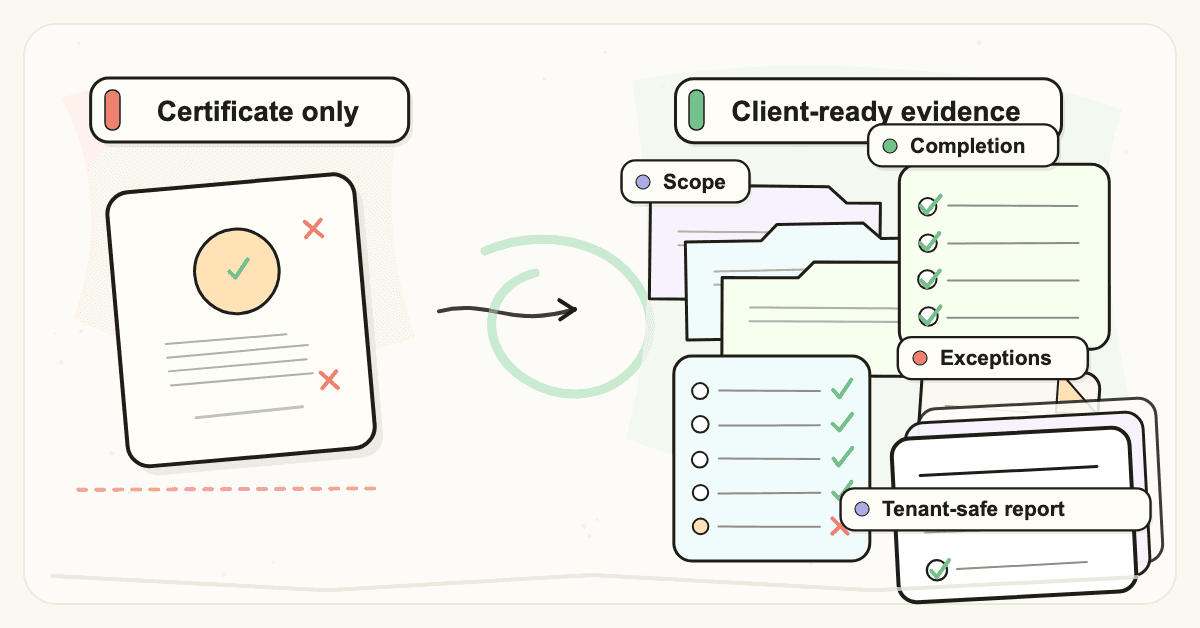
It is the platform that helps an MSP prove the awareness work happened: the right users, the right client tenant, the right training, the right dates, the right exceptions, and the right report.
Security awareness training can support ISO 27001 Clause 7.3 and Annex A 6.3 evidence. It does not prove ISO 27001 compliance on its own.
For MSPs, the practical test is simple: can you hand a client an audit-ready awareness evidence pack without rebuilding exports, separating tenants by hand, or explaining why the report only shows a generic completion percentage?
What "best SAT for ISO 27001 evidence" really means
SAT means security awareness training. In an ISO 27001 context, it sits in the people layer of the information security management system, or ISMS.
The official ISO/IEC 27001:2022 page describes ISO 27001 as a standard for establishing, implementing, maintaining, and continually improving an ISMS. That is the first guardrail.
SAT is one evidence layer inside the ISMS. It is not the ISMS.
The buying question is still useful, though, because ISO 27001 audits create a specific kind of pressure. A client does not only need staff to watch a module. The client needs evidence that can be reviewed later.
For an MSP, "best" means the SAT platform can support 4 jobs at once:
- deliver awareness training that matches the client's risks and policies;
- keep client tenants separate;
- produce clear evidence for audits, insurance, QBRs, and client reviews;
- reduce the recurring admin burden on the MSP team.
That is a different question from "which SAT tool has the most videos?"
Content matters. But compliance evidence fails in the reporting layer, the scope layer, and the exception layer more often than it fails because a module was not polished enough.
Why ISO 27001 awareness evidence is different
ISO 27001 has 2 awareness-related ideas MSPs should understand.
Clause 7.3 is about awareness. In plain English, people doing work under the organisation's control need to understand relevant information security policies, their contribution to the ISMS, and the consequences of not following requirements.
Annex A 6.3 is the matching control for information security awareness, education, and training. ISMS.online's guide to Annex A 6.3 describes the need for suitable instruction, regular policy refreshers, and training relevant to roles. Advisera's Control 6.3 guide frames the audit evidence around defined competencies, relevant people being trained, and people knowing why security is needed.
That means the platform has to help answer practical questions:
- Who was in scope?
- What were they assigned?
- Did they complete it?
- What policy, risk, or responsibility did the training support?
- Who missed it?
- What exception was approved?
- Can the report be reproduced later?
- Is the evidence tied to the right client tenant?
A certificate can be useful. A completion screenshot can be useful.
Neither is enough if the MSP cannot explain the scope, date range, assignment, overdue users, and tenant boundary.
What the platform must prove
Use this table as the buying checklist. It is not a feature wishlist. It is the evidence story an MSP will need to defend.
| Evidence question | What the SAT platform should show | Weak version to avoid |
|---|---|---|
| Who was in scope? | Client tenant, user roster, included groups, excluded groups, and date range | A dashboard total with no user baseline |
| What was assigned? | Campaign, module, topic, policy or risk link, assigned date, due date | "Cyber awareness" with no topic or policy context |
| Who completed it? | User-level completion, completion date, status, export date | Certificates only, with no assigned-user list |
| Who missed it? | Overdue users, reminder history, escalation owner, next action | A clean percentage that hides exceptions |
| Was it current? | Content version, policy version, last review date, campaign date | Old module with no version or review trail |
| Was it tenant-safe? | Client-separated reports, tenant labels, access controls, export boundaries | One blended MSP fleet report |
| Can it support a review? | Auditor/client-ready report, source system, evidence index, plain-English summary | Spreadsheet cleanup every time someone asks |
| Can the MSP repeat it? | Templates, automation, scheduled reports, reusable client workflow | Manual screenshot pack rebuilt at audit time |
The last line is where MSP margin gets hit.
An ISO 27001 awareness report that takes 3 hours to rebuild for every client is not a small admin issue. It changes the economics of the service.
Selection criteria for MSPs
1. Tenant separation before pretty reporting
MSPs do not need one beautiful awareness report if it blends clients together.
They need client-specific evidence.
The platform should separate each client's users, assignments, reports, reminders, and exports. It should also make it hard for an engineer to accidentally include another client's data in the pack.
This is why multi-tenant SAT matters for compliance evidence. The MSP needs central control, but the client needs clean proof for its own audit scope.
2. User scope and lifecycle records
The most common weak evidence pattern is simple: the report shows completion, but nobody can prove whether the right users were included.
A good SAT platform should help track:
- active users in scope;
- new starters;
- leavers;
- contractors or excluded users;
- role or department groups;
- users added after the campaign started.
This matters because ISO 27001 awareness is tied to people doing work under the organisation's control. If the MSP cannot explain why 11 users are missing from the training population, the evidence pack gets messy.
3. Assignment and topic history
The auditor or client stakeholder may not accept "everyone did awareness training" as a complete answer.
They may ask what the training covered.
That is reasonable. Awareness should connect to real risks, policies, responsibilities, and user roles.
CISA's guidance on avoiding social engineering and phishing attacks is a good reminder that awareness topics change in practice: phishing, vishing, smishing, spoofed links, suspicious attachments, and social engineering all need clear user guidance. A platform that cannot show topic history makes it harder to prove the program kept pace with practical risk.
For MSPs, the report should show the content assigned, the date, the audience, and the reason it was relevant.
4. Completion is not the whole evidence pack
Completion matters. It is just not the whole story.
CIS Control 14 says organisations should establish and maintain a security awareness program to influence workforce behaviour and reduce cybersecurity risk. The CIS Controls assessment specification for Control 14 is more concrete: it points to a list of workforce members, most recent completion dates, users who have and have not completed training, and the date the content was last reviewed or updated.
That is useful for MSPs because it translates awareness into evidence fields.
Do not settle for a report that only says "93% complete."
Ask for the export that shows:
- who completed training;
- who did not;
- when they last completed it;
- whether the content was reviewed;
- which users are overdue;
- whether reminders or escalations happened.
5. Exception handling
Every real client has exceptions.
Someone joins late. Someone is on leave. A contractor is out of scope. A shared mailbox appears in the user list. A department needs a different role-based topic. A campaign closes with 4 overdue users because the client owner accepted the risk.
The platform does not need to solve every exception automatically.
It does need to make exceptions visible.
Hidden exceptions create audit friction. Plain exceptions create a cleaner conversation.
6. Auditor-ready exports
Secureframe's guide to ISO 27001 evidence collection describes a familiar audit problem: evidence may exist, but not in an acceptable format, not with timestamps, not labelled well, or scattered across systems. That is exactly what happens when SAT reporting is treated as a dashboard instead of an evidence source.
The best SAT platform for ISO 27001 evidence should export reports that are readable without a product tour.
A client or auditor should be able to see:
- client name or tenant;
- date range;
- report generation date;
- source system;
- users in scope;
- assigned topics;
- completion status;
- overdue users;
- exception notes or a place to attach them.
If every export needs 45 minutes of spreadsheet cleanup, the platform is pushing work back onto the MSP.
7. Reports clients can understand
Audit evidence has to be accurate. It also has to be explainable.
The MSP owner does not want a service manager rewriting the same cover note every quarter.
Client-ready reporting should support:
- monthly or quarterly evidence packs;
- QBR summaries;
- cyber insurance responses;
- audit request handoffs;
- internal client leadership updates.
This is where automated reports and white-label delivery help. The client should see the MSP as the security partner, not a vendor portal the MSP barely controls.
8. Pricing that does not punish coverage
ISO 27001 evidence gets weaker when pricing encourages narrow coverage.
If every extra user adds cost, an MSP may feel pressure to train only the minimum group. That can be a business decision, but it is not always the best compliance evidence decision.
For MSPs selling awareness training across many clients, flat-fee pricing can make broader coverage easier to package. It reduces the seat-count argument and lets the MSP focus on whether the right people are covered.
The evidence still needs to be accurate. Flat pricing does not make a weak report strong.
But it removes one common reason coverage gets negotiated down.
Step-by-step: how to evaluate SAT for ISO 27001 evidence
1. Start with the evidence pack, not the course catalogue
Ask the vendor for a sample ISO 27001 awareness evidence pack.
Do not ask only for a course list.
The pack should show scope, users, assigned content, completion, overdue users, report date, and client separation. If the sample is just a completion certificate, keep digging.
2. Test one realistic client scenario
Use a normal MSP client shape:
- 120 users;
- 3 departments;
- 8 new starters during the quarter;
- 4 leavers;
- 6 overdue users;
- 2 approved exceptions;
- one manager requesting a QBR report;
- one auditor requesting awareness evidence.
Then ask what the platform exports.
This test shows whether the tool supports operations, not just training delivery.
3. Check tenant boundaries
Ask how the platform prevents cross-client leakage in reports, roles, exports, emails, and admin access.
For an MSP, this is not a nice-to-have. It is basic hygiene.
A single wrong-client report can damage trust quickly.
4. Review the reminder and escalation workflow
Training evidence is stronger when overdue users are visible and acted on.
Ask how reminders work, how escalations are recorded, and whether the MSP can show follow-up history. If the only answer is "the client can log in and check," the MSP will still own the chase.
5. Map content to risk, policy, and role
NIST SP 800-50, Building an Information Technology Security Awareness and Training Program, is old but still useful because it treats awareness and training as a program to design, develop, implement, maintain, and measure. NIST CSF 2.0 also keeps awareness and training in the Protect function through its Cybersecurity Framework.
The lesson is practical: awareness should not be a random annual checkbox.
Ask whether the SAT platform can show role-based or risk-based assignment history, not just a generic course completion.
6. Ask what the MSP team still has to do manually
This is the margin question.
List every manual step:
- user import;
- client setup;
- campaign assignment;
- reminder chasing;
- report export;
- spreadsheet cleanup;
- exception notes;
- QBR summary;
- audit handoff.
Then decide whether the tool is really MSP-ready.
What good looks like
For ISO 27001 awareness evidence, good looks boring.
That is a compliment.
The report is clear. The client tenant is obvious. The user population is traceable. Completion dates are visible. Overdue users are not hidden. Exceptions are plain. The topic list makes sense. The export date is there. The MSP can reproduce the report next month.
The MSP team does not have to perform a last-minute evidence rescue.
Bridewell's guide to Stage 1 and Stage 2 ISO 27001 audits separates documentation review from implementation review. That distinction is useful for SAT evidence.
Stage 1 asks whether the awareness process exists and is ready.
Stage 2 asks whether it actually ran.
A good SAT platform helps with both conversations:
- process evidence: campaign structure, policy links, topic map, planned cadence;
- operating evidence: users, assignments, completion, reminders, exceptions, reports.
Mistakes to avoid
Choosing the biggest library instead of the cleanest proof
A large content library can be useful.
It does not automatically produce audit-ready evidence.
If compliance evidence is the buying driver, reporting quality and client separation deserve equal weight.
Treating certificates as the whole answer
Certificates help prove individual completion.
They do not prove the assigned-user baseline, overdue population, reminder workflow, policy context, or exception handling.
Use certificates as one evidence item, not the whole pack.
Mixing client evidence
Blended MSP reports can help internal service management.
They are not enough for ISO 27001 client evidence.
Each client needs its own clean scope and report.
Saying SAT proves ISO 27001 compliance
Do not say this.
SAT supports awareness evidence. ISO 27001 certification depends on the wider ISMS and the auditor's assessment.
Overclaiming makes the MSP look less credible.
Buying a tool that creates reporting work every month
The first campaign may feel easy.
The tenth report is where the operating model shows.
If the MSP has to rebuild every client evidence pack by hand, the SAT platform is not doing enough of the job.
Framework mapping: how SAT evidence fits
SAT evidence is not only an ISO 27001 artefact.
It can also support wider client conversations when handled carefully.
| Framework or source | Relevant awareness idea | What MSPs should keep |
|---|---|---|
| ISO 27001 Clause 7.3 | People understand policies, contribution to the ISMS, and consequences | Scope, policy/topic mapping, user records, completion, exceptions |
| ISO 27001 Annex A 6.3 | Awareness, education, and training relevant to roles and responsibilities | Training plan, assigned topics, refreshers, role groups, report history |
| NIST SP 800-50 | Awareness and training should be designed, implemented, maintained, and measured | Program cadence, topic plan, metrics, maintenance records |
| NIST CSF 2.0 | Awareness and training sit in the Protect function | Role-aware training records and repeatable reporting |
| CIS Control 14 | Establish and maintain a security awareness program; track completion and content review | Workforce list, completion dates, overdue users, content review dates |
| CISA phishing guidance | Social engineering, phishing, vishing, smishing, spoofing, and attachments need user recognition | Topic history and current threat coverage |
The important word is "support."
SAT evidence supports these conversations. It does not replace the rest of the client's control evidence.
How a flat-rate MSP SAT platform helps
Defendwise is built for MSPs that want flat-rate, white-label, multi-tenant security awareness training with client-ready reporting and low-admin delivery.
For ISO 27001 evidence, that means the awareness layer can be easier to package across all clients: one MSP operating model, separated client tenants, branded reports, and a pricing model that does not punish broader user coverage.
Start with the evidence pack you want to hand a client. Then choose the SAT platform that can produce it repeatedly.
Frequently asked questions
What is the best SAT for compliance evidence for ISO 27001?
The best SAT for compliance evidence for ISO 27001 is the platform that can show who was in scope, what training was assigned, when users completed it, which users missed it, what exceptions exist, and which client tenant the evidence belongs to.
For MSPs, multi-tenant separation and client-ready reporting matter as much as the training content.
Does SAT prove ISO 27001 compliance?
No. Security awareness training can support ISO 27001 Clause 7.3 and Annex A 6.3 evidence, but it does not prove the whole ISMS.
ISO 27001 also depends on scope, risk management, policies, controls, internal audit, management review, continual improvement, and wider operational evidence.
What SAT evidence do auditors usually ask for?
Useful SAT evidence includes the user population in scope, assigned topics, policy or risk mapping, completion records, overdue users, reminder history, assessment or acknowledgement data, exception notes, report export date, and source system.
The exact request depends on the audit scope and auditor.
Why is multi-tenant SAT important for MSP compliance evidence?
Multi-tenant SAT helps MSPs manage many client organisations from one operating layer while keeping each client's users, reports, assignments, and evidence separate.
That matters because a blended fleet report is not enough for a client audit, insurance request, or QBR.
Should ISO 27001 awareness training be annual or continuous?
Many organisations run annual awareness training, but stronger programs keep awareness current through onboarding, refreshers, role-specific topics, policy changes, phishing and social engineering updates, and recurring reports.
CIS Control 14 calls for training at hire and at least annually, with content reviewed annually or after significant changes.
Can Defendwise help MSPs with ISO 27001 SAT evidence?
Defendwise can help MSPs deliver flat-rate, white-label, multi-tenant security awareness training with client-ready reporting.
It supports the awareness evidence layer; it does not replace the client's broader ISO 27001 management system or the MSP's wider compliance evidence work.