Economics of Per Seat Versus Flat Pricing for MSP SAT
Economics of per seat versus flat pricing changes MSP margins, client coverage, and SAT packaging. Use this guide before renewal.
DefendWise
DefendWise
TL;DR
The economics of per seat versus flat pricing is not a tidy pricing-theory debate for MSPs.
It decides whether security awareness training can be bundled across the client base without eating margin, creating admin, or forcing the MSP to choose which users are worth protecting.
Per-seat pricing can be fair when the cost and value of the product rise with each user. Flat pricing works better when the MSP is selling a repeatable managed service and needs predictable cost, broad coverage, and less client-by-client billing friction.
For MSP SAT, the real question is simple: does the pricing model help you protect more users while keeping the service profitable?
What the economics of per seat versus flat pricing really means
Per-seat pricing charges for each user, learner, employee, or licensed person.
Flat pricing charges one fixed price for the service, usually with usage boundaries or fair-use terms.
Both models can be reasonable.
The problem starts when the model does not match the job the buyer is trying to do.
In ordinary SaaS, seat-based pricing became popular because it is easy to explain and easy to forecast. Schematic's guide to seat-based SaaS pricing says the model works best when each added user creates real value and when the product maps naturally to headcount, such as collaboration or internal workflow tools.
That logic is sound.
If each extra user needs access, support, storage, security, and workflow value, a per-user fee can make sense. The buyer sees where the bill comes from. The vendor has a clean expansion path. Procurement can tie cost to team size.
Security awareness training for MSPs is different.
The MSP is not buying training for one internal company. It is packaging a client-facing security service across many tenants, many client sizes, many renewal dates, and many user lifecycle events.
That changes the economics.
The cost question is no longer:
"How many employees need training this month?"
The better question is:
"Can we include SAT across the client base without making every new user a margin decision?"
That is where per-seat and flat pricing diverge.
Why per-seat pricing exists
Per-seat pricing is not a scam.
It exists because it gives the vendor and buyer a simple unit of account: one user, one price.
KnowBe4's public security awareness training pricing page is a clear example. As of its May 2026 listed pricing, the US monthly MSRP per seat on a 3-year term ranges from $2.40 for SAT Foundation at 25-50 seats down to $1.63 at 501-1000 seats, with Advanced priced higher and 1001+ seats moving to quote. That is transparent per-seat pricing for a direct comparison.
Huntress's security awareness training cost guide gives a wider market frame, saying average security awareness training can range from $0.45 to $6 per employee per month, depending on pricing model, features, and whether training is managed internally or outsourced.
Those numbers are useful.
They also prove the main point: SAT pricing is usually calculated per person.
For a single internal IT buyer, that may be fine. A 200-person company can multiply the user count by the per-user price, compare vendors, and approve the line item.
For an MSP, the same math becomes a service-design question.
The MSP has to decide:
- whether SAT is a standalone resale line item or part of the managed service package;
- whether every client gets covered or only clients willing to pay extra;
- whether small clients receive the same security baseline as larger clients;
- whether new hires, leavers, casual users, shared mailboxes, and seasonal staff create billing noise;
- whether the service desk has to reconcile training seats against real client directories;
- whether reporting and evidence packs can be delivered without manual cleanup.
Per-seat pricing can still work when the MSP passes the exact cost through to the client with margin on top.
It struggles when the MSP wants SAT to be standard across the whole book.
Why flat pricing changes the MSP margin model
Flat pricing changes the shape of the decision.
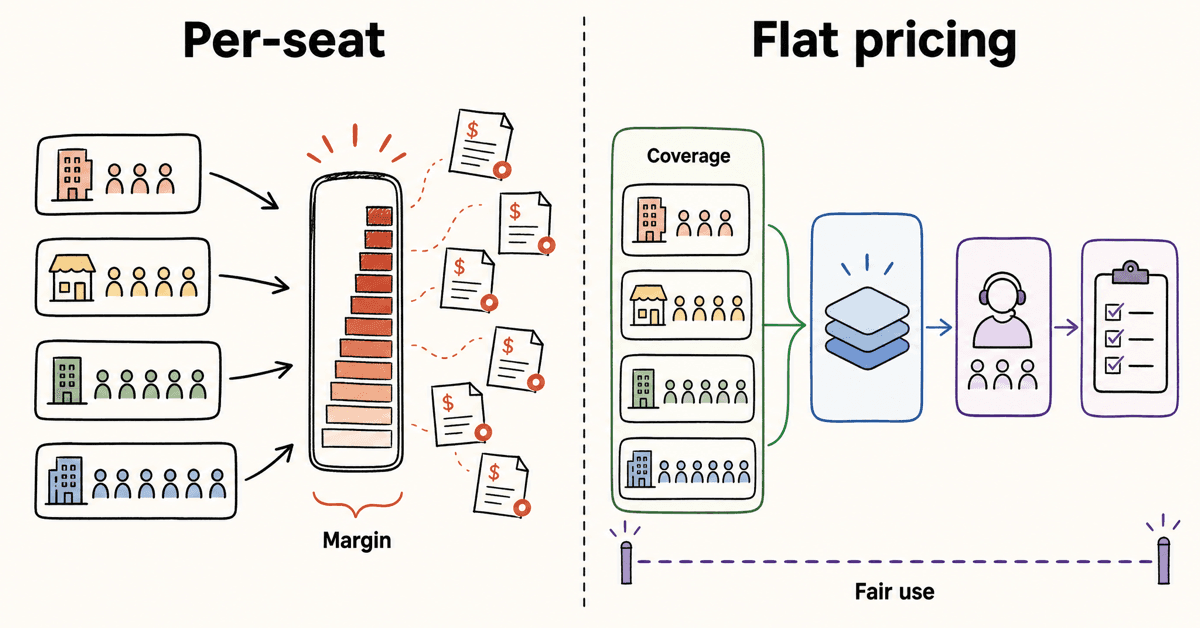
Instead of treating every learner as a cost event, the MSP treats SAT as a fixed platform cost behind a managed service.
That matters because MSPs usually sell packaged outcomes, not raw tools.
Kaseya's MSP pricing guide frames managed services around pricing models, revenue streams, rates, and margins. It also reports that its 2023 MSP Benchmark Survey had 1,091 respondents, with 63% identifying as general-purpose MSPs, 18% as MSSPs, and 19% as network and data-center focused providers. In other words, MSP pricing is already a packaging discipline, not only a software procurement exercise.
SAT should be judged the same way.
If an MSP buys SAT per seat and resells it per seat, the service behaves like a pass-through subscription.
If an MSP buys SAT at a flat rate and bundles it into managed packages, the service behaves like an operating layer.
That difference shows up in 5 places.
1. Margin expands with coverage
With per-seat pricing, vendor cost rises as the client base grows.
That does not automatically kill margin, but it means growth keeps carrying a variable cost. If a client adds users, the MSP either absorbs the extra vendor cost or reopens the client billing conversation.
With flat pricing, the MSP has a fixed base cost. More covered users can improve gross margin as long as usage stays inside fair-use boundaries and delivery does not create extra manual labour.
This is the core flat-pricing wedge.
The MSP can protect more users without asking whether each user is worth a separate line item.
2. Packaging gets easier
Per-seat SAT pushes the MSP toward add-on selling.
"Do you want training for 37 users?"
That question creates friction. Some clients say yes. Some say no. Some ask for only managers. Some ask to wait until renewal. Some trim the user list to save money.
Flat pricing lets the MSP ask a different question:
"Which managed service package includes awareness training by default?"
That is a better commercial question.
It lets the MSP build SAT into bronze, silver, gold, compliance, cyber insurance, or security bundles without recalculating the cost of every client seat.
3. Small clients stop being awkward
Per-seat pricing can make small clients look uneconomic.
The smallest clients still need setup, reminders, reporting, and evidence. They may not generate enough per-seat revenue to justify the effort if the MSP has to manage them by hand.
Flat pricing helps here because the marginal billing decision is gone.
The MSP can include a 9-user client without turning the client into a mini procurement debate.
That does not mean every tiny account is free money. Support, reporting, and onboarding still have costs. But the pricing model no longer nudges the MSP to exclude small clients from a basic human-risk control.
4. Admin becomes part of the pricing model
Huntress's cost guide makes an important point: free or cheap training can move the real cost into management overhead, outdated content, or limited reporting.
That is exactly the MSP problem.
The cheapest SAT line item may be expensive if technicians spend time:
- reconciling users;
- checking who was billed;
- chasing completion reports;
- exporting evidence;
- cleaning client names;
- handling leavers;
- explaining price changes;
- producing QBR material.
Flat pricing does not magically remove admin.
It only works if the platform also supports multi-tenant delivery, automation, reminders, and reporting. Without that, the flat price is only a simpler invoice attached to the same operational mess.
5. Renewal risk gets smaller
Per-seat renewals can become uncomfortable when the client has grown.
The MSP has to explain why the SAT bill rose, why a client with more staff now pays more, or why a lower-volume tier changed. That may be fair, but it still creates a renewal conversation.
Flat pricing shifts the renewal story.
The MSP can focus on service coverage, reporting, risk, and evidence rather than defending a seat count.
For a service that MSPs want to include by default, that is a better conversation.
Per-seat versus flat pricing for MSP SAT
The right model depends on how the MSP sells and supports the service.
| Decision area | Per-seat SAT pricing | Flat SAT pricing |
|---|---|---|
| Vendor cost | Rises with each user or licensed learner | Fixed monthly platform cost, usually with fair-use terms |
| Client packaging | Easier to resell as a line item | Easier to bundle into managed service packages |
| Margin behaviour | Margin depends on pass-through price and seat accuracy | Margin can expand as coverage grows, if admin stays low |
| Small clients | Can feel inefficient to quote and manage | Easier to include as part of a standard baseline |
| User lifecycle | Every joiner, leaver, and seat count can affect billing | User changes matter operationally, but not as monthly price triggers |
| Sales friction | Client sees a visible per-user add-on | Client sees SAT as part of the managed service |
| Reporting burden | Depends on vendor reporting and MSP process | Still depends on reporting, but fixed cost supports repeatable delivery |
| Best fit | Direct resale, narrow rollout, cost allocation by user | Bundled SAT, broad rollout, predictable MSP margin |
The table is deliberately practical.
This is not about which pricing model is morally better.
It is about which model fits the service motion.
If the MSP is reselling licenses, per-seat can work.
If the MSP is building an always-on security service, flat pricing is usually cleaner. The next commercial step is to compare security awareness training pricing for MSPs against the way you sell and package SAT.
Step-by-step workflow for comparing the models
Do not compare pricing pages in isolation.
Compare the operating model.
1. Pick 3 real client sizes
Use actual clients, not imagined averages.
Pick:
- one small client;
- one typical client;
- one larger or fast-growing client.
For each, record current users, expected 12-month growth, turnover, seasonal users, and whether SAT would be included in an existing package or sold separately.
This prevents the MSP from buying for the imaginary clean account that never changes.
2. Model total vendor cost
For per-seat pricing, multiply the user count by the monthly price and by the expected client count.
Use public numbers only where they are actually public. KnowBe4's pricing page gives published per-seat tiers. Huntress's guide gives a broad market range of $0.45 to $6 per employee per month. Tartan's SAT pricing dataset says its USD annualized sample had an average of $38.72 per user per year and a median of $18.00, with the page noting methodology limits and channel differences.
For flat pricing, use the fixed platform fee and read the fair-use terms.
Then model the seat-tax impact, then ask:
- What happens if users grow by 20%?
- What happens if 5 small clients are added?
- What happens if one client doubles headcount?
- What happens if every client receives SAT by default?
The right answer is rarely one number.
It is a range that shows margin sensitivity.
3. Add the admin cost
Seat cost is not total cost.
Add the time spent to run the service.
At minimum, include:
- tenant setup;
- user import or sync;
- client branding;
- campaign assignment;
- reminder setup;
- exception management;
- completion reporting;
- evidence export;
- QBR reporting;
- renewal review;
- billing reconciliation.
This is where many per-seat comparisons undercount the real cost.
The invoice may be accurate and still miss the technician time wrapped around it.
4. Decide whether SAT is optional or standard
This is the commercial fork.
If SAT is optional, per-seat can be a clean add-on.
If SAT is standard, per-seat creates pressure every time a client adds users.
Most MSPs should decide this before looking at vendor demos. Otherwise the demo becomes a feature tour and the pricing model gets evaluated too late.
Ask:
- Is awareness training part of our standard security baseline?
- Is it in every managed package?
- Is it only in premium packages?
- Is it sold only when cyber insurance, ISO 27001, Essential Eight, or client pressure demands it?
- Who owns the reporting commitment?
The pricing model should follow that answer.
5. Check reporting and evidence fit
Security awareness training is not only content.
NIST SP 800-50 Rev. 1 frames cybersecurity and privacy learning as a life cycle program that should encourage behaviour change, support security culture, and include metrics and evaluation methods. CIS Control 14 calls for establishing and maintaining a security awareness program to influence workforce behaviour and reduce cybersecurity risk.
That means the MSP needs evidence, not just assigned modules.
For each pricing model, check whether you can produce:
- tenant-specific completion reports;
- overdue-user lists;
- topic coverage;
- reminder history;
- exportable evidence;
- client-ready summaries;
- admin activity records;
- monthly or QBR-ready reporting.
If evidence is manual, the pricing model will not save the service.
6. Stress-test the client conversation
Imagine the renewal call.
With per-seat pricing, can you explain the bill clearly when headcount changes?
With flat pricing, can you explain the value clearly when the client asks why SAT is included in the package?
Both conversations need discipline.
Per-seat needs clean user counts and pass-through logic.
Flat pricing needs strong packaging and a clear service promise.
The MSP should choose the conversation it wants to have every month.
What good looks like
Good SAT pricing for MSPs has 6 signals.
Predictable cost
The MSP can forecast cost without building a spreadsheet every time a client hires 12 people.
Predictability is not only financial. It also reduces internal hesitation. If the service desk knows new users can be covered without a billing debate, rollout gets cleaner.
Broad coverage
The model encourages the MSP to cover more users, not fewer.
Security awareness training has weak economics if the people most likely to click, approve payments, handle inboxes, or open attachments are trimmed out to save money.
Clear package fit
The MSP knows where SAT lives in the offer.
Maybe it is in every managed service package. Maybe it is in the security tier. Maybe it sits inside compliance or cyber insurance readiness. The bad version is a one-off add-on that every account manager explains differently.
Low operational drag
Training, reminders, reporting, and evidence should not require a custom project for every tenant.
This is where multi-tenant management, automation, and automated reports matter more than the content library.
Honest usage boundaries
Flat pricing needs fair-use rules.
Unlimited should mean the MSP can grow normal client coverage without seat anxiety. It should not mean the vendor has no boundaries at all.
Good fair-use terms protect both sides: predictable for the MSP, bounded for the vendor.
Clean evidence
The MSP can prove what happened.
That means completion, topics, reminder status, exceptions, and per-client reporting. A pricing model that protects margin but leaves evidence scattered across screenshots is still unfinished.
Mistakes to avoid
Comparing only the lowest per-user number
A low per-user number looks attractive.
It may even be the right choice.
But it is not enough.
The MSP also needs to model admin, reporting, client packaging, small-client coverage, and renewal friction. A low seat price can still produce a messy service.
Treating flat pricing as permission to ignore usage
Flat pricing should remove pointless seat anxiety.
It should not remove operational discipline.
The MSP still needs to know which clients are covered, which users are active, which reports were delivered, and where usage might fall outside fair bounds.
Selling SAT as a compliance checkbox
Security awareness helps with compliance and insurance evidence, but it is not a complete compliance program.
NIST and CIS both frame awareness as part of a broader learning or control program. Do not claim that SAT alone proves ISO 27001, NIST CSF, Essential Eight, or cyber insurance readiness.
Ignoring small clients
Small clients are often where per-seat economics create bad behaviour.
The MSP delays rollout, trims the audience, or waits for a separate upsell. That may protect short-term margin, but it weakens the standard service baseline.
If the MSP believes SAT is a baseline control, the pricing model should make small-client inclusion easier.
Buying the biggest content library instead of the best service fit
Content matters.
But for MSPs, the bigger question is whether the platform supports repeated delivery across clients.
Look at tenant separation, white-labeling, user lifecycle, reminders, reporting, evidence, and package economics. A giant library does not help much if the MSP cannot run it cleanly.
How Defendwise fits
Defendwise is built around the flat-pricing side of this argument.
The model is simple: $399/month, unlimited users under fair use, white-label, multi-tenant, and built for MSP delivery.
That matters because the commercial promise is not "cheaper training for one company."
The promise is:
You can make SAT part of the managed service package without turning every user into a new cost argument.
The flat-fee model is the pricing layer. Fair use is the boundary. White-label and multi-tenant delivery are what make the model usable for MSPs rather than only attractive on a pricing page.
The practical next step is not to debate pricing theory.
Take 3 clients. Model per-seat cost. Model flat cost. Add admin time. Decide whether SAT should be standard or optional.
The better model will show itself quickly.
FAQ
What does the economics of per seat versus flat pricing mean for MSPs?
It means the MSP should judge SAT pricing by margin, client coverage, admin effort, renewal risk, and package fit, not only by the vendor's headline price. Per-seat pricing scales with user count. Flat pricing gives the MSP a fixed cost base when the service is bundled across many clients.
Is per-seat pricing always bad for security awareness training?
No. Per-seat pricing can be fair when each added user creates matching cost or value, and when the buyer wants direct cost allocation by user. It becomes painful for MSPs when seat growth, seasonal users, client churn, and bundle pricing make the cost hard to predict or pass through.
When does flat pricing work better for MSP SAT?
Flat pricing works better when the MSP wants to include SAT across a client base, protect small clients without a separate upsell, and avoid recalculating cost every time users join, leave, or move between tenants. It needs clear fair-use terms so the model stays honest.
How should an MSP compare per-user SAT pricing with flat-fee SAT?
Compare total monthly vendor cost, client coverage, internal admin time, reporting effort, renewal exposure, and whether the service can be bundled into managed service packages. A cheap per-user rate can still create margin drag if it blocks rollout across the client base.
What is the hidden cost of per-seat SAT pricing?
The hidden cost is not only the seat bill. It is the time spent tracking users, reconciling invoices, explaining client-size changes, handling exceptions, and deciding which clients are worth covering. Those costs matter more when an MSP is trying to standardise delivery.
Can flat-rate SAT create risk for the vendor?
Yes. Flat-rate SAT has to be priced with clear fair-use boundaries, tenant limits, and service assumptions. Otherwise one extreme account can distort support, infrastructure, and content costs. A fair flat-rate model is predictable for the MSP and bounded for the vendor.
Does Defendwise use per-seat pricing?
Defendwise is built as flat-rate, white-label, multi-tenant SAT for MSPs. It is priced at $399/month with unlimited users under fair use, so MSPs can package awareness training without per-seat margin anxiety.
Source notes
- https://schematichq.com/blog/seat-based-pricing-101-the-classic-saas-model-that-still-works-sometimes
- https://www.knowbe4.com/products/security-awareness-training/pricing
- https://www.huntress.com/cybersecurity-training-guide/average-cost-of-security-awareness-training
- https://tartan.app/security-awareness-training-pricing/
- https://www.kaseya.com/resource/msp-pricing-managed-it-services-pricing/
- https://www.maxio.com/blog/guide-to-saas-pricing-models-strategies-and-best-practices
- https://www.flexera.com/blog/saas-management/from-seats-to-consumption-why-saas-pricing-has-entered-its-hybrid-era/
- https://usecure.io/pricing
- https://infimasec.com/guides/msp-security-awareness-training
- https://csrc.nist.gov/pubs/sp/800/50/r1/final
- https://www.cisecurity.org/controls/security-awareness-and-skills-training